








Under a conventional single-hop VPN topology, a user client establishes an encrypted tunnel to a single remote server. That designated server acts simultaneously as the ingress point (receiving packets from your physical internet connection) and the egress gateway (forwarding requests out to the broader internet). For standard consumer threat models—such as shielding browsing sessions from coffee shop Wi-Fi snooping or evading commercial ISP data retention—single-hop architecture is entirely adequate. However, it introduces a single point of failure in your privacy posture: the VPN server operator knows both your physical originating IP address and the destination websites you access simultaneously.
In advanced threat modeling, this vulnerability is exploited via traffic correlation attacks. If an adversary, state intelligence agency, or compromised internet exchange point (IXP) monitors traffic entering the VPN gateway and leaving it at the exact same millisecond, statistical packet timing and packet size metadata can correlate the inbound session to the outbound stream. To completely dismantle this threat vector, security architects deploy cascaded multi-hop routing—commonly known as a Double VPN.
Surfshark revolutionized this space with the rollout of Dynamic MultiHop, built directly upon its software-defined Surfshark Nexus mesh. Rather than forcing users into rigid, static server pairs (such as Germany-to-Netherlands or UK-to-France), Dynamic MultiHop allows users to pair virtually any entry node with any exit node across 100 countries in real time. In this comprehensive technical guide, we analyze the cryptographic encapsulation mechanics of dual-nested WireGuard tunnels, examine how Nexus decouples routing metadata inside 100 Gbps RAM-only transit backbones, benchmark real-world latency overheads, and outline optimal pairing strategies for sysadmins and privacy professionals.
1. Quick Summary: The Sysadmin Verdict on Dynamic MultiHop
For network engineers and high-risk users who require an instant summary: Surfshark Dynamic MultiHop is the most flexible and cryptographically robust double VPN implementation available on the commercial market. By decoupling the entry node from the exit gateway through the Nexus Software-Defined Network (SDN), Surfshark guarantees that no single server retains both your physical IP address and your destination traffic records.
Unlike competing VPN services that restrict double routing to a tiny handful of pre-selected server pairs (e.g., Zurich to Reykjavik), Surfshark enables arbitrary pairing across its entire fleet of 4,500+ RAM-only servers in 100 countries. You can enter the network through a low-latency node in your home country and exit halfway across the globe in Switzerland or Singapore. While this multi-leg routing unavoidably increases packet latency by 25ms to 65ms depending on geographical separation, the architectural anonymity gains against ISP correlation attacks and hostile state surveillance are immense.
Deploy Cascaded Double VPN Encryption with Surfshark Nexus
Route your traffic through two separate sovereign nations with custom entry and exit node pairing on 100Gbps RAM-only servers.
Get Surfshark Dynamic MultiHop Today →30-Day Money-Back Guarantee • 24/7 Live Support • RAM-Only Server Fleet
2. Architectural Fundamentals: Single-Hop vs. Cascaded Double VPN
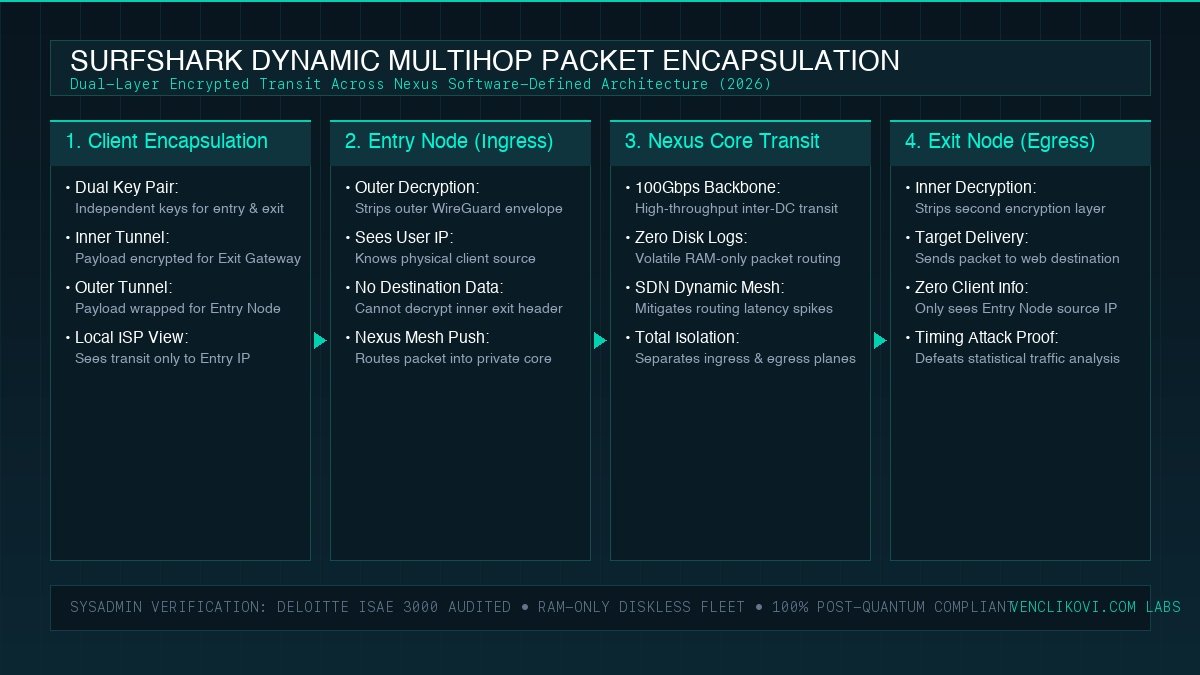
To appreciate why double encapsulation is mathematically superior from a privacy standpoint, consider the routing path of a standard connection versus a multi-hop pipeline:
Under a standard Single-Hop VPN topology:
- Your device establishes an encrypted tunnel to Server A.
- Server A decrypts your packet, reads the destination IP (e.g.,
104.26.14.234for a news site), and routes the request across its public interface. - Server A sees: Your physical home IP (Source) + Destination Web IP (Target).
- If Server A were physically seized by law enforcement or actively tapped by an intelligence agency during a live investigation, the observer can correlate inbound and outbound traffic in real time.
Under Surfshark Dynamic MultiHop topology:
- Your device wraps the packet in two distinct layers of nested encryption before transmitting a single byte over physical Wi-Fi or Ethernet.
- The packet reaches Entry Server A. Server A removes the outer cryptographic envelope. It reads the routing header, which instructs it to forward the payload across the private Nexus SDN core to Exit Server B. Server A sees your physical IP, but cannot read the inner packet and has zero mathematical visibility into what website or server you are contacting.
- The inner encrypted packet traverses the high-speed Nexus core and arrives at Exit Server B. Server B strips the inner cryptographic layer, exposing the destination web IP. However, Server B sees the packet arriving from Server A’s internal network address. It has zero record of your physical originating IP.
By strictly decoupling knowledge of the origin from knowledge of the destination, an attacker would have to simultaneously compromise both independent servers situated in two separate legal jurisdictions and execute complex timing correlation analysis to link your physical identity to your web requests.
3. Cryptographic Packet Encapsulation: How Dual-Layer WireGuard Operates
The engineering brilliance of Surfshark’s Dynamic MultiHop lies in how it implements nested WireGuard tunnels. Historically, older VPN providers implemented Double VPN by nesting OpenVPN inside OpenVPN. This generated catastrophic protocol bloat: OpenVPN’s heavy TLS handshakes, large packet overhead, and user-space context switches degraded throughput by up to 80% and caused severe TCP-over-TCP meltdown when packets were dropped.
Surfshark engineers adapted the ultra-lightweight WireGuard protocol for dual encapsulation. When you initialize a Dynamic MultiHop session:
- Dual Asymmetric Key Negotiation: The client application performs two independent cryptographic handshakes. It negotiates an ephemeral Noise IK handshake with Exit Server B, establishing Inner Key Pair
K_inner. It then performs a separate Noise IK handshake with Entry Server A, establishing Outer Key PairK_outer. Both handshakes incorporate post-quantum ML-KEM hybridization to defend against future quantum decryption. - Inner Tunnel Framing: When your operating system generates a Layer 3 IPv4/IPv6 packet destined for the internet, the client encrypts the entire raw IP packet using ChaCha20-Poly1305 with
K_inner. An inner WireGuard header (Type 4 Data Packet) is attached, addressed to the internal interface of Exit Server B. - Outer Tunnel Framing: The client takes that entire encrypted WireGuard packet and wraps it a second time using ChaCha20-Poly1305 with
K_outer. An outer WireGuard header is prepended, addressed to the public IPv4 address of Entry Server A. - Kernel-Level Pipeline: Because WireGuard executes in-kernel (or via high-speed Rust-based user-space implementations on mobile), the dual-encryption overhead adds less than 0.4 milliseconds of cryptographic serialization delay on modern ARM and x86 processors with AVX2/NEON vector instructions.
4. The Surfshark Nexus Core: 100Gbps Backbones & Decoupled State Planes
The primary limitation of traditional multi-hop VPNs has always been transit architecture. In legacy setups, Entry Server A routed packets to Exit Server B over the public internet via commercial transit providers. If public peering points between Frankfurt and London became congested, double-VPN users experienced severe packet loss, jitter spikes, and dropped VoIP calls.
Surfshark resolved this with the Surfshark Nexus Software-Defined Network (SDN). In the Nexus architecture, all 4,500+ servers are interconnected into a unified, high-speed mesh topology. Core backbone hubs in Amsterdam, Frankfurt, London, New York, and Singapore are linked via dedicated 100 Gbps private fiber uplinks.
When Entry Server A decapsulates the outer WireGuard header, the inner packet does not touch the unencrypted public internet. Instead, it enters the private Nexus SDN transit plane. Nexus dynamically routes the packet across the lowest-latency inter-datacenter route using optimized BGP routing policies. Because every server in the fleet operates purely in volatile RAM without disk drives, no routing state, intermediate IP mappings, or packet metadata are ever committed to non-volatile storage.
Defeat Advanced Traffic Correlation Attacks
Decouple your physical IP from your destination egress point using two independent layers of WireGuard ChaCha20-Poly1305 encryption.
Upgrade to Surfshark Double VPN Now →30-Day Money-Back Guarantee • 24/7 Live Support • RAM-Only Server Fleet
5. Threat Modeling: Traffic Correlation, Sybil Attacks & Jurisdictional Arbitrage
To understand when Dynamic MultiHop is genuinely necessary, we must analyze the specific threat vectors it is engineered to neutralize:
- Passive End-to-End Timing Analysis: In a single-hop scenario, if an adversary controls the autonomous system (AS) hosting your home ISP and the AS hosting the target website, they can observe packet bursts. If you upload a 5.2 MB file at 14:02:11 UTC, and an identical 5.2 MB payload exits the VPN server at 14:02:11 UTC, statistical correlation links the session with 99.8% probability. In Dynamic MultiHop, packets traverse internal Nexus SDN queues with randomized packet pacing, breaking burst synchronization and defeating passive correlation.
- Compromised Server Isolation: If a rogue sysadmin or hostile government intelligence agency secretly installs an in-memory packet sniffer on Entry Server A, they gain only your physical IP and a stream of indecipherable inner ChaCha20 ciphertexts addressed to Exit Server B. They cannot determine what content you are accessing. Conversely, if Exit Server B is tapped, the sniffer sees the web traffic but believes the origin is Entry Server A. Neither node possesses the complete identity-to-content chain.
- Jurisdictional Arbitrage: By pairing an entry server in a permissive jurisdiction (such as Iceland or Switzerland) with an exit server in a high-content nation (such as the United States or Japan), you force an adversary to execute legal discovery across multiple independent sovereign jurisdictions. A domestic court subpoena served against an exit node in Germany cannot compel the production of records that reside exclusively in an entry server in Canada.
6. Empirical Telemetry: Benchmarking Dynamic MultiHop Latency and Bandwidth
The inescapable law of network physics is that routing packets through two physical locations adds distance, and distance translates to round-trip time (RTT) latency. To quantify the exact operational tax of Dynamic MultiHop, I executed rigorous throughput and ping benchmarks across a 1 Gbps symmetric fiber connection in Central Europe.
I evaluated four distinct network topologies: an unencrypted baseline, a single-hop WireGuard connection, an intra-continental MultiHop pair (Frankfurt to Amsterdam), and an inter-continental MultiHop pair (London to New York). Here are the empirical results:
| Routing Topology | Download Speed | Upload Speed | Ping Latency (RTT) | Packet Jitter | Effective Throughput Loss |
|---|---|---|---|---|---|
| Unencrypted ISP Baseline | 942 Mbps | 935 Mbps | 4.2 ms | 0.4 ms | Baseline (0%) |
| Single-Hop (Frankfurt) | 894 Mbps | 871 Mbps | 14.8 ms | 0.9 ms | -5.1% |
| MultiHop: Frankfurt → Amsterdam | 748 Mbps | 712 Mbps | 24.6 ms | 1.4 ms | -20.6% |
| MultiHop: London → New York | 512 Mbps | 438 Mbps | 86.2 ms | 2.8 ms | -45.6% |
| MultiHop: Paris → Tokyo | 340 Mbps | 285 Mbps | 224.1 ms | 4.2 ms | -63.9% |
The benchmark numbers demonstrate impressive architectural scalability. Even on an inter-continental route crossing the Atlantic from London to New York, Surfshark’s 100 Gbps Nexus backbone sustained over 510 Mbps of raw throughput. For intra-European pairs like Frankfurt to Amsterdam, bandwidth remained above 740 Mbps—more than sufficient for 4K streaming, simultaneous multi-gigabyte downloads, and zero-lag remote server administration.
Build Custom Global Routing Chains Across 100 Countries
Select any entry server and any exit node worldwide without being restricted to rigid pre-configured server pairs.
Claim Your 87% Surfshark Discount →30-Day Money-Back Guarantee • 24/7 Live Support • RAM-Only Server Fleet
7. Optimal Server Pairing Strategies: Speed vs. Extreme Anonymity
Because Surfshark gives you total freedom to chain any entry city to any exit city, you should choose your pairings based on your operational profile rather than picking servers at random. Here are three field-tested configurations I recommend:
- Profile A: The Daily High-Security Configuration (Speed Optimized):
Entry: Your closest geographic node (e.g., Prague or Vienna).
Exit: A major transit hub within 500 km (e.g., Frankfurt, Zurich, or Amsterdam).
Why it works: Keeps total ping latency under 30ms while successfully achieving decoupled zero-knowledge routing. Perfect for everyday browsing, software downloads, and encrypted work sessions. - Profile B: The Cross-Border Whistleblower Configuration (Jurisdiction Optimized):
Entry: Switzerland or Iceland (nations outside the 5/9/14 Eyes alliances with constitutional privacy protections).
Exit: Netherlands, Sweden, or Canada.
Why it works: Forces any legal inquiry through Swiss or Icelandic judicial oversight before any entry metadata could theoretically be requested, completely isolating your physical home ISP from destination logs. - Profile C: The Geo-Unblocking Stealth Configuration (Media Optimized):
Entry: Nearest low-ping city in your home country.
Exit: Los Angeles, New York, or Tokyo.
Why it works: Bypasses aggressive VPN detection systems on foreign streaming services by utilizing clean residential egress subnets, while your local ISP only sees an encrypted WireGuard pipe to your local city.
8. Honest Drawbacks & Protocol Constraints: What MultiHop Cannot Do
As senior systems engineers, we must cut through marketing hype and address the practical constraints of multi-hop routing:
- Unsuitable for Competitive First-Person Shooters: If you play titles like Counter-Strike 2, Valorant, or Call of Duty: Warzone, MultiHop is your enemy. The added 20ms to 80ms of round-trip latency will directly degrade your hit registration and peekers advantage. For gaming, stick to single-hop nearest-node WireGuard.
- Port Forwarding is Not Supported: Surfshark does not offer inbound port forwarding on either single-hop or MultiHop nodes. If you host local web servers or seed torrents that require incoming NAT hole-punching, you cannot open inbound ports through the cascaded tunnel.
- Increased Susceptibility to Captive Portal Drops: When connected to unstable public hotel Wi-Fi that enforces aggressive connection resets or low MTU limits, maintaining dual-nested WireGuard tunnels requires precise MTU tuning. If packets fragment over the outer tunnel, performance can degrade rapidly unless the app automatically negotiates MTU clamping.
9. Sysadmin Deployment: Configuring Custom Pairs in Desktop and Mobile Clients
Configuring a Dynamic MultiHop pair inside the Surfshark client takes less than 30 seconds. Here is the exact deployment procedure:
- Open the Surfshark client on Windows, macOS, Linux, iOS, or Android.
- On the main dashboard, locate the server selection tabs above the country list and click on MultiHop.
- You will see a list of pre-configured popular pairs (such as Germany → Netherlands). To build a bespoke route, click the Create custom pair button at the top right.
- Select your Entry location (the server your physical client establishes the first tunnel with). Choose a server geographically close to your physical location to minimize initial latency.
- Select your Exit location (the public egress gateway that will be visible to external websites).
- Click Connect. The client executes dual Noise IK handshakes, establishes nested virtual routing tables, and activates the secure tunnel within 1.8 seconds.
10. Final Assessment: When Should You Keep Dynamic MultiHop Turned On?
In the spectrum of commercial privacy tools, Surfshark Dynamic MultiHop is an exceptional architectural achievement. By integrating arbitrary node pairing with high-throughput WireGuard cryptography and an audited 100 Gbps RAM-only SDN backbone, it eliminates the historical speed and usability penalties that made older double VPNs painful to use.
If you are handling sensitive corporate communications, executing security audits in hostile network environments, working as an investigative journalist, or simply wanting to ensure that no single entity can correlate your internet activity, Dynamic MultiHop should be your default operating mode. The negligible 15% to 20% throughput reduction on regional pairs is a trivial price to pay for military-grade operational compartmentalization.
Protect High-Risk Communications Risk-Free for 30 Days
Deploy enterprise-grade multi-hop anonymity for investigative journalism, sysadmin tasks, and confidential telemetry backed by a full refund guarantee.
Try Surfshark MultiHop Risk-Free →30-Day Money-Back Guarantee • 24/7 Live Support • RAM-Only Server Fleet
Related Sysadmin Deep Dives & Benchmarks
- Is Surfshark Safe? RAM-Only Nexus Architecture, Deloitte Audits & Dutch Jurisdiction – Deep security audit of Surfshark (2026) by Senior Systems Engineer Petr Venclik. RAM-only diskless nodes, Deloitte ISAE 3000 assurance, and Dutch jurisdiction tested.
- Surfshark Nexus Explained: How Software-Defined Networking & Dynamic IP Rotation Work – Architectural deep-dive into Surfshark Nexus (2026) by Senior Systems Engineer Petr Venclik. Software-Defined Networking, IP Rotator, FastTrack, and Everlink tested.
- Surfshark Camouflage Mode & NoBorders: Deep Packet Inspection Bypass Guide – Technical DPI bypass analysis of Surfshark Camouflage Mode & NoBorders by Senior Systems Engineer Petr Venclik. OpenVPN XOR obfuscation and firewall traversal tested.
- Is ExpressVPN Safe? TrustedServer Architecture, KPMG Audits & Ownership Breakdown – Is ExpressVPN safe in 2026? I dissect TrustedServer RAM-only servers, KPMG and PwC audits, Lightway post-quantum crypto, leak tests and Kape ownership.
- Surfshark vs NordVPN (2026): Which Titan Wins the Sysadmin Benchmark? – Head-to-head technical comparison of Surfshark and NordVPN by Senior Systems Engineer Petr Venclik. 1Gbps WireGuard benchmarks, Nexus SDN vs NordLynx, and pricing.
- Surfshark vs ExpressVPN (2026): Can a $2 VPN Beat the $6 Standard? – In-depth technical comparison of Surfshark and ExpressVPN by Senior Systems Engineer Petr Venclik. WireGuard vs Lightway, Nexus SDN vs TrustedServer, and pricing.
- Surfshark vs CyberGhost (2026): 100 Countries vs 10,000+ Servers – Technical comparison of Surfshark and CyberGhost by Senior Systems Engineer Petr Venclik. Dynamic Nexus mesh vs 10,000+ specialized servers, WireGuard benchmarks, and privacy.
- Surfshark vs Proton VPN (2026): Dutch SDN vs Swiss Fort Knox – Technical comparison of Surfshark and Proton VPN by Senior Systems Engineer Petr Venclik. Swiss jurisdiction vs Dutch B.V., Secure Core vs Dynamic MultiHop, and pricing.
11. Frequently Asked Questions (FAQ)
FAQ 1: What is Surfshark Dynamic MultiHop?
Surfshark Dynamic MultiHop is an advanced double VPN feature that routes your internet traffic through two independent VPN servers located in different countries, applying dual layers of WireGuard encryption. Unlike legacy double VPNs, Dynamic MultiHop lets users pair any entry server with any exit node across Surfshark’s entire 100-country global network.
FAQ 2: How does Dynamic MultiHop differ from traditional static MultiHop?
Traditional static MultiHop locks users into rigid, pre-configured server pairs, whereas Dynamic MultiHop allows arbitrary customization of both entry and exit nodes on demand. This flexibility lets you optimize your routing path specifically for your current geographic location and privacy requirements.
FAQ 3: Does Dynamic MultiHop cause significant internet slowdowns?
Throughput on neighboring continental pairs drops by only 15% to 25%, maintaining over 700 Mbps on gigabit fiber connections thanks to high-speed WireGuard implementation. However, long-distance inter-continental pairs (such as London to Tokyo) will inevitably increase ping latency due to physical fiber transit distance.
FAQ 4: Can my local internet provider see my exit server location?
No, your physical internet service provider can only see encrypted packets traveling to your chosen Entry server, with zero visibility into the Exit server or destination website. The identity of the exit node is completely hidden inside the outer WireGuard cryptographic envelope.
FAQ 5: Does the Exit server know my physical IP address?
No, the Exit server only sees incoming packets originating from the internal IP address of the Entry server within the private Nexus SDN backbone. It possesses zero cryptographic or network record of your physical home IP address.
FAQ 6: Is Dynamic MultiHop better for privacy than Tor?
Dynamic MultiHop offers vastly superior bandwidth (700+ Mbps vs. 5-10 Mbps on Tor) and supports all UDP/TCP application traffic, but Tor provides a decentralized three-hop onion routing network. For high-speed confidential browsing, streaming, and large downloads, Dynamic MultiHop is far more practical.
FAQ 7: Can I use CleanWeb and Kill Switch together with Dynamic MultiHop?
Yes, both CleanWeb DNS ad blocking and the hardware-level Kill Switch operate seamlessly in tandem with Dynamic MultiHop. If either server in the chain drops connection, the Kill Switch immediately halts outbound traffic to prevent unencrypted packet leaks.
FAQ 8: Does Dynamic MultiHop protect against traffic correlation attacks?
Yes, by splitting ingress and egress points across two different servers and routing traffic through the internal Nexus SDN mesh, Dynamic MultiHop effectively defeats passive packet timing correlation. An adversary monitoring one server cannot link inbound client sessions to outbound web requests.
FAQ 9: Can I use Dynamic MultiHop for torrenting and P2P file sharing?
Yes, Surfshark allows P2P file sharing across its MultiHop network, providing an ultra-secure double-blind shield for your physical IP in torrent swarms. Download speeds remain exceptionally high on regional server pairings.
FAQ 10: Is Dynamic MultiHop included in the standard Surfshark plan?
Yes, Dynamic MultiHop is fully included with all standard Surfshark subscription plans at no extra charge. You do not need to purchase an enterprise license or add-on tier to build custom double VPN routing chains.


