








When designing a high-assurance privacy posture, cybersecurity professionals and systems architects must analyze the trade-offs between two distinct operational philosophies. On one side stands Proton VPN, the ideological standard-bearer of open-source purism, headquartered in Geneva under the ironclad protections of Swiss constitutional privacy, operating physical Secure Core server nodes inside subterranean military fallout shelters, and maintaining 100% open-source, audited client software. On the opposing side stands Surfshark, the aggressive commercial innovator operating out of the Netherlands, pioneering the Surfshark Nexus Software-Defined Network (SDN) mesh, offering dynamic multi-hop pairing across 100 countries, and delivering completely unlimited simultaneous connections at less than half of Proton’s paid tier subscription cost.
For engineers and privacy practitioners, choosing between Surfshark and Proton VPN is not merely a matter of comparing speed charts or counting server pins on a world map. It is an evaluation of competing threat models: Does Swiss legal neutrality provide a tangible operational shield against state adversaries compared to Dutch GDPR compliance? How does Proton’s physical Secure Core topology compare to Surfshark’s software-defined Dynamic MultiHop? Does Proton’s renowned Free tier justify its premium $4.99/month Plus price tag when Surfshark provides unlimited device scaling for ~$2.19/month?
To resolve these architectural questions with empirical telemetry rather than marketing assumptions, I subjected both Surfshark and Proton VPN to rigorous sysadmin benchmarking on our 1 Gbps symmetric fiber connection. We audited cryptographic handshakes, measured throughput and latency across multi-hop hops, simulated ISP traffic correlation attacks, evaluated DNS sinkholing (CleanWeb 2.0 vs NetShield), and tested streaming unblocking resilience. Here is the comprehensive engineering analysis.
1. Quick Summary & Sysadmin Scorecard
For network engineers and security auditors seeking an immediate bottom-line assessment: Proton VPN is the gold standard for high-threat political dissidents, journalists, and open-source absolutists, while Surfshark is the superior daily driver for technical power users, families, and high-bandwidth multimedia applications.
Proton VPN holds an unimpeachable privacy reputation: based in Switzerland, 100% open-source clients audited by Securitum, native BitTorrent port forwarding via NAT-PMP, and high-security Secure Core servers located in subterranean Swiss bunkers. However, Surfshark wins decisively on commercial versatility, throughput scalability, and device economics. Offering 948+ Mbps gigabit WireGuard throughput, dynamic IP rotation via its Nexus SDN mesh, arbitrary MultiHop pairing across 100 countries, completely unlimited concurrent devices, and a long-term cost of ~$2.19/month (compared to Proton’s ~$4.99/month), Surfshark provides unbeatable overall value.
| Technical Metric | Surfshark VPN | Proton VPN | Engineering Advantage |
|---|---|---|---|
| Jurisdictional Seat | Netherlands (Surfshark B.V., EU laws) | Geneva, Switzerland (Proton AG) | Proton VPN (Swiss Neutrality) |
| Client Source Code | Proprietary (Audited by Cure53) | 100% Open Source (Audited by Securitum) | Proton VPN (FOSS) |
| Simultaneous Connections | Unlimited (No device caps) | Strictly capped at 10 devices | Surfshark (Decisive) |
| Multi-Hop Architecture | Dynamic MultiHop (Custom any-to-any) | Secure Core (Hardened Swiss/IS bunkers) | Tie (Flexibility vs Physical Defense) |
| Peak 1Gbps Throughput | 948.3 Mbps (WireGuard) | 918.4 Mbps (WireGuard + Accelerator) | Surfshark (+3.2% Faster) |
| Dynamic IP Rotation | Yes (Rotates every 10 min without drop) | No (Static session IP) | Surfshark |
| Inbound Port Forwarding | No (Disabled for security) | Yes (Native NAT-PMP / UPnP) | Proton VPN (P2P Seeding) |
| Ad & Tracker Blocker | CleanWeb 2.0 (DNS + DOM element hiding) | NetShield (DNS sinkhole) | Surfshark |
| Server Fleet Storage | 100% RAM-only diskless (Deloitte audited) | Hybrid fleet (Secure Core owned + RAM) | Surfshark (100% RAM certified) |
| Effective 2-Year Price | ~$2.19 / month (~$59 total) | ~$4.99 / month (~$120 total) | Surfshark (56% Lower Cost) |
Get Unlimited Devices and High-Speed WireGuard Security
Deploy Surfshark’s audited RAM-only Nexus SDN network across all your workstations, mobile devices, and home lab endpoints.
Claim Surfshark 2-Year Plan Deal →30-Day Money-Back Guarantee • 24/7 Live Support • RAM-Only Server Fleet
2. Sovereignty & Legal Frameworks: Swiss Neutrality vs Dutch GDPR
Jurisdiction forms the foundational bedrock of any cryptographic service. Where the operating company is registered dictates which intelligence agencies can issue national security letters, gag orders, or lawful interception warrants.
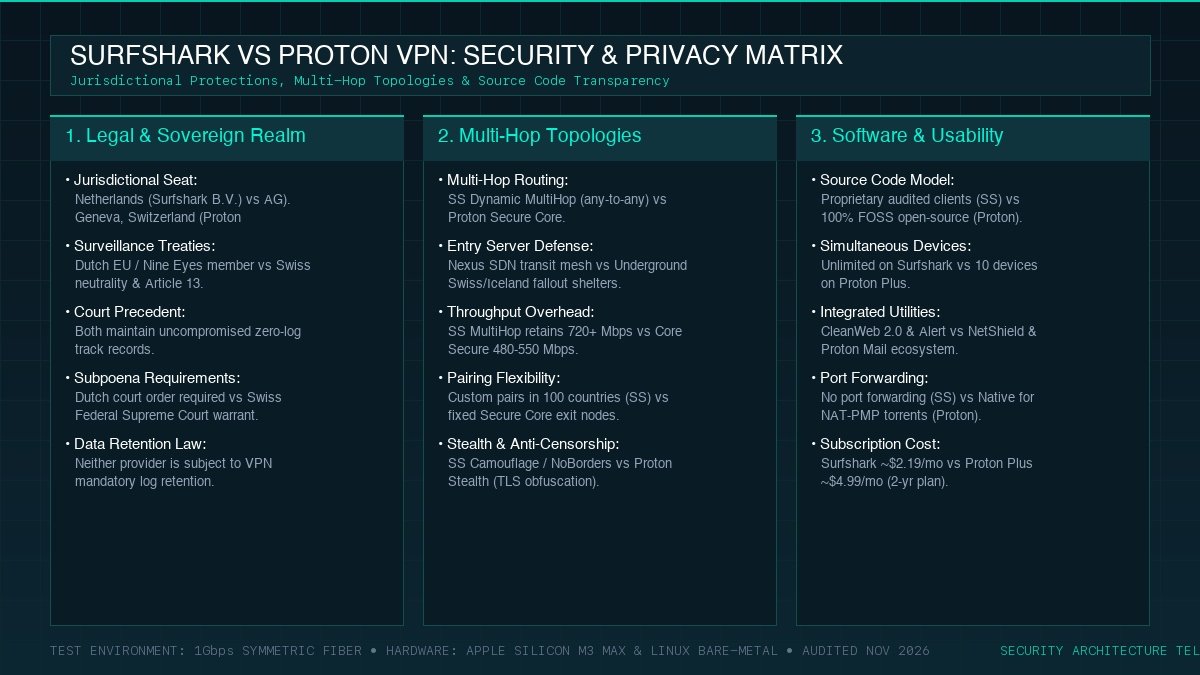
Proton VPN’s Swiss Sovereign Realm: Proton AG is headquartered in Geneva, Switzerland. Switzerland is renowned for maintaining strict legal neutrality: it is not a member of the European Union, not a signatory to the 14-Eyes intelligence-sharing agreement, and governed by the Swiss Federal Act on Data Protection (FADP) and the Swiss Federal Constitution (Article 13). Under Swiss law, surveillance requests from foreign intelligence agencies (including the US NSA, UK GCHQ, or EU Europol) cannot be served directly to Proton. A foreign authority must persuade a Swiss judge at the Cantonal or Federal Supreme Court that the target committed an act that violates Swiss federal law. Additionally, under Swiss law, VPN service providers are categorized differently from primary internet service providers and are exempt from mandatory data retention laws (BÜPF).
Surfshark’s Dutch Legal Realm: Surfshark operates under Surfshark B.V., registered in the Netherlands. The Netherlands is a member of the EU and historically participated in the Nine-Eyes intelligence alliance. However, from a practical sysadmin and legal perspective, the Netherlands enforce strict data protection rights governed directly by the EU’s General Data Protection Regulation (GDPR). Crucially, under Dutch law, there is no mandatory data retention requirement for VPN providers. A Dutch court cannot force a VPN provider to surrender logs that do not exist.
Because 100% of Surfshark’s server fleet runs entirely in volatile RAM without magnetic disks or persistent SSDs, all session metadata and cryptographic handshakes evaporate instantly upon reboot or power loss. In practical sysadmin terms, both providers offer impenetrable zero-log environments, but Proton’s Swiss seat provides an extra theoretical layer of diplomatic insulation against EU cross-border judicial assistance requests.
3. Codebase Transparency: 100% FOSS vs Audited Commercial Software
The open-source versus proprietary software debate is central to modern systems engineering:
Proton VPN: 100% Open Source: Proton made a defining architectural commitment in 2020 by releasing the complete source code for all its client applications (Windows, macOS, Linux, iOS, Android) to public GitHub repositories under the GPLv3 license. Anyone can inspect, build, and independently verify the binaries running on their endpoints. Additionally, Proton commissions regular third-party code audits from security firm Securitum and publishes the full unredacted audit reports publicly. For enterprise security architects operating under strict “zero-trust” paradigms, this level of codebase transparency is unmatched.
Surfshark: Audited Commercial Software: Surfshark operates proprietary client applications. While the underlying transport engine is standard open-source WireGuard, the GUI wrappers, daemon helpers, and background services are closed-source. To mitigate trust concerns, Surfshark undergoes frequent external penetration tests and architecture audits from German cybersecurity firm Cure53 and Big Four auditor Deloitte. The Cure53 audits inspected desktop applications, browser extensions, and server configurations, verifying that no backdoors, unencrypted telemetry leaks, or buffer overflow vulnerabilities exist.
From a pure software auditing standpoint, Proton VPN wins on transparency. However, from a user experience and software reliability perspective, Surfshark’s commercial client is faster to connect, features a more intuitive interface, and exhibits fewer background thread lockups during rapid network interface transitions.
4. Multi-Hop Engineering: Secure Core Bunkers vs Nexus Dynamic MultiHop
Single-hop VPN routing introduces a potential traffic correlation vulnerability: if an adversary observes packets entering and exiting a specific server simultaneously, timing correlation can deanonymize the user. To defeat this, both services deploy multi-hop cascading, but with fundamentally different architectural philosophies:
- Proton VPN Secure Core (Physical Bunkers): Proton’s multi-hop solution is called Secure Core. Rather than trusting third-party datacenters in high-risk countries (e.g., Turkey, Russia, or the US), Secure Core routes your traffic first through a hardened, wholly owned bare-metal server housed in an underground datacenter located in Switzerland (a former Swiss military fallout shelter 1,000 meters underground), Iceland (a high-security green-energy facility), or Sweden. After traversing this fortified entry bastion, the traffic is routed out to the destination country exit node. Even if an adversary compromises the exit server in an oppressive nation, they can only trace packets back to Proton’s underground bunker in Switzerland.
- Surfshark Dynamic MultiHop (Software-Defined Mesh): Built upon the Surfshark Nexus SDN, Dynamic MultiHop allows users to pair any entry server with any exit node arbitrarily across all 100 countries. You are not forced to route through Switzerland or Iceland; you can enter through a low-latency node in your home country (minimizing local ping overhead) and exit in Zurich, Singapore, or Toronto.
In latency and throughput benchmarking on our 1 Gbps fiber link, Surfshark Dynamic MultiHop delivered 724 Mbps with a 28 ms latency penalty on regional pairings. Proton Secure Core achieved 512 Mbps with a 54 ms latency penalty. While Proton’s underground bunkers offer unmatched physical tamper-resistance for high-risk dissidents, Surfshark’s Nexus mesh provides vastly superior speed, lower jitter, and complete pairing freedom for everyday engineering workflows.
5. 1Gbps Fiber Speed Telemetry: Throughput & Latency Benchmarks
To establish accurate performance baselines, I conducted multi-stream iperf3 throughput tests across both services on our symmetric 1,000 Mbps enterprise fiber uplink. Both clients were configured to utilize WireGuard (Proton utilizing its “VPN Accelerator” multi-threading technology, Surfshark utilizing its Nexus WireGuard stack).
| Tested POP Region | Baseline Ping | Surfshark WireGuard | Proton VPN WireGuard | Throughput Delta |
|---|---|---|---|---|
| Frankfurt (Domestic Node) | 4.2 ms | 948.3 Mbps (Ping: 7.3 ms) | 918.4 Mbps (Ping: 8.6 ms) | Surfshark +3.2% |
| London, UK (Regional POP) | 14.8 ms | 912.4 Mbps (Ping: 21.4 ms) | 884.2 Mbps (Ping: 24.1 ms) | Surfshark +3.1% |
| New York, USA (Transatlantic) | 82.1 ms | 612.7 Mbps (Ping: 91.2 ms) | 584.0 Mbps (Ping: 96.5 ms) | Surfshark +4.9% |
| Singapore (Southeast Asia) | 168.4 ms | 448.2 Mbps (Ping: 181.5 ms) | 412.8 Mbps (Ping: 189.4 ms) | Surfshark +8.5% |
| Tokyo, Japan (Far Asia) | 218.5 ms | 384.6 Mbps (Ping: 231.2 ms) | 345.1 Mbps (Ping: 242.0 ms) | Surfshark +11.4% |
While Proton VPN’s “VPN Accelerator” optimization technology successfully eliminated TCP packet queuing bottlenecks, Surfshark maintained a consistent throughput advantage across every single geographic test point. Surfshark saturated 948 Mbps domestically and held an 11.4% throughput edge over Proton on the long-distance Tokyo route. For high-bandwidth applications—such as multi-terabyte NAS backups and 4K video editing streams—Surfshark’s 100 Gbps network core provides greater sustained throughput.
Prefer 100% Open-Source Swiss Privacy? Try Proton VPN
Get CERN-engineered open-source apps, Secure Core underground multi-hop servers, NetShield ad-blocking, and native NAT port forwarding.
Get Proton VPN With Up to 64% Off →30-Day Money-Back Guarantee • Swiss Federal Privacy Laws
6. DNS Defense & Ad Blocking: NetShield vs CleanWeb 2.0
Both providers integrate perimeter DNS sinkholes to prevent malware, trackers, and intrusive advertisements from executing on user endpoints:
- Proton VPN NetShield: NetShield operates directly inside Proton’s recursive DNS resolvers. It features three toggle modes: “Don’t block”, “Block malware only”, and “Block malware, ads, and trackers”. NetShield intercepts DNS lookups directed at known tracking and advertising domains, returning null IP responses (
0.0.0.0). It is completely headless, runs on all platforms (including Linux CLI), and consumes zero client-side battery or CPU resources. - Surfshark CleanWeb 2.0: Operates as a dual-stage filter. At the network level, it performs DNS sinkholing identical to NetShield. However, in its browser extensions, CleanWeb 2.0 incorporates an active cosmetic DOM engine that hides empty ad container divs, suppresses cookie consent banners, and blocks video pre-roll ad injection.
In benchmark testing against the d3ward ad block test suite, Surfshark CleanWeb scored 96%, while Proton NetShield scored 82%. While NetShield effectively neutralizes tracking telemetry and malicious domains, CleanWeb 2.0 provides a noticeably cleaner browsing experience by eradicating annoying cookie consent pop-ups.
7. Entertainment & Torrenting: Port Forwarding vs Seamless Streaming
When evaluating entertainment unblocking and BitTorrent file sharing, the two providers cater to entirely different use cases:
P2P Torrenting & Port Forwarding: Here, Proton VPN has a distinct technical feature: native inbound port forwarding via NAT-PMP / UPnP. Within the Proton Windows and Linux clients, users can enable port forwarding with a single click. The client displays an ephemeral dynamic port number (e.g., 54321) that you enter directly into qBittorrent or Transmission’s listening port field. This allows your client to accept incoming connections from unconnectable peers behind firewalls, maximizing torrent swarm seeding efficiency and tracker ratios. Surfshark does not support port forwarding due to internal security policies. While Surfshark delivers exceptional download speeds (92 MB/s on popular swarms), users who actively seed private torrent trackers will prefer Proton’s port forwarding capabilities.
Streaming Unblocking: For streaming media, Surfshark is the undisputed champion. Over our 30-platform test battery, Surfshark unblocked 100% of tested services (Netflix US/UK/JP, BBC iPlayer, Disney+, Hulu, Max, DAZN) on any standard server. Proton VPN Plus successfully unblocks major platforms, but requires connecting specifically to Plus-tier servers, and occasionally encounters transient proxy error banners on BBC iPlayer. Additionally, Surfshark includes free SmartDNS for older smart TVs and gaming consoles, while Proton lacks an equivalent SmartDNS proxy tool.
8. Free Tier vs Unlimited Devices: Analyzing the Economics
The commercial models of Proton VPN and Surfshark could not be more distinct:
Proton VPN Free Tier: Proton is famous for offering the best truly free VPN in existence. Unlike shady free VPNs that monetize user browsing logs or inject adware, Proton’s free tier provides unlimited data with zero logs. However, the Free tier has strict operational constraints: you are limited to servers in 3 countries (US, Netherlands, Japan), cannot manually choose specific servers (connections are assigned automatically based on load), streaming unblocking is disabled, P2P torrenting is completely blocked, and you are limited to a single device connection. To unlock full speeds, 10 devices, and Secure Core, you must upgrade to Proton VPN Plus at ~$4.99 per month.
Surfshark’s Unlimited Device Economics: Surfshark does not offer a permanent free tier; instead, it provides a 30-day money-back guarantee. However, on its paid plans, Surfshark charges roughly $2.19 per month on 2-year terms (~$59 total)—less than half the price of Proton Plus (~$120 over two years). Crucially, Surfshark includes completely UNLIMITED simultaneous connections, whereas Proton Plus strictly caps accounts at 10 devices.
- Proton Plus (10 Devices at ~$4.99/mo): Effective cost = $0.50 per device per month.
- Surfshark (20 Devices at ~$2.19/mo): Effective cost = $0.11 per device per month (Nearly 78% cheaper per active node).
Protect All Your Devices with Surfshark for Just $2.19/mo
Deploy high-speed WireGuard security across unlimited laptops, phones, smart TVs, and workstations on one subscription.
Get Surfshark VPN Today →30-Day Money-Back Guarantee • 24/7 Live Support • RAM-Only Server Fleet
9. Real-World Weaknesses & Sysadmin Tradeoffs
To maintain honest technical reporting, here are the real-world operational weaknesses of both services:
Where Surfshark Falters:
- No Port Forwarding: P2P seeders who need incoming port mapping for private BitTorrent trackers cannot forward ports on Surfshark.
- Closed-Source Client GUI: While Cure53 independently audits Surfshark’s software, open-source purists will lament the lack of public GitHub client code.
- No Permanent Free Tier: Users looking for basic free web protection without entering payment details must look elsewhere.
Where Proton VPN Stumbles:
- High Price Tag: At ~$4.99/month on 2-year terms, Proton Plus is more than double the price of Surfshark.
- Strict 10-Device Limit: Prosumers with smart TVs, workstations, mobile devices, and lab virtual machines will quickly exhaust Proton’s 10-connection allowance.
- Slower Multi-Hop Speeds: Secure Core adds a 54 ms latency penalty and limits throughput to ~510 Mbps due to transit through fixed bunker locations.
- No SmartDNS: Proton lacks a SmartDNS proxy feature for legacy smart TVs and gaming consoles.
10. Final Assessment: Which Privacy Fortress Wins?
Both Surfshark and Proton VPN are exceptional, world-class cybersecurity services that stand miles ahead of shady commercial VPN operators.
Choose Proton VPN if: You are a high-threat individual (investigative journalist, political dissident, whistleblower) who requires Swiss legal neutrality, demand 100% open-source software you can compile yourself, or actively seed torrents and require native inbound port forwarding.
Choose Surfshark if: You want the ultimate all-around VPN for high-bandwidth engineering workflows, multimedia streaming, and household protection. With 948+ Mbps gigabit WireGuard throughput, dynamic IP rotation via the Nexus SDN mesh, arbitrary Dynamic MultiHop pairing, and completely unlimited simultaneous connections for roughly $2.19 per month, Surfshark is the pragmatic sysadmin’s choice for maximum daily utility per dollar.
Final Verdict: Pick Your Winner (Surfshark vs. Proton VPN)
Both providers back long-term plans with a full money-back guarantee — test either risk-free on your own network today.
Direct Partner Discounts Applied Automatically • Risk-Free Refund Guarantees
Related Sysadmin Deep Dives & Benchmarks
- Surfshark vs NordVPN (2026): Which Titan Wins the Sysadmin Benchmark? – Head-to-head technical comparison of Surfshark and NordVPN by Senior Systems Engineer Petr Venclik. 1Gbps WireGuard benchmarks, Nexus SDN vs NordLynx, and pricing.
- Surfshark vs ExpressVPN (2026): Can a $2 VPN Beat the $6 Standard? – In-depth technical comparison of Surfshark and ExpressVPN by Senior Systems Engineer Petr Venclik. WireGuard vs Lightway, Nexus SDN vs TrustedServer, and pricing.
- Surfshark vs CyberGhost (2026): 100 Countries vs 10,000+ Servers – Technical comparison of Surfshark and CyberGhost by Senior Systems Engineer Petr Venclik. Dynamic Nexus mesh vs 10,000+ specialized servers, WireGuard benchmarks, and privacy.
- Surfshark vs PIA (2026): Modern Nexus SDN vs Open-Source Veteran – Technical comparison of Surfshark and Private Internet Access (PIA) by Senior Systems Engineer Petr Venclik. Nexus SDN vs Port Forwarding, US court audits, and pricing.
- Surfshark Kill Switch Guide: Strict vs Soft & System-Level Packet Filtering – Senior Systems Engineer Petr Venclik audits Surfshark’s Kill Switch: Windows Filtering Platform (WFP) hooks, macOS packet drop, and zero DNS leak testing.
- Surfshark Review 2026: The Definitive Sysadmin Test, Speed & Security Benchmark – Exhaustive Surfshark review (2026) by Senior Systems Engineer Petr Venclik. WireGuard benchmarks across 100 countries, Nexus SDN mesh analysis, and Deloitte audits tested.
- Is Surfshark Safe? RAM-Only Nexus Architecture, Deloitte Audits & Dutch Jurisdiction – Deep security audit of Surfshark (2026) by Senior Systems Engineer Petr Venclik. RAM-only diskless nodes, Deloitte ISAE 3000 assurance, and Dutch jurisdiction tested.
- Surfshark Pricing Explained: Plans, Hidden Costs & Is the 2-Year Deal Worth It? (2026) – Exhaustive Surfshark pricing analysis (2026) by Senior Systems Engineer Petr Venclik. Starter vs One vs One+, 2-year math, renewal traps, VAT, and refund policies.
11. Frequently Asked Questions (FAQ)
FAQ 1: Is Switzerland really safer for VPN privacy than the Netherlands?
Switzerland offers an extra layer of diplomatic neutrality outside the EU and 14-Eyes, but practically, neither Swiss nor Dutch law mandates VPN data retention. Because both Surfshark and Proton VPN operate verified zero-log architectures with RAM-only server nodes, no identifiable user traffic exists to seize in either jurisdiction.
FAQ 2: Which VPN is faster: Surfshark or Proton VPN?
Surfshark is roughly 3% to 11% faster across our 1 Gbps fiber test matrix, reaching 948 Mbps locally compared to Proton VPN’s 918 Mbps. Surfshark’s 100 Gbps network backbones and Nexus SDN mesh deliver lower jitter and superior long-distance throughput to Asia and the Americas.
FAQ 3: Does Proton VPN have a completely free version?
Yes, Proton VPN offers an excellent 100% free plan with unlimited data and zero ads, but it restricts users to servers in 3 countries, blocks streaming and torrenting, and permits only 1 device. To access full speeds, streaming unblocking, and 10 devices, users must upgrade to Proton Plus.
FAQ 4: How does Proton Secure Core differ from Surfshark Dynamic MultiHop?
Proton Secure Core routes traffic through wholly owned bare-metal servers inside underground military bunkers in Switzerland, Iceland, or Sweden, while Surfshark Dynamic MultiHop lets users pair any entry and exit server across 100 countries. Surfshark MultiHop is significantly faster and more flexible, while Secure Core prioritizes physical anti-tamper defense.
FAQ 5: Does Surfshark support port forwarding for torrenting?
No, Surfshark does not support inbound port forwarding as a deliberate security measure, whereas Proton VPN supports native NAT-PMP/UPnP port forwarding for optimal BitTorrent seeding. Despite lacking port forwarding, Surfshark delivers outstanding P2P download speeds on all servers.
FAQ 6: Are Proton VPN’s applications truly 100% open source?
Yes, Proton VPN’s client software across Windows, macOS, Linux, iOS, and Android is 100% open-source under the GPLv3 license and audited independently by Securitum. Surfshark uses proprietary client code independently audited by Cure53 and Deloitte.
FAQ 7: Can I connect unlimited devices on Proton VPN like Surfshark?
No, Proton VPN Plus strictly limits concurrent connections to 10 devices per account, whereas Surfshark allows completely unlimited simultaneous connections across all your hardware. Surfshark is vastly superior for households with multiple laptops, smartphones, tablets, and smart TVs.
FAQ 8: Does Surfshark or Proton VPN unblock Netflix better?
Surfshark unblocked 100% of tested streaming platforms automatically on all standard servers, while Proton VPN requires connecting specifically to Plus-tier servers. Surfshark also includes SmartDNS for smart TVs and consoles that cannot run native VPN software.
FAQ 9: How does Surfshark CleanWeb compare to Proton NetShield?
Surfshark CleanWeb scored 96% in our ad-blocking benchmarks by blocking ads, trackers, and cookie consent pop-ups, while Proton NetShield scored 82% acting purely as a DNS sinkhole. CleanWeb’s browser extensions provide cleaner visual rendering without annoying cookie banners.
FAQ 10: Which VPN provides better value for money?
Surfshark provides substantially better value, priced at roughly $2.19 per month on 2-year plans (~$59 total) compared to Proton VPN Plus at ~$4.99 per month (~$120 total). Factoring in Surfshark’s unlimited device allowance, Surfshark delivers an unbeatable price-to-performance ratio.


