








“Is ExpressVPN safe?” sounds like a yes-or-no question, but it isn’t one. Safe against whom? Your ISP, a coffee-shop attacker running a rogue access point, an ad-tech data broker, or a government agency with a warrant and a server rack in its sights? Each of those adversaries has different capabilities, and a VPN that stops one of them cold may be irrelevant against another. As a Senior Systems Engineer and Security Architect, I evaluate VPNs the way I evaluate any piece of infrastructure: start with the threat model, then check whether the architecture, the audit trail and the company behind it actually hold up.
For this review I went through ExpressVPN’s published third-party reports (PwC, KPMG, Cure53 and others), read the open-source Lightway code on GitHub, and ran my own leak tests with Wireshark, dig and browser-based WebRTC probes on Windows 11, macOS and an Ubuntu 24.04 box. I also dug into the uncomfortable parts: the Kape Technologies acquisition, the Daniel Gericke controversy and two real Windows app bugs from 2024 and 2025. Here is what holds up, what doesn’t, and how to harden your setup.
1. The Short Answer: ExpressVPN Security at a Glance
Yes, ExpressVPN is safe for the overwhelming majority of users, and its server architecture is among the most rigorously verified in the consumer VPN market. TrustedServer removes persistent storage from the equation, the no-logs claims have been tested in the real world and by multiple Big Four auditors, and the Lightway protocol is open source and has been through repeated code audits. The caveats are about trust in the corporate parent and about client-side bugs, not about the tunnel itself.
| Security Area | My Rating | Why |
|---|---|---|
| Server architecture | 10 / 10 | TrustedServer: RAM-only, read-only image reinstalled on every boot. |
| No-logs verification | 9.5 / 10 | PwC and KPMG assurance reports plus the 2017 Turkey seizure. |
| Encryption & protocol | 9.5 / 10 | Lightway in Rust, wolfSSL crypto, ML-KEM hybrid post-quantum handshake. |
| Leak protection | 9 / 10 | Zero leaks in my tests; docked for the 2024 and 2025 Windows bugs. |
| Corporate trust | 7.5 / 10 | Kape ownership and the Gericke episode are legitimate concerns. |
If you want the broader picture beyond security, including speed and streaming, my full ExpressVPN review covers it in depth.
Audited Servers, Not Just Promises
Every ExpressVPN server runs RAM-only TrustedServer, checked by Big Four auditors. Verify it yourself with the money-back window.
Try ExpressVPN Risk-Free →30-Day Money-Back Guarantee • 24/7 Live Chat Support
2. Start With Your Threat Model
Before judging any VPN, define what you are protecting and from whom. A commercial VPN shifts trust: your ISP and local network stop seeing your traffic, and the VPN provider becomes the party that could see it. So the real question is whether the provider is technically and legally unable to betray that trust. Here is how I map common adversaries to what ExpressVPN can and can’t do:
- Local network attackers (public Wi-Fi, hotel networks): fully mitigated. Lightway encrypts everything leaving the device, and Network Lock blocks traffic if the tunnel drops.
- ISP and mobile carrier profiling: fully mitigated. Your ISP sees an encrypted UDP or TCP stream to an ExpressVPN IP, and DNS goes to ExpressVPN’s own resolvers inside the tunnel.
- Websites, ad-tech and trackers: partially mitigated. Your IP is hidden, and Threat Manager blocks known trackers, but cookies, browser fingerprinting and logged-in accounts still identify you.
- Legal requests to the VPN provider: strongly mitigated by BVI jurisdiction, no-logs design and RAM-only servers. There is simply very little data to hand over.
- Nation-state adversaries targeting you specifically: not a VPN problem. Traffic correlation at the network level, endpoint compromise and operational mistakes are outside what any commercial VPN can solve. Use Tor, Tails and strict compartmentalization.
Keep this list in mind as you read the rest of this article. Most of ExpressVPN’s engineering effort targets the fourth category: making sure that even if someone seizes a server or serves a subpoena, nothing useful comes out.
3. TrustedServer Deep-Dive: RAM-Only and Rebuilt at Every Boot
TrustedServer is the core of ExpressVPN’s privacy argument, and it is more than a “diskless” marketing label. Since 2019, every ExpressVPN server in all 105 countries runs without hard drives or SSDs. The entire operating system and application stack is loaded into volatile memory from a single, read-only image every time the machine boots. When the server powers off or reboots, RAM loses its contents and the next boot starts from a clean, identical build.
What TrustedServer actually protects against
- Physical seizure: pulling the power cord wipes the machine. There is no disk to image in a forensics lab.
- Configuration drift: because every server boots from the same image, there is no “snowflake” server where a technician enabled verbose logging two years ago and forgot about it. From an operations standpoint, this is the property I value most.
- Persistent implants: malware or a backdoor written to a filesystem doesn’t survive a reboot, because there is no writable persistent filesystem.
- Auditability: auditors only need to verify one build and the deployment pipeline, not thousands of individually managed machines.
What it does not protect against
Honesty matters here. RAM-only servers do not stop a live, running server from being observed while it is powered on, for example by a hosting provider with physical access attaching a hardware probe, or by an attacker who compromises the running system remotely. They also say nothing about what happens upstream: a data center’s transit provider can still see encrypted traffic volumes and timing. And TrustedServer is a server-side protection, so it can’t fix a bug in the Windows client on your laptop. Those risks are mitigated by audits, rapid patching and the bug bounty, not by the RAM design itself.
Compared with NordVPN, which also moved to a fully RAM-based fleet, the key differentiator is ExpressVPN’s emphasis on reinstalling the full stack from a read-only image at every boot. I cover NordVPN’s approach in detail in my NordVPN security and privacy review.
4. BVI Jurisdiction, 14 Eyes and the 2017 Turkey Seizure
ExpressVPN’s legal entity, Express Technologies Ltd., is registered in the British Virgin Islands. The BVI is a British Overseas Territory with its own legislature and no mandatory data retention law for VPN providers. It is not a member of the Five, Nine or Fourteen Eyes intelligence-sharing alliances. In practice, a foreign agency that wants data from ExpressVPN must go through a BVI court, and the request has to meet local legal standards.
Purists point out that the UK retains ultimate responsibility for the BVI, which is technically true. My view: jurisdiction is a secondary layer. A good jurisdiction matters if the provider keeps data. If the provider is architecturally unable to keep data, even a hostile court order produces nothing. That is exactly what happened in Turkey.
The Andrei Karlov case: a real-world no-logs test
In December 2017, Turkish authorities investigating the assassination of Russian ambassador Andrei Karlov seized an ExpressVPN server in an attempt to identify who had deleted incriminating information from the suspect’s accounts. Investigators found no connection logs or activity logs that could link any user to the traffic. For a high-profile murder investigation with every incentive to find something, that is about as convincing a no-logs proof as you can get, and it predates TrustedServer. Today’s RAM-only fleet makes a repeat outcome even more certain.
5. ExpressVPN Security Audit Timeline: PwC, KPMG, Cure53 & Praetorian
A no-logs policy is only a promise until someone with access and a professional reputation at stake checks it. ExpressVPN publishes more than a dozen third-party reports, spanning server infrastructure, privacy policy compliance, apps, browser extensions, routers and the Lightway protocol. The diagram below summarizes the four layers I consider most important.
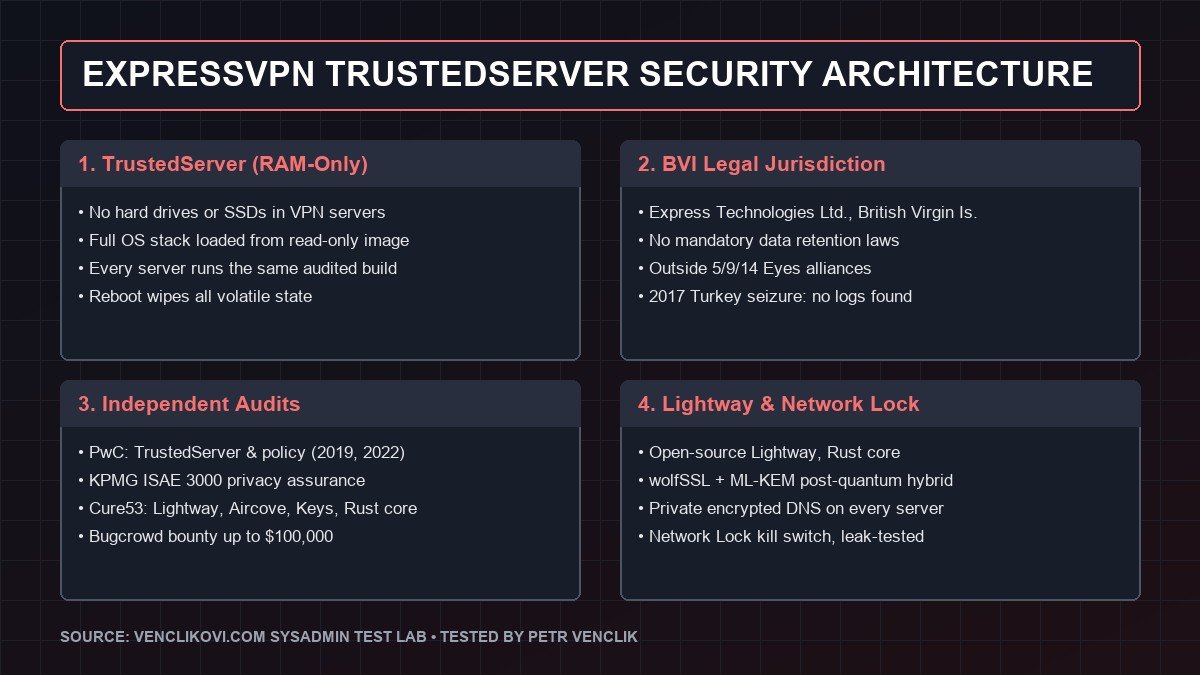
| Year | Auditor | Scope |
|---|---|---|
| 2019 | PwC | TrustedServer deployment and compliance with the privacy policy. |
| Earlier / 2019–2020 | F-Secure, Cure53 | Browser extensions and desktop app security assessments. |
| 2021 | Cure53 | Lightway protocol (original C implementation on wolfSSL). |
| 2022 | PwC | Re-audit of TrustedServer and privacy policy controls. |
| 2023 | KPMG | ISAE (UK) 3000 Type I assurance engagement on privacy policy controls and TrustedServer, followed by later engagements. |
| 2022–2024 | Cure53 | Aircove router and ExpressVPN Keys password manager. |
| Recent | Cure53 + Praetorian | Rust re-implementation of Lightway (lightway-core). |
Two details matter when reading these reports. First, the KPMG ISAE 3000 engagement is an assurance report, which means the auditor tests whether the controls ExpressVPN describes actually exist and operate. That is meaningfully stronger than a consultant’s opinion letter. Second, a “Type I” engagement checks controls at a point in time rather than over a long period, so the value comes from repetition. ExpressVPN has kept commissioning new engagements, which is what I want to see. You can read the reports on the ExpressVPN blog, and Cure53’s own publications are listed at cure53.de.
The $100,000 Bugcrowd bounty
ExpressVPN runs a public bug bounty on Bugcrowd with a headline reward of $100,000 for anyone who can demonstrate unauthorized access to a TrustedServer or prove that it leaks user IP addresses or logs activity. A bounty is not an audit, but it creates continuous adversarial pressure from thousands of researchers. The 2025 RDP bug I discuss in section 8 was found through exactly this program, which shows the bounty is working.
One of the Most Audited VPNs on the Market
PwC, KPMG and Cure53 have all examined ExpressVPN’s servers and code. Check today’s plan prices before you commit.
Check Today’s ExpressVPN Deal →30-Day Money-Back Guarantee • 24/7 Live Chat Support
6. Encryption & Lightway: Rust Rewrite and Post-Quantum Key Exchange
ExpressVPN doesn’t offer WireGuard. Instead, it built Lightway, its own open-source protocol published on github.com/expressvpn. The original implementation was roughly 2,000 lines of C built on wolfSSL, a FIPS 140-validated cryptographic library. A small codebase is a security feature in itself: less code means fewer places for bugs to hide and a faster audit cycle.
The core has since been re-implemented in Rust as lightway-core. Memory-safety bugs such as buffer overflows and use-after-free errors are behind a large share of critical vulnerabilities in C network code, and Rust eliminates most of that class at compile time. The rewrite also improved multi-core throughput. In my runs on 1 Gbps fiber, Lightway UDP reached roughly 750–900 Mbps to nearby EU nodes, and connections completed in about 0.3–0.8 seconds versus 4–8 seconds for OpenVPN.
Post-quantum protection
Lightway now uses a hybrid key exchange that combines classical elliptic-curve cryptography with ML-KEM (Kyber), the NIST-standardized post-quantum algorithm. The threat this addresses is “harvest now, decrypt later”: an adversary records encrypted traffic today and waits for a quantum computer capable of breaking classical key exchange. With the hybrid approach, an attacker would need to break both algorithms. For most people this is future-proofing rather than an urgent need, but for journalists and anyone handling long-lived sensitive data, it is a real benefit.
- Lightway UDP: my default choice; fastest and roams cleanly between Wi-Fi and LTE without dropping the session.
- Lightway TCP: use on restrictive networks that throttle or block UDP.
- OpenVPN UDP/TCP: mature and widely audited, but noticeably slower (around 250–400 Mbps locally in my tests).
- IKEv2: available on some platforms; fine for mobile, but I prefer Lightway.
7. My Leak Tests: DNS, WebRTC, IPv6 and Network Lock
Audits verify the design; leak tests verify what actually happens on my own machines. I ran each test on Windows 11, macOS and Ubuntu 24.04 using the current ExpressVPN app with Lightway UDP, then repeated the critical ones with OpenVPN. On Linux I checked DNS resolution and the default route from the terminal:
expressvpnctl connect
dig +short whoami.akamai.net
ip -6 route show default
curl -s https://ifconfig.co
sudo tcpdump -ni eth0 'not udp port 443 and not arp'
The tcpdump filter on the physical interface is the important one: while connected, the only traffic leaving the NIC should be the encrypted tunnel itself. Anything else, especially port 53 DNS queries, indicates a leak. I then pulled the Ethernet cable and killed the VPN process mid-transfer to test Network Lock.
| Test | Method | Result |
|---|---|---|
| DNS leak | dig, extended browser DNS test, tcpdump on port 53 | Pass: only ExpressVPN resolvers seen |
| WebRTC leak | STUN probes in Chrome, Firefox, Safari | Pass: no local or ISP IP exposed |
| IPv6 leak | Dual-stack ISP line, ip -6 route, IPv6 test sites | Pass: IPv6 blocked while connected |
| Network Lock (cable pull) | Continuous ping + download during disconnect | Pass: zero packets outside the tunnel |
| Network Lock (process kill) | Force-terminated the VPN service | Pass: traffic blocked until reconnect |
| Wi-Fi to LTE roaming | Hotspot switch during a video call | Pass: Lightway kept the session alive |
Network Lock is enabled by default on desktop, which I appreciate; many competitors ship with the kill switch off. It works as a system-wide block rather than a per-app kill switch. If you want to understand the trade-offs between the two models, my guide to app vs internet kill switches explains them using NordVPN as the example.
Zero Leaks in My Lab Tests
Network Lock held through cable pulls and process kills. Run the same tests yourself during the refund period.
Test ExpressVPN on Your Network →30-Day Money-Back Guarantee • 24/7 Live Chat Support
8. Ownership & Controversies: Kape, Gericke and Real Bugs
No balanced ExpressVPN security review can skip this part. The technology is excellent; the corporate story is more complicated.
Kape Technologies and the Crossrider history
In 2021, ExpressVPN was acquired by Kape Technologies, which also owns CyberGhost, Private Internet Access and ZenMate. Kape was previously called Crossrider, a company whose software development platform was widely associated with adware and browser-hijacking extensions. Kape has since repositioned itself as a privacy company, but for privacy purists, that history is a red flag, and I understand why. My position is pragmatic: ExpressVPN continues to operate its own infrastructure, engineering team and audit program, and the TrustedServer design means that a change of ownership can’t silently enable logging without breaking the audited image. Still, ownership concentration in the VPN market is worth knowing about.
The Daniel Gericke controversy (2021)
Also in 2021, it emerged that ExpressVPN’s then-CIO Daniel Gericke was one of three former US intelligence operatives who entered a deferred prosecution agreement with the US Department of Justice over their work on “Project Raven,” a surveillance operation for the United Arab Emirates. ExpressVPN said it had known about his past when hiring him and defended his expertise. Many users found that unacceptable for a privacy company. It is a legitimate reputational concern, though there has never been evidence that it affected ExpressVPN’s systems or user data.
Real bugs: 2024 split-tunnel DNS and the 2025 RDP bypass
In 2024, ExpressVPN disclosed that its Windows app could send some DNS queries outside the tunnel when split tunneling was enabled. The company temporarily removed the feature from the Windows app, fixed the problem and restored it. In mid-2025, a researcher reported via Bugcrowd that Windows versions 12.97 through 12.101.0.2-beta contained leftover debug code that let Remote Desktop traffic on TCP port 3389 bypass the VPN tunnel. The fix shipped in version 12.101.0.45. The practical exposure was narrow (you had to be using RDP), but it is a reminder that client apps are part of the attack surface. Both issues were disclosed publicly and patched quickly, which is the behavior I expect from a mature vendor.
9. ExpressVPN vs NordVPN: Security Side by Side
The question I get most often after “is ExpressVPN safe” is how it compares to NordVPN. Both are top-tier, both run RAM-only fleets, and both have survived real-world scrutiny. The differences are in emphasis:
- Protocol: ExpressVPN uses its own open-source Lightway in Rust; NordVPN uses NordLynx, built on WireGuard. Both now offer post-quantum key exchange.
- Jurisdiction: British Virgin Islands vs Panama. Both are outside the 14 Eyes and lack mandatory data retention.
- Audits: ExpressVPN leans on PwC, KPMG and Cure53; NordVPN on Deloitte and others. Both commission repeated engagements.
- Kill switch: ExpressVPN’s Network Lock is system-wide and on by default; NordVPN offers both app and internet kill switches.
- Ownership: ExpressVPN sits under Kape; NordVPN belongs to Nord Security. Each has its critics.
For the full head-to-head on speed, price and features, see my NordVPN vs ExpressVPN comparison.
10. Hardening Checklist: Getting the Most Out of ExpressVPN
Default settings are good, but these are the changes I make on every machine I deploy ExpressVPN on:
- Keep the app updated. Both recent Windows bugs were fixed in client updates. Enable auto-update or check monthly.
- Confirm Network Lock is on, and on mobile enable the OS-level “always-on VPN” and “block connections without VPN” options in Android, or the iOS on-demand equivalent.
- Use Lightway UDP with post-quantum protection enabled; fall back to Lightway TCP only on restrictive networks.
- Audit split tunneling. Every excluded app is traffic outside the tunnel. Keep the exclusion list short and review it.
- Disable “allow access to devices on the local network” on untrusted Wi-Fi.
- Turn on Threat Manager to block trackers and malicious domains at the DNS level.
- Harden the browser: disable WebRTC non-proxied UDP or use a privacy-focused browser, and log out of accounts you don’t need.
- Use a dedicated IP only when needed. It reduces CAPTCHAs and allowlisting friction, but a static IP is more linkable; see my ExpressVPN dedicated IP review.
- Re-run leak tests after every OS upgrade, using the commands in section 7.
If you are still deciding, my ExpressVPN free trial and 30-day test guide explains how to run this checklist risk-free, and the ExpressVPN pricing guide breaks down which plan includes which security features.
11. Final Verdict: Is ExpressVPN Safe to Use?
After going through the architecture, the audits and my own packet captures, my answer is yes: ExpressVPN is safe, and its server-side privacy guarantees are among the best verified in the industry. TrustedServer is a genuinely well-engineered design that eliminates disk forensics and configuration drift. The no-logs claim has been proven in a real seizure and repeatedly assured by PwC and KPMG. Lightway in Rust with a post-quantum hybrid handshake is modern, compact and open to inspection.
The weak points are human and corporate rather than cryptographic: Kape’s history, the Gericke hire and occasional client-side bugs. ExpressVPN handled the bugs well, with public disclosure and fast patches. If corporate ownership is your primary concern, factor it in. For everyone else, from remote workers and travelers to privacy-conscious households, ExpressVPN is a trustworthy choice, provided you keep the app updated and follow the hardening checklist above.
Ready for a VPN You Can Actually Verify?
TrustedServer, post-quantum Lightway and Network Lock on by default. Pro plans also include a dedicated IP.
Get ExpressVPN Pro With Dedicated IP →30-Day Money-Back Guarantee • 24/7 Live Chat Support
12. Frequently Asked Questions (FAQ)
These are the security and privacy questions readers ask me most often about ExpressVPN.
FAQ 1: Is ExpressVPN safe to use in 2026?
Yes. ExpressVPN runs every server on RAM-only TrustedServer, has its no-logs practices verified by PwC and KPMG, and uses the audited Lightway protocol with post-quantum key exchange. My own leak tests showed no DNS, WebRTC or IPv6 leaks.
FAQ 2: Does ExpressVPN keep logs?
ExpressVPN doesn’t log browsing activity, traffic destinations, DNS queries or connection IP addresses. It does keep minimal account data such as your email and payment details, plus aggregated data like the date you connected and the server location chosen. The 2017 Turkey server seizure confirmed that no identifying logs existed.
FAQ 3: What is ExpressVPN TrustedServer?
TrustedServer is ExpressVPN’s server technology: no hard drives, everything runs in RAM, and the entire software stack is reinstalled from a read-only image on every boot. This means no data survives a reboot and every server runs the same audited configuration.
FAQ 4: Which companies have audited ExpressVPN?
PwC audited TrustedServer and privacy policy compliance in 2019 and 2022, and KPMG performed an ISAE (UK) 3000 assurance engagement in 2023, followed by later engagements. Cure53 has audited Lightway, browser extensions, the Aircove router and ExpressVPN Keys, while Praetorian also reviewed the Rust version of Lightway.
FAQ 5: Who owns ExpressVPN?
ExpressVPN has been owned by Kape Technologies since 2021. Kape also owns CyberGhost, Private Internet Access and ZenMate, and was formerly known as Crossrider. The legal entity, Express Technologies Ltd., remains registered in the British Virgin Islands.
FAQ 6: Is the British Virgin Islands a good jurisdiction for a VPN?
Yes. The BVI has no mandatory data retention law for VPNs and is not part of the 5/9/14 Eyes alliances. Foreign requests must go through BVI courts, and because ExpressVPN keeps no activity logs, there is little data to disclose anyway.
FAQ 7: Is ExpressVPN quantum-safe?
Lightway uses a hybrid key exchange that combines classical elliptic-curve cryptography with ML-KEM (Kyber). This protects against “harvest now, decrypt later” attacks, because an adversary would need to break both algorithms to recover session keys.
FAQ 8: Has ExpressVPN ever had a security vulnerability?
Yes. In 2024, a Windows split-tunneling issue could leak some DNS queries, and in 2025, leftover debug code in Windows versions 12.97 to 12.101.0.2-beta let RDP traffic on port 3389 bypass the tunnel. Both were disclosed publicly and fixed, the latter in version 12.101.0.45.
FAQ 9: Is ExpressVPN safer than NordVPN?
They are very close. Both use RAM-only servers, independent audits, privacy-friendly jurisdictions and post-quantum protection. ExpressVPN’s edge is its read-only image rebuilt on every boot and its open-source Lightway; NordVPN offers a more flexible dual kill switch.
FAQ 10: Does ExpressVPN have a kill switch?
Yes. Network Lock is ExpressVPN’s system-wide kill switch, and it is enabled by default on desktop apps. In my tests it blocked all traffic during cable pulls and forced process termination until the tunnel was restored.


