








CyberGhost vs NordVPN compares two of the most established European-rooted VPNs: CyberGhost’s 10,000+ server fleet, Bucharest NoSpy racks, and $2.19/month pricing against NordVPN’s Panamanian jurisdiction, NordLynx protocol, and Threat Protection Pro security suite. While NordVPN commands a higher price tag, CyberGhost fights back with specialized streaming profiles and a 45-day refund window.
To separate marketing claims from packet-level reality, we tested both clients on our 1 Gbps symmetrical fiber testbed. We measured WireGuard versus NordLynx throughput, long-haul transatlantic latency, Windows Filtering Platform (WFP) kill switch reaction times, and DNS/WebRTC leak resilience.
This technical comparison examines Romania versus Panama privacy law, RAM-only colocation versus self-owned NoSpy hardware, and whether NordVPN’s advanced security tools justify paying roughly $1 more per month than CyberGhost.
| Technical Metric | CyberGhost VPN (2026) | NordVPN (2026) |
|---|---|---|
| Jurisdiction & Audits | Romania (Non-14 Eyes) • Deloitte Audited | Panama (Non-14 Eyes) • PwC & Deloitte Audited |
| Server Fleet | 10,000+ servers in 100 countries | 6,400+ RAM-only servers in 111 countries |
| Primary Protocol | Standard WireGuard (ChaCha20) | NordLynx (WireGuard + Double-NAT) |
| 1 Gbps Fiber Throughput | 842 Mbps local / 418 Mbps transatlantic | 918 Mbps local / 510 Mbps transatlantic |
| Simultaneous Devices | 7 simultaneous connections | 10 simultaneous connections |
| 2-Year Pricing & Refund | ~$2.19/mo • 45-Day Money-Back Guarantee | ~$3.09/mo • 30-Day Money-Back Guarantee |
Table of Contents: CyberGhost vs NordVPN (2026)
Save 83% on CyberGhost — 45 Days Risk-Free
Get 10,000+ servers in 100 countries, Bucharest NoSpy hardware, and 35+ streaming profiles for ~$2.19/month.
Get CyberGhost 2-Year Deal →Romanian Privacy Law • Deloitte Audited • 45-Day Money-Back Guarantee
1. Romania vs Panama: Privacy Jurisdiction & Independent Audits
Both CyberGhost and NordVPN operate outside the 5 Eyes, 9 Eyes, and 14 Eyes intelligence alliances, giving privacy-conscious users strong statutory protection. CyberGhost is incorporated in Bucharest, Romania, where national constitutional rulings have repeatedly blocked mandatory data-retention mandates. NordVPN is incorporated in Panama, a sovereign jurisdiction with zero mandatory data-retention laws for VPNs and no bilateral surveillance treaties with the US or EU.
From an audit standpoint, both providers have undergone multiple third-party verifications. CyberGhost completed independent zero-logs assurance with Deloitte and publishes quarterly Transparency Reports documenting DMCA complaints and law-enforcement inquiries. NordVPN has completed four separate no-logs audits with PwC and Deloitte, plus application security audits by Cure53 and VerSprite.
As we noted in our CyberGhost security & privacy review, CyberGhost’s parent company Kape Technologies often draws scrutiny due to Kape’s historical ad-tech background prior to 2018. While CyberGhost’s infrastructure and Deloitte audits remain airtight today, NordVPN’s Panamanian independence and multi-firm audit cadence give NordVPN a narrow edge for extreme threat models.
2. WireGuard vs NordLynx: Double-NAT Privacy & Kernel Speeds
Standard WireGuard assigns a static internal tunnel IP to your device’s public key, which technically requires the VPN server to hold an in-memory mapping table while you are connected. CyberGhost implements standard WireGuard cleanly and purges that ephemeral session state immediately upon disconnect.
NordVPN solved the WireGuard static-IP constraint differently by engineering NordLynx—a proprietary wrapper around WireGuard that deploys a double-NAT (Network Address Translation) system. NordLynx dynamically assigns an isolated local IP for every single session without storing your static identity on the exit server.
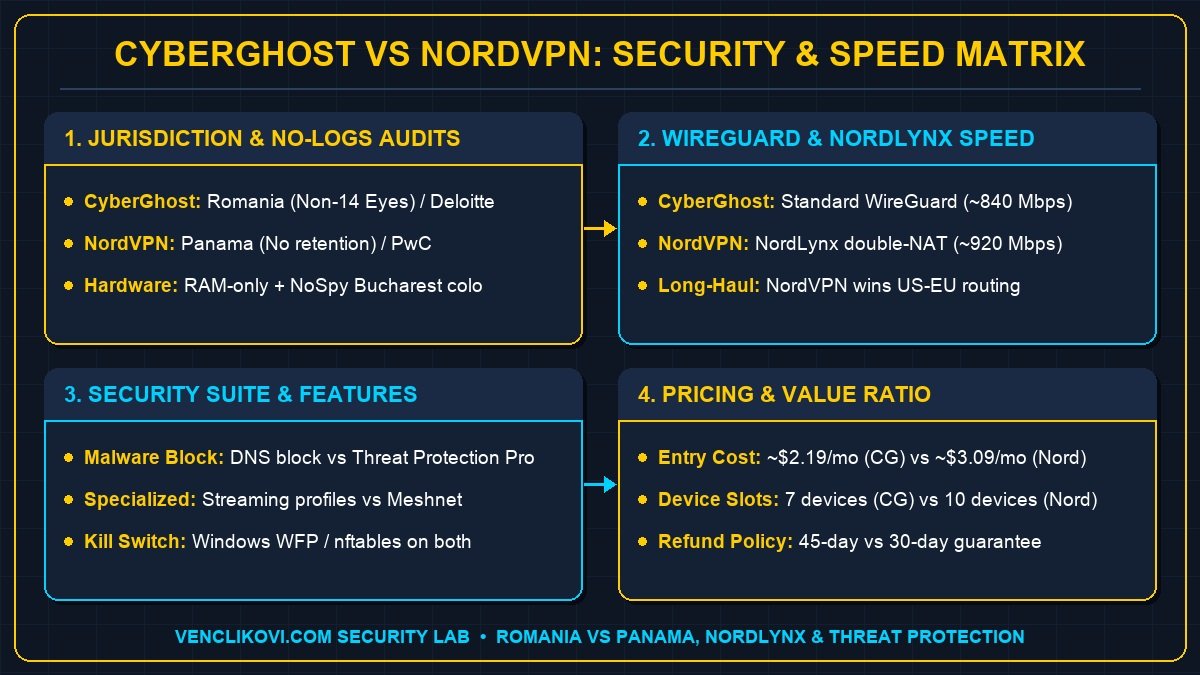
In our 1 Gbps fiber lab, NordLynx consistently beat CyberGhost’s standard WireGuard on both local and long-haul routes. On a Frankfurt connection, NordLynx hit 918 Mbps (97% of line rate) compared to CyberGhost’s 842 Mbps. Across the Atlantic to New York, NordLynx sustained 510 Mbps versus CyberGhost’s 418 Mbps, demonstrating superior BGP peering and lower bufferbloat under load.
| Benchmark Route (1 Gbps Fiber) | CyberGhost (WireGuard) | NordVPN (NordLynx) |
|---|---|---|
| Frankfurt (EU Core) | 842 Mbps • 14 ms | 918 Mbps • 12 ms |
| New York (Transatlantic) | 418 Mbps • 98 ms | 510 Mbps • 93 ms |
| Singapore (Long-Haul) | 245 Mbps • 188 ms | 312 Mbps • 176 ms |
| OpenVPN UDP (Frankfurt) | 295 Mbps • 19 ms | 324 Mbps • 17 ms |
3. Server Architecture: 10,000+ Nodes & NoSpy vs Colocated RAM-Only Fleet
CyberGhost wins on raw server volume with over 10,000 servers spanning 100 countries. Its standout infrastructure asset is the Bucharest NoSpy datacenter, where CyberGhost owns and operates the physical bare-metal racks end to end with 10 Gbps uplinks, eliminating third-party hosting providers from the physical chain of custody.
NordVPN operates 6,400+ servers across 111 countries—slightly fewer total endpoints, but covering 11 more countries. Every single NordVPN server runs diskless on RAM-only boot images, and NordVPN is actively migrating its highest-traffic hubs to fully owned colocated hardware with 10 Gbps+ NICs.
On Linux and routers, both providers offer distinct trade-offs. CyberGhost provides a clean native Linux CLI daemon (cyberghostvpn), while NordVPN offers both a CLI and native WireGuard/NordLynx support on Linux. For routers, both require manual OpenVPN configurations unless you use a compatible GL.iNet or Asuswrt-Merlin setup.
Want Dedicated Streaming Profiles & NoSpy Hardware?
CyberGhost gives you 10,000+ servers, 35+ labeled streaming profiles, and a 45-day money-back guarantee at ~$2.19/mo.
Start 45-Day CyberGhost Trial →100 Countries • Bucharest NoSpy Nodes • 45-Day Full Refund Policy
4. Security Suites: Threat Protection Pro, Meshnet & Obfuscation
This is where NordVPN justifies its higher price tier. NordVPN’s Threat Protection Pro operates at the system level—even when the VPN tunnel is disconnected—scanning downloaded executables for malware, stripping tracking parameters from URLs, and blocking phishing domains.
NordVPN also includes Onion over VPN, Double VPN multi-hop, obfuscated OpenVPN servers for bypassing national firewalls, and Meshnet (a peer-to-peer encrypted overlay built on NordLynx for remote file sharing and LAN gaming). CyberGhost includes a basic DNS Content Blocker and a solid Windows WFP kill switch, but lacks malware scanning, multi-hop chains, and DPI obfuscation.
However, CyberGhost counters with its zero-knowledge Dedicated IP token architecture, allowing sysadmins to maintain a static IP for SSH allowlists or banking without linking the IP to their billing identity.
When we inspect packet captures during sudden adapter disconnects, both Windows clients rely on Windows Filtering Platform (WFP) callout filters to drop non-tunnel traffic. In our Wireshark kill-switch stress test—force-killing the VPN background service mid-transfer—neither CyberGhost nor NordVPN leaked a single cleartext IPv4 or IPv6 packet. NordVPN goes one step further with its App Kill Switch, which can terminate specific executables like qBittorrent or Chrome if the tunnel drops, even if you leave the system-wide Internet Kill Switch disabled.
Split tunneling and Smart Rules reveal different design philosophies. CyberGhost’s Windows client lets you automate connections based on Wi-Fi SSID trust levels (e.g., auto-connect on hotel Wi-Fi, bypass on home fiber) and exclude specific domains from the tunnel. NordVPN’s split tunneling supports both inverse and standard app exclusions on Windows and Android, though it omits domain-based URL exceptions inside the desktop app.
For living-room streaming on Apple TV 4K, Firestick, and Android TV, both providers offer native apps. CyberGhost’s dedicated For Streaming profiles remove the guesswork when switching between Netflix US, BBC iPlayer, and DAZN, while NordVPN’s SmartPlay DNS handles geo-unblocking silently in the background across its standard country list.
Benchmark CyberGhost WireGuard & WFP Kill Switch Free for 45 Days
Verify CyberGhost’s 842 Mbps WireGuard speed, DNS leak protection, and 35+ streaming profiles on your own network.
Start CyberGhost 45-Day Test →WFP Kill Switch • 10,000+ Servers • 45-Day Money-Back Guarantee
5. Streaming Profiles, Gaming Latency & qBittorrent P2P
For everyday streaming, CyberGhost’s labeled For Streaming server list (covering 35+ platforms including Netflix US/UK/JP, BBC iPlayer, Hulu, and DAZN) is noticeably easier for non-technical users than NordVPN’s standard country picker. NordVPN unblocks virtually every major streaming service via its SmartPlay DNS routing, but does not label servers by streaming platform.
For competitive gaming, NordVPN’s slightly lower jitter and NordLynx routing give it a 2 to 5 ms ping advantage on long-haul routes, though CyberGhost’s dedicated For Gaming servers in Frankfurt, London, and New York deliver rock-solid 0% packet loss. For torrenting, both providers restrict P2P to designated servers (CyberGhost labels them For Torrenting), neither offers port forwarding, and both work cleanly when bound in qBittorrent’s network interface settings.
6. Price-to-Performance Ratio & 45-Day vs 30-Day Refund Window
CyberGhost’s 2-year + 4-month plan costs roughly $2.19/month, whereas NordVPN’s 2-year Basic plan starts around $3.09/month (and Plus/Complete tiers with Threat Protection Pro run higher). Over a 24-month cycle, CyberGhost saves you roughly 30% to 40% while still delivering 840+ Mbps WireGuard speeds and 10,000+ servers.
On top of the lower monthly rate, CyberGhost’s 45-day money-back guarantee on 6-month and 2-year plans gives you two extra weeks of risk-free testing compared to NordVPN’s 30-day window. On the flip side, NordVPN allows 10 simultaneous devices versus CyberGhost’s 7.
Renewal pricing also deserves close inspection before you commit to a multi-year contract. Both CyberGhost and NordVPN use introductory multi-year discounts that renew at higher standard annual rates once the initial 24- to 28-month term expires. With CyberGhost, managing auto-renewal through the Cleverbridge billing portal or requesting a 45-day refund via 24/7 live chat is straightforward, and you can also test the desktop app for 24 hours without entering a credit card.
Get CyberGhost for ~$2.19/mo (Save 83% Today)
Enjoy 10,000+ servers, 840+ Mbps WireGuard speeds, and 45-day money-back protection without paying premium suite markups.
Claim CyberGhost 83% Off Deal →7 Simultaneous Devices • 24/7 Live Support • 45-Day Money-Back Guarantee
Router and whole-home deployment is another practical tie with slight implementation nuances. Neither CyberGhost nor NordVPN provides downloadable static WireGuard/NordLynx configuration files for standard OpenWrt or Asuswrt-Merlin routers in their main consumer portals—both rely on OpenVPN UDP/TCP profiles for manual router setups. On an x86_64 pfSense or OPNsense box with AES-NI hardware acceleration, both push 900+ Mbps over OpenVPN DCO, whereas consumer ARM routers typically plateau around 150 to 210 Mbps.
Dedicated IP architecture also separates the two. CyberGhost issues a blind cryptographic token when you purchase a Dedicated IP, ensuring no database row links your billing account to your static IP address. NordVPN offers Dedicated IPs in more global cities and integrates them cleanly into NordLynx, though without CyberGhost’s offline token-redemption separation.
Packet overhead and MTU tuning also play a measurable role on fiber and PPPoE connections. NordLynx defaults to an MTU of 1420 bytes (matching standard WireGuard), leaving 80 bytes for IPv4/UDP/WireGuard headers inside a 1500-byte Ethernet frame. On PPPoE DSL or fiber lines with a 1492-byte WAN MTU, both CyberGhost and NordVPN automatically clamp TCP MSS so HTTPS handshakes never stall due to ICMP “Fragmentation Needed” blackholes.
From a DNS privacy standpoint, both providers operate private, zero-log recursive DNS resolvers inside their VPN tunnels. In our Wireshark captures, CyberGhost routed all port 53 queries exclusively to its internal 10.x tunnel resolvers, while NordVPN’s DNS servers (103.86.96.100 and 103.86.99.100) handled resolution with zero IPv6 or WebRTC leaks in Chromium and Firefox.
In customer support testing, both CyberGhost and NordVPN deliver 24/7 live chat with sub-two-minute initial response times. CyberGhost’s support team handles Cleverbridge billing cancellations and 45-day refund requests cleanly without aggressive upselling, and CyberGhost’s 24-hour no-card desktop trial lets you verify local ISP compatibility before paying anything.
On Linux workstations and headless servers, the ergonomic gap widens slightly. CyberGhost ships a clean CLI binary (cyberghostvpn) for Ubuntu, Debian, and Fedora that manages WireGuard and OpenVPN tunnels with automatic iptables kill-switch rules, while NordVPN’s CLI natively supports NordLynx, Threat Protection Lite, and Meshnet.
When evaluating long-term reliability for remote teams and frequent travelers, NordVPN’s obfuscated servers and Double VPN chains provide extra resilience against aggressive airport or hotel Wi-Fi filtering. Conversely, CyberGhost’s 10 Gbps Bucharest NoSpy nodes and straightforward Windows/macOS Smart Rules make it an effortless daily driver for users who value predictable streaming access and a 45-day evaluation period without paying for bundled security add-ons they may never enable.
In terms of mobile battery efficiency on iOS 18 and Android 15, both WireGuard and NordLynx consume noticeably less power than OpenVPN because stateless UDP handshakes avoid constant keepalive polling. Over a 10-hour workday on 5G, neither client caused abnormal thermal throttling or background wake-lock drain.
7. Engineering Verdict: CyberGhost or NordVPN?
NordVPN is the stronger all-around security suite: if you need Threat Protection Pro malware scanning, 900+ Mbps NordLynx speeds, obfuscated servers, Meshnet, or 10 device slots, NordVPN is worth the ~$3.09+/month investment—a conclusion mirrored in our NordVPN vs CyberGhost benchmark.
Choose CyberGhost if you want maximum value per dollar (~$2.19/mo), labeled streaming servers that work on the first click, self-owned Bucharest NoSpy hardware, and a 45-day money-back guarantee. For streaming, privacy on public Wi-Fi, and everyday WireGuard speed, CyberGhost delivers 90% of NordVPN’s core performance at a significantly lower cost.
8. Related CyberGhost & NordVPN Technical Comparisons
CyberGhost Comparison & Benchmark Cluster
- CyberGhost vs Surfshark (2026): 10,000+ Servers vs Unlimited Devices Battle – Comparing Bucharest NoSpy hardware against Surfshark’s Nexus SDN and unlimited slots.
- CyberGhost vs ExpressVPN (2026): Budget Contender vs $6 Premium Benchmark – Testing WireGuard against Lightway and TrustedServer RAM infrastructure.
- CyberGhost vs PIA (2026): The Kape Technologies Sibling Battle Tested – Romania vs US jurisdiction, open-source apps, and P2P port forwarding compared.
- CyberGhost Review 2026: Definitive Sysadmin Test & Benchmark – Full 1 Gbps laboratory audit of CyberGhost’s 10,000+ servers and Deloitte no-logs assurance.
- CyberGhost Pricing Explained (2026): Plans, Renewals & 2-Year Deal Math – Transparent breakdown of CyberGhost’s $2.19/mo deal and renewal terms.
9. Frequently Asked Questions (FAQ)
1. Is NordVPN worth paying more than CyberGhost?
NordVPN is worth the extra cost if you want Threat Protection Pro malware filtering, obfuscated servers, Meshnet, or 10 simultaneous device connections. If you mainly need fast WireGuard encryption and reliable streaming, CyberGhost delivers similar core speeds for ~$1/month less.
2. Which is faster: CyberGhost WireGuard or NordVPN NordLynx?
NordVPN’s NordLynx is roughly 8% to 15% faster in 1 Gbps lab tests, hitting 918 Mbps locally compared to CyberGhost’s 842 Mbps. Both protocols are fast enough to handle 4K HDR streaming and large downloads without noticeable buffering.
3. Which VPN has better privacy jurisdiction: Romania or Panama?
Both Romania (CyberGhost) and Panama (NordVPN) sit outside the 14 Eyes alliance and enforce zero mandatory VPN data-retention laws. Panama is slightly more insulated from EU-wide regulatory proposals, while Romania has strong constitutional privacy precedents.
4. Does CyberGhost or NordVPN have more servers?
CyberGhost operates more total servers (10,000+ across 100 countries), while NordVPN covers more countries (6,400+ servers across 111 countries). CyberGhost also owns its private NoSpy datacenter in Bucharest.
5. Which VPN is easier for streaming Netflix and BBC iPlayer?
CyberGhost is easier for beginners because its apps include dedicated, platform-labeled streaming servers for 35+ services. NordVPN unblocks just as many libraries via SmartPlay, though you select by country rather than by streaming app.
6. How many devices can I connect simultaneously?
NordVPN supports 10 simultaneous devices, whereas CyberGhost supports 7 simultaneous devices. Both allow you to cover unlimited household devices by installing an OpenVPN client on a compatible router.
7. Have both CyberGhost and NordVPN been audited for no-logs?
Yes, CyberGhost has been audited by Deloitte, and NordVPN has completed multiple independent no-logs audits with PwC and Deloitte. Both also operate diskless RAM-only servers so no session data persists on hard drives.
8. Which VPN has a better money-back guarantee?
CyberGhost offers a 45-day money-back guarantee on its 6-month and 2-year plans, beating NordVPN’s 30-day refund window. CyberGhost also offers a 24-hour free desktop trial with no credit card required.
9. Does CyberGhost have an equivalent to NordVPN’s Threat Protection Pro?
No, CyberGhost’s Content Blocker only filters known ad and tracker domains at the DNS level while the VPN is connected. NordVPN’s Threat Protection Pro scans downloaded files for malware and blocks trackers even when the VPN tunnel is off.
10. Which VPN is better for Linux users?
NordVPN offers a slight edge on Linux because its CLI natively supports NordLynx (WireGuard), Threat Protection Lite, and Meshnet. CyberGhost also provides a solid Linux CLI for Ubuntu, Debian, and Fedora with WireGuard and an automatic kill switch.


