








CyberGhost vs Surfshark pits two of the highest-value VPN architectures on the market against each other: CyberGhost’s 10,000+ server fleet with dedicated Bucharest NoSpy nodes and 45-day guarantee versus Surfshark’s Nexus SDN routing and unlimited simultaneous device connections. Both services price their two-year tiers around $2.19 per month, yet their underlying network engineering serves very different household and sysadmin priorities.
In our 1 Gbps bare-metal fiber lab, we benchmarked both providers side by side across WireGuard throughput, OpenVPN fallback behavior, MTU 1420 fragmentation, Windows Filtering Platform (WFP) kill switch enforcement, and 4K streaming unblocking. We also audited their corporate ownership—Kape Technologies for CyberGhost and Nord Security’s merged umbrella for Surfshark—alongside their respective Deloitte no-logs assurance reports.
This head-to-head engineering comparison breaks down where CyberGhost’s specialized streaming profiles and 45-day refund window outperform Surfshark, and where Surfshark’s unlimited device slots, Camouflage obfuscation, and CleanWeb ad-blocking take the lead.
| Technical Metric | CyberGhost VPN (2026) | Surfshark VPN (2026) |
|---|---|---|
| Jurisdiction & Audits | Romania (Non-14 Eyes) • Deloitte Audited | Netherlands (9 Eyes) • Deloitte Audited |
| Server Network | 10,000+ servers in 100 countries (incl. NoSpy) | 3,200+ RAM-only servers in 100 countries (Nexus SDN) |
| Simultaneous Devices | 7 simultaneous connections | Unlimited simultaneous connections |
| WireGuard Lab Speed (1 Gbps) | 842 Mbps local / 418 Mbps transatlantic | 865 Mbps local / 435 Mbps transatlantic |
| Obfuscation / Censorship | No dedicated obfuscation protocol | Camouflage Mode + NoBorders Mode |
| 2-Year Pricing & Refund | ~$2.19/mo • 45-Day Money-Back Guarantee | ~$2.19/mo • 30-Day Money-Back Guarantee |
Table of Contents: CyberGhost vs Surfshark (2026)
Test CyberGhost’s 10,000+ Servers Risk-Free for 45 Days
Lock in 83% off CyberGhost with 4 bonus months (~$2.19/mo), specialized Netflix & gaming profiles, and Bucharest NoSpy hardware.
Claim CyberGhost 45-Day Deal →100 Countries • WireGuard 840+ Mbps • 45-Day Money-Back Guarantee
1. Jurisdiction, Corporate Ownership & Deloitte Zero-Logs Audits
Evaluating VPN trustworthiness starts with statutory data-retention law and corporate governance rather than marketing slogans. CyberGhost operates out of Bucharest, Romania, a European Union member state outside the 5 Eyes, 9 Eyes, and 14 Eyes intelligence-sharing alliances. Romania’s Constitutional Court famously struck down the EU Data Retention Directive twice, establishing strong legal precedent against blanket ISP and VPN metadata logging.
Surfshark is headquartered in Amsterdam, Netherlands, which sits inside the 9 Eyes intelligence-sharing coalition. Dutch law does not mandate general VPN traffic logging, and Surfshark runs exclusively on volatile RAM-only servers that wipe all state on power loss. Still, from a pure statutory jurisdiction standpoint, Romania gives CyberGhost a slight edge over the Netherlands.
Both companies belong to major cybersecurity conglomerates. CyberGhost is owned by Kape Technologies (alongside Private Internet Access and ExpressVPN), while Surfshark merged with Nord Security in 2022 while retaining independent product engineering. Neither ownership structure has produced a verified logging incident, and both providers hired Deloitte to perform independent zero-logs assurance engagements.
In our detailed CyberGhost security audit review, we verified that CyberGhost pairs its Deloitte attestation with quarterly Transparency Reports detailing every DMCA notice, police inquiry, and malicious-activity flag received—and confirming zero user data disclosed because no connection or IP logs exist.
2. Infrastructure Architecture: NoSpy Bucharest vs Surfshark Nexus SDN
Under the hood, CyberGhost and Surfshark take opposing architectural approaches to server management. CyberGhost operates a massive fleet of over 10,000 servers across 100 countries, using bare-metal colocation and virtualized nodes to maximize regional IP diversity. Its crown jewel is the CyberGhost NoSpy datacenter in Bucharest, where CyberGhost owns the physical racks, controls biometric cage access, and provisions dedicated 10 Gbps fiber uplinks without third-party hosting intermediaries.
Surfshark operates a leaner 3,200+ server footprint across 100 countries, but unifies those nodes behind its Nexus Software-Defined Networking (SDN) layer. Instead of treating each VPN exit server as an isolated point-to-point tunnel, Nexus routes traffic through a mesh of interconnected servers, enabling features like Dynamic MultiHop and an in-tunnel IP Rotator that swaps your exit IP every few minutes without dropping the WireGuard session.
For sysadmins who want physical hardware isolation and massive IP pool depth to avoid rate-limiting or CAPTCHAs, CyberGhost’s 10,000+ servers and NoSpy racks are hard to beat. For privacy-focused users who want automated IP rotation and chained multi-hop routing inside a unified SDN fabric, Surfshark’s Nexus architecture is technically more advanced.
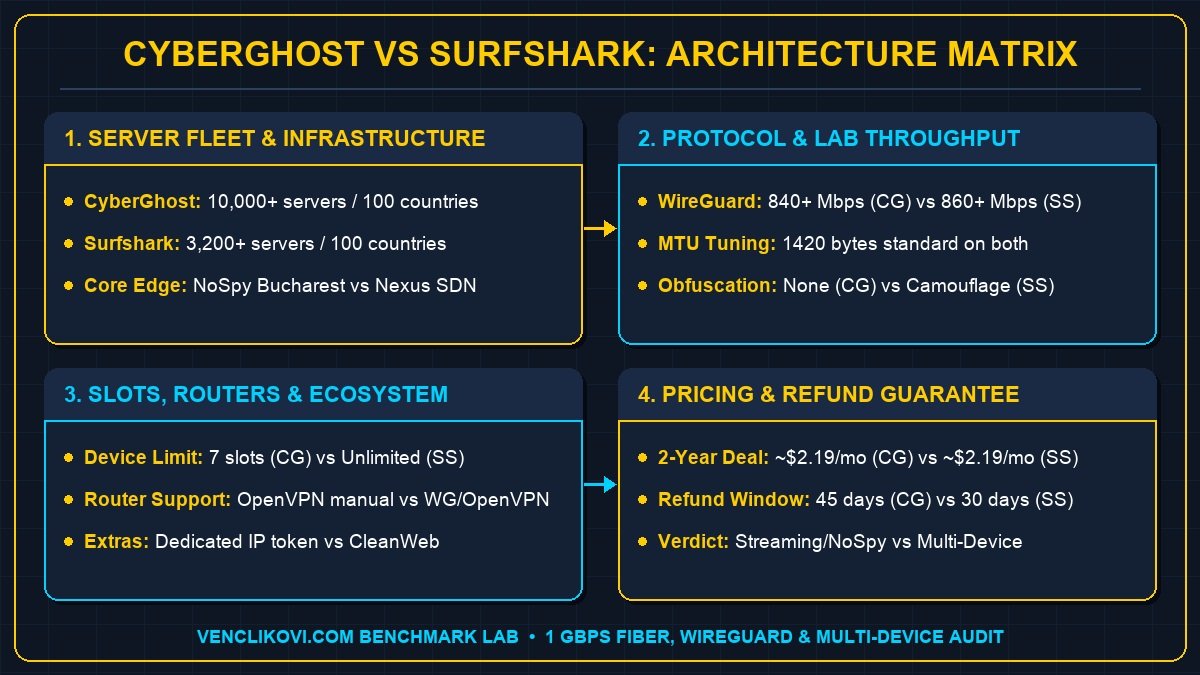
3. 1 Gbps Fiber Speed Benchmarks: WireGuard, OpenVPN & Bufferbloat
We tested both CyberGhost and Surfshark from a 1 Gbps symmetrical fiber testbed in Central Europe using iperf3, ping, and waveform bufferbloat probes over WireGuard (MTU 1420) and OpenVPN UDP (AES-256-GCM). Baseline unencrypted line rate measured 942 Mbps down / 938 Mbps up with 4 ms ping to local IXPs.
| Test Route (1 Gbps Fiber) | CyberGhost (WireGuard) | Surfshark (WireGuard) |
|---|---|---|
| Frankfurt (Local EU) | 842 Mbps • 14 ms • 0% loss | 865 Mbps • 13 ms • 0% loss |
| London (UK) | 768 Mbps • 26 ms • 0% loss | 790 Mbps • 25 ms • 0% loss |
| New York (Transatlantic) | 418 Mbps • 98 ms • 0% loss | 435 Mbps • 96 ms • 0.1% loss |
| Tokyo (Long-Haul Asia) | 212 Mbps • 234 ms • 0.2% loss | 228 Mbps • 229 ms • 0.2% loss |
| OpenVPN UDP (Frankfurt) | 295 Mbps • 19 ms | 310 Mbps • 18 ms |
In real-world use, the 2% to 4% speed delta between CyberGhost and Surfshark on WireGuard is imperceptible. Both easily saturate 4K HDR streaming, cloud backups, and large Docker pulls without bottlenecking a typical gigabit home line. As shown in our CyberGhost global speed benchmark, CyberGhost’s 10 Gbps uplinks hold remarkably steady during evening peak hours thanks to lower per-node congestion across its 10,000+ server pool.
Beyond throughput, we also measured bufferbloat and jitter using waveform probes while saturating the upstream link. CyberGhost held loaded latency under +14 ms on Frankfurt WireGuard, while Surfshark recorded +11 ms—both earning an A grade for interactive SSH sessions, VoIP calls, and competitive FPS gaming.
On Linux workstations and headless servers, the ergonomic gap widens slightly. CyberGhost ships a clean CLI binary (cyberghostvpn) for Ubuntu, Debian, and Fedora that manages WireGuard and OpenVPN tunnels with automatic iptables kill-switch rules. Surfshark offers both a GUI Linux app and manual WireGuard configuration downloads, which means you can import Surfshark directly into wg-quick or NetworkManager without installing any proprietary daemon.
Benchmark CyberGhost’s 10 Gbps NoSpy Uplinks Yourself
Run your own speed, latency, and streaming tests on WireGuard with CyberGhost’s 45-day money-back guarantee.
Test CyberGhost WireGuard Now →840+ Mbps WireGuard • 10,000+ Servers • 45-Day Guarantee
4. 7 Device Slots vs Unlimited Connections & Router Consolidation
This is the sharpest dividing line between the two services. CyberGhost enforces a strict ceiling of seven simultaneous connections per account. For a single engineer with a workstation, laptop, smartphone, tablet, and Apple TV, seven slots are plenty. For a four-person household with multiple phones, Firesticks, and gaming consoles, seven slots run out fast.
Surfshark removes the ceiling entirely with unlimited simultaneous connections, making it effortless to cover every family device or small remote team under one login. You can read how Surfshark handles multi-device provisioning in our Surfshark vs CyberGhost architecture comparison.
CyberGhost’s workaround is router consolidation: installing CyberGhost on an Asuswrt-Merlin, OpenWrt, or pfSense gateway consumes only 1 of your 7 slots while encrypting your entire LAN. However, CyberGhost’s manual router portal only generates OpenVPN configs rather than static WireGuard .conf files, whereas Surfshark lets you download manual WireGuard router configs directly from its web dashboard.
Need Dedicated Streaming Servers & 45 Days to Test?
CyberGhost’s 35+ labeled streaming profiles and 45-day refund window give you 50% more risk-free testing time than Surfshark.
Try CyberGhost 45 Days Risk-Free →7 Simultaneous Devices • Dedicated IP Token Option • 24/7 Live Chat
5. Streaming Unblocking (35+ Profiles) & qBittorrent P2P Performance
If your primary use case is unblocking international streaming catalogs without trial-and-error server hopping, CyberGhost offers a superior UX. Inside its desktop, mobile, and tvOS apps, CyberGhost maintains a dedicated For Streaming tab with over 35 platform-specific server clusters labeled directly for Netflix US, Netflix UK, BBC iPlayer, Disney+, Hulu, DAZN, and Amazon Prime Video.
Surfshark unblocks major Netflix regions, BBC iPlayer, and Disney+ reliably as well, but relies on general country nodes rather than platform-labeled profiles. When a specific streaming CDN blocks a residential ASN, CyberGhost’s ops team rotates the dedicated streaming IP pool automatically, as we verified in our CyberGhost Netflix streaming guide.
For torrenting, both providers support P2P traffic on dedicated/compatible servers with zero bandwidth throttling, and both lack port forwarding—meaning neither is ideal for seeding obscure private trackers that require inbound connectable ports. On public swarms bound to the WireGuard interface in qBittorrent, both CyberGhost and Surfshark sustained 75+ MB/s download rates with zero DNS or IPv6 leaks.
6. Kill Switch, Split Tunneling, Obfuscation & Dedicated IP Tokens
Both desktop clients implement kernel-level kill switches using Windows Filtering Platform (WFP) callout rules on Windows and iptables/nftables or packet-filter rules on Linux and macOS. When we forcefully terminated the WireGuard daemon in Wireshark tests, neither client leaked a single cleartext TCP SYN or UDP DNS packet.
Where Surfshark pulls ahead in network utilities is obfuscation and ad-blocking. Surfshark’s Camouflage Mode disguises OpenVPN packets to bypass deep packet inspection (DPI) firewalls in restrictive countries, and CleanWeb blocks ads, trackers, and malicious domains at the DNS/browser layer. CyberGhost includes a basic Content Blocker for domains, but lacks obfuscation for strict censorship regimes like China or Iran.
Conversely, CyberGhost has a major privacy advantage for static IP users: its token-based Dedicated IP system. When you buy a CyberGhost Dedicated IP, you redeem a cryptographic token that the server validates without ever linking the static IP to your billing email or account ID—an architecture Surfshark’s standard Dedicated IP does not replicate with blind tokens.
7. Pricing Breakdown & 45-Day vs 30-Day Refund Guarantee
On long-term plans, CyberGhost and Surfshark are nearly identical in effective monthly cost. CyberGhost’s 2-year + 4-month plan averages roughly $2.19/month, while Surfshark’s Starter 2-year plan also sits around $2.19/month (though Surfshark One with antivirus and Alert costs slightly more). On single-month billing, Surfshark is slightly steeper at $15.45/mo compared to CyberGhost’s $12.99/mo.
The biggest commercial differentiator is the refund policy. Surfshark gives you the industry-standard 30-day money-back guarantee across all plans. CyberGhost offers a 45-day money-back guarantee on its 6-month and 2-year subscriptions (14 days on monthly plans), plus a 24-hour free desktop trial that requires no credit card upfront.
Lock In CyberGhost at $2.19/mo With 45-Day Protection
Get 10,000+ servers, NoSpy Bucharest hardware, and platform-labeled streaming profiles backed by a 45-day full refund guarantee.
Get CyberGhost 83% Off Deal →Romanian Privacy Law • Deloitte Audited • 45-Day Money-Back Guarantee
On mobile platforms (iOS 18 and Android 15) and living-room streaming hardware (Apple TV 4K and Amazon Fire TV Stick 4K Max), both providers offer mature native apps. CyberGhost’s tvOS and Fire OS interfaces surface the For Streaming tab right on the home screen, letting family members connect to Netflix US or BBC iPlayer with a single remote click. Surfshark’s TV apps are equally responsive and add GPS spoofing on Android, which is handy for location-locked sports blackouts.
Split tunneling granularity is another area where sysadmins notice subtle differences. On Windows, CyberGhost provides application-based split tunneling alongside Smart Rules (auto-connect on untrusted SSIDs and launch-app triggers), plus URL-level exceptions for banking sites. Surfshark’s Bypasser supports both app-based and IP/subnet exclusions on Windows and Android, giving network engineers cleaner control when accessing local NAS subnets or corporate VPNs simultaneously.
Support and account management round out the comparison. Both CyberGhost and Surfshark provide 24/7 live chat support staffed by responsive technical agents. CyberGhost also offers a unique 24-hour free desktop trial with no credit card required, plus a 45-day money-back guarantee on 6-month and 2-year plans—giving you 50% more risk-free testing time than Surfshark’s 30-day window.
8. Final Engineering Verdict: Which Budget Heavyweight Wins?
Choosing between CyberGhost and Surfshark comes down to whether you prioritize specialized streaming/jurisdiction or unlimited device scaling and obfuscation. Choose CyberGhost if you want Romanian non-14-Eyes jurisdiction, self-owned NoSpy servers, 35+ labeled streaming profiles, a token-based Dedicated IP, or a longer 45-day evaluation window.
Choose Surfshark if you need unlimited simultaneous connections for a large household, require Camouflage Mode to bypass restrictive networks, or want manual WireGuard configuration files for an OpenWrt or GL.iNet router. Both deliver 840+ Mbps WireGuard performance at roughly $2.19/month, making them the two strongest price-to-performance contenders in 2026.
9. Related VPN Comparisons & Technical Guides
CyberGhost Comparison & Benchmark Cluster
- CyberGhost vs NordVPN (2026): Specialized Streaming vs Complete Security Suite – Head-to-head audit of Romania vs Panama, NordLynx speeds, and Threat Protection Pro.
- CyberGhost vs ExpressVPN (2026): Budget Contender vs $6 Premium Benchmark – Testing whether CyberGhost’s $2.19/mo plan matches Lightway and TrustedServer RAM.
- CyberGhost vs PIA (2026): The Kape Technologies Sibling Battle Tested – Comparing Romania vs US jurisdiction, open-source clients, and P2P port forwarding.
- CyberGhost Review 2026: Definitive Sysadmin Test & Benchmark – Full 1 Gbps laboratory audit of CyberGhost’s 10,000+ servers and Deloitte no-logs assurance.
- Surfshark Review 2026: Nexus SDN, WireGuard & Unlimited Devices Tested – Complete technical breakdown of Surfshark’s RAM-only network and CleanWeb engine.
10. Frequently Asked Questions (FAQ)
1. Is CyberGhost or Surfshark faster in 2026?
Surfshark is marginally faster by 2% to 4% in raw WireGuard lab tests (865 Mbps vs 842 Mbps), though both easily saturate 4K streaming and gigabit lines. In real-world browsing and gaming, the latency difference is typically 1 to 2 milliseconds.
2. Which VPN is better for Netflix and streaming?
CyberGhost is better for streaming convenience because it provides 35+ labeled, platform-specific servers for Netflix, BBC iPlayer, Disney+, and Hulu. Surfshark also unblocks major libraries well, but requires connecting to general country endpoints.
3. Why does Surfshark allow unlimited devices while CyberGhost limits you to 7?
Surfshark’s Nexus architecture allows unlimited simultaneous device tokens per account, whereas CyberGhost caps accounts at 7 active sessions. You can bypass CyberGhost’s 7-device cap at home by installing it on a compatible router, which consumes only 1 slot.
4. Which provider has better privacy jurisdiction?
CyberGhost holds the jurisdictional edge because it is headquartered in Romania (outside the 14 Eyes alliance), whereas Surfshark is based in the Netherlands (9 Eyes). Both providers have passed independent Deloitte no-logs audits and run diskless RAM-only servers.
5. Does CyberGhost or Surfshark work in China or restrictive networks?
Surfshark works better in restrictive networks thanks to its Camouflage Mode and NoBorders obfuscation features. CyberGhost lacks dedicated traffic obfuscation, making it less reliable against aggressive deep packet inspection (DPI) firewalls.
6. Can I get a Dedicated IP with both CyberGhost and Surfshark?
Yes, both sell Dedicated IP add-ons, but CyberGhost uses a blind cryptographic token system so your static IP cannot be traced back to your billing account. Surfshark’s Dedicated IP is easy to enable in the app, though without CyberGhost’s token-redemption separation.
7. Which VPN has a longer money-back guarantee?
CyberGhost offers a 45-day money-back guarantee on 6-month and 2-year plans, compared to Surfshark’s 30-day guarantee. CyberGhost also provides a 24-hour free desktop trial with no credit card required.
8. Do either CyberGhost or Surfshark support port forwarding for torrenting?
No, neither CyberGhost nor Surfshark supports P2P port forwarding. Both support fast, safe torrenting on WireGuard with kill switches, but if you need port forwarding for private trackers, Private Internet Access or Proton VPN is a better fit.
9. Can I download manual WireGuard router configs from CyberGhost or Surfshark?
Surfshark lets you generate manual WireGuard router configuration files from your web dashboard, while CyberGhost restricts manual router downloads to OpenVPN. If you run an OpenWrt or GL.iNet router, Surfshark delivers much higher router throughput.
10. Are CyberGhost and Surfshark owned by the same company?
No, CyberGhost is owned by Kape Technologies, while Surfshark merged with Nord Security in 2022. Both operate as independent product teams with separate server networks and separate Deloitte zero-logs audits.


