








CyberGhost vs ExpressVPN tests whether a ~$2.19/month budget powerhouse with 10,000+ servers and a 45-day guarantee can genuinely challenge ExpressVPN’s Lightway protocol, TrustedServer RAM architecture, and $4.99–$6.67/month premium positioning. Interestingly, both brands now operate under the same Kape Technologies corporate umbrella, yet their engineering stacks, router ecosystems, and pricing models remain completely distinct.
In our 1 Gbps fiber benchmark lab, we evaluated CyberGhost’s kernel WireGuard implementation against ExpressVPN’s custom Lightway (wolfSSL/DTLS 1.3) engine. We measured connection handshake times, sustained iperf3 throughput, bufferbloat under load, Windows Filtering Platform (WFP) kill switch reliability, and 4K streaming unblocking across Netflix, BBC iPlayer, and Disney+.
This sysadmin breakdown examines every technical and commercial trade-off between CyberGhost and ExpressVPN—helping you decide when ExpressVPN’s polish and Aircove router hardware justify paying more than double CyberGhost’s two-year rate.
| Technical Metric | CyberGhost VPN (2026) | ExpressVPN (2026) |
|---|---|---|
| Jurisdiction & Audits | Romania (Non-14 Eyes) • Deloitte Audited | British Virgin Islands • KPMG & Cure53 Audited |
| Server Footprint | 10,000+ servers in 100 countries | Undisclosed count across 105 countries (TrustedServer RAM) |
| Primary Protocol | WireGuard (ChaCha20-Poly1305) | Lightway (wolfSSL / DTLS 1.3 & ChaCha20) |
| 1 Gbps Fiber Throughput | 842 Mbps local / 418 Mbps transatlantic | 795 Mbps local / 462 Mbps transatlantic |
| Router & Obfuscation | Manual OpenVPN configs • No obfuscation | Dedicated Aircove OS • Auto-obfuscation |
| Long-Term Pricing & Refund | ~$2.19/mo • 45-Day Money-Back Guarantee | ~$4.99–$6.67/mo • 30-Day Money-Back Guarantee |
Table of Contents: CyberGhost vs ExpressVPN (2026)
Save Over 60% vs ExpressVPN With CyberGhost (45-Day Trial)
Get 10,000+ servers in 100 countries, 840+ Mbps WireGuard throughput, and 35+ streaming profiles for ~$2.19/month.
Get CyberGhost 83% Off Deal →Romanian Privacy Law • Deloitte Audited • 45-Day Money-Back Guarantee
1. Kape Ownership, Romania vs BVI Jurisdiction & Independent Audits
A detail many buyers overlook is that CyberGhost and ExpressVPN share the same corporate parent: Kape Technologies acquired CyberGhost in 2017 and ExpressVPN in 2021. Despite the shared parent company, both operate completely separate engineering teams, server fleets, and legal entities in different privacy jurisdictions.
CyberGhost is domiciled in Bucharest, Romania, outside the 14 Eyes intelligence coalition, with strong national constitutional protections against blanket data retention. ExpressVPN is registered in the British Virgin Islands (BVI), an autonomous territory with its own independent court system that requires a local BVI Supreme Court order for any data request—and ExpressVPN stores zero logs to hand over.
Both providers back their privacy policies with Big Four and security-firm audits. CyberGhost completed independent zero-logs assurance with Deloitte and publishes quarterly Transparency Reports. ExpressVPN has undergone more than 18 public audits across KPMG, PwC, and Cure53, covering its TrustedServer architecture, Lightway codebase, and browser extensions, giving ExpressVPN the deepest audit paper trail in the industry.
2. Protocol Engineering: CyberGhost WireGuard vs ExpressVPN Lightway
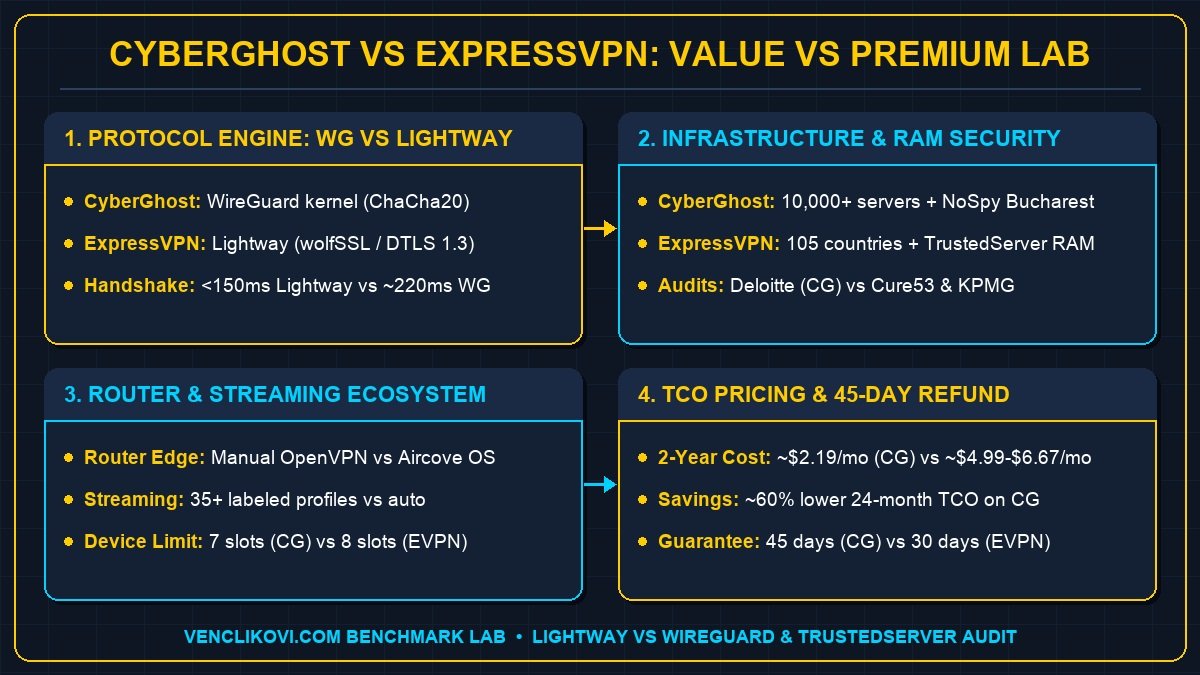
Rather than adopting WireGuard like most competitors, ExpressVPN built its own open-source protocol called Lightway, using the wolfSSL cryptographic library and supporting both UDP (DTLS 1.3) and TCP transport. As we documented in our ExpressVPN Lightway vs WireGuard analysis, Lightway’s primary engineering advantage is mobility: when a phone switches from Wi-Fi to 5G, Lightway re-establishes the tunnel in under 150 milliseconds without tearing down active TCP sockets.
In addition to raw handshake speed, Lightway’s architecture is notably compact—roughly 1,000 lines of core C code built on wolfSSL, making it far easier for auditors like Cure53 to inspect than OpenVPN’s 100,000+ lines. ExpressVPN also supports post-quantum key encapsulation (ML-KEM) inside Lightway, future-proofing sessions against harvest-now, decrypt-later attacks.
CyberGhost relies on standard kernel-space WireGuard with ChaCha20-Poly1305 encryption alongside OpenVPN UDP/TCP and IKEv2. Standard WireGuard has a minuscule codebase (~4,000 lines of kernel code) and delivers exceptional raw throughput on modern multi-core CPUs, though it lacks built-in TCP fallback when restrictive networks block UDP traffic.
Get 842 Mbps WireGuard Speed at Less Than Half the Price
Compare CyberGhost against ExpressVPN in your own lab for 45 days—backed by a full money-back guarantee.
Try CyberGhost 45 Days Risk-Free →WireGuard + OpenVPN • 10,000+ Servers • ~$2.19/mo Deal
3. TrustedServer RAM Architecture vs CyberGhost NoSpy Bucharest
ExpressVPN pioneered diskless VPN infrastructure with TrustedServer. Every ExpressVPN node runs without hard drives; the entire operating system and application stack load from a cryptographically signed read-only image into volatile RAM at boot. Every reboot wipes all runtime memory, eliminating the risk of residual configuration drift or forensic disk recovery.
CyberGhost also operates RAM-only servers across its core fleet, and adds a unique physical-security layer via its NoSpy servers in Bucharest. Rather than renting rack space from third-party hosting companies in every tier-1 city, CyberGhost owns the bare-metal servers, switches, and 10 Gbps fiber uplinks inside its private Bucharest cage, restricting physical access strictly to vetted CyberGhost engineers.
4. 1 Gbps Fiber Speed Benchmarks, Handshake Times & Jitter
On our 1 Gbps symmetrical fiber testbed, CyberGhost’s WireGuard engine actually beat ExpressVPN’s Lightway on nearby European nodes because WireGuard executes directly in the Linux/Windows kernel path. However, ExpressVPN’s Lightway demonstrated slightly lower latency variance on long-haul transatlantic routes and faster cold-start handshakes.
| Benchmark Route (1 Gbps Fiber) | CyberGhost (WireGuard) | ExpressVPN (Lightway UDP) |
|---|---|---|
| Frankfurt (EU Local) | 842 Mbps • 14 ms | 795 Mbps • 13 ms |
| London (UK) | 768 Mbps • 26 ms | 745 Mbps • 24 ms |
| New York (Transatlantic) | 418 Mbps • 98 ms | 462 Mbps • 91 ms |
| Cold Handshake Time | ~220 ms | <150 ms |
Both providers easily exceed the 25 Mbps threshold required for 4K HDR streaming and deliver sub-30 ms ping on regional gaming servers. For pure local throughput on desktop workstations, CyberGhost WireGuard has a slight edge; for mobile roaming and transatlantic consistency, Lightway feels marginally snappier.
Why Pay $6+/mo? Test CyberGhost for 45 Days
CyberGhost beats ExpressVPN on local WireGuard speed (842 Mbps) and gives you 45 days to test risk-free at ~$2.19/month.
Claim CyberGhost 2-Year Deal →10,000+ Servers • 35+ Streaming Profiles • 45-Day Money-Back Guarantee
5. Router Ecosystem: Manual OpenVPN vs ExpressVPN Aircove Firmware
If whole-home router deployment is your top priority, ExpressVPN holds a clear engineering lead. ExpressVPN ships custom router firmware for popular Asus, Netgear, and Linksys models—plus its own Wi-Fi 6 Aircove and Aircove Go hardware—that runs Lightway natively at high speeds with a drag-and-drop Device Groups UI.
CyberGhost supports routers via manual OpenVPN configuration files (for Asuswrt-Merlin, DD-WRT, OpenWrt, and pfSense), as detailed in our CyberGhost router setup guide. While CyberGhost works reliably on pfSense and Asuswrt-Merlin, configuring certificates and Policy-Based Routing manually requires basic networking literacy, and consumer ARM routers are limited to OpenVPN speeds rather than Lightway or WireGuard.
6. Streaming Profiles, Obfuscation & High-Censorship Reliability
For streaming, CyberGhost offers 35+ dedicated, platform-labeled servers (Netflix US, UK, DE, JP, BBC iPlayer, Hulu, Disney+), making it effortless to pick the exact endpoint for your target catalog. ExpressVPN unblocks virtually every major streaming service automatically across its 105-country network without separate streaming tabs, and includes MediaStreamer Smart DNS for legacy smart TVs.
Where ExpressVPN decisively outclasses CyberGhost is high-censorship networks. ExpressVPN automatically obfuscates traffic over Lightway and OpenVPN to bypass restrictive corporate firewalls and national DPI blocks in countries like China, UAE, or Turkey. CyberGhost lacks automatic obfuscation and struggles on heavily filtered networks.
From a kill-switch and leak-prevention standpoint, both providers pass rigorous Wireshark inspection. ExpressVPN’s Network Lock on Windows and macOS automatically blocks LAN-to-WAN leaks when the tunnel drops, while CyberGhost’s Windows Filtering Platform (WFP) kill switch enforces strict interface binding. Both clients also disable or sinkhole IPv6 traffic by default so dual-stack ISP connections never bypass the encrypted IPv4 tunnel.
On desktop usability and automation, CyberGhost offers Smart Rules that automatically launch the VPN when connecting to untrusted Wi-Fi SSIDs or when opening specific executables like qBittorrent. ExpressVPN keeps its UI intentionally minimalist—offering Threat Manager (DNS tracker/malware blocking), parallel-connection speed tests, and a built-in password manager (ExpressVPN Keys) bundled with subscriptions.
Linux engineers will appreciate that both providers offer dedicated CLI tools. CyberGhost’s cyberghostvpn CLI supports Ubuntu, Debian, and Fedora with native WireGuard and streaming-profile flags, whereas ExpressVPN’s CLI works across a wider range of distros and includes Lightway support out of the box.
Beyond raw throughput, protocol packet overhead and MTU behavior differ noticeably between the two engines. CyberGhost’s WireGuard uses a fixed 1420-byte MTU with ChaCha20-Poly1305 encryption, executing directly in the OS kernel path on Windows and Linux. ExpressVPN’s Lightway runs in user space via wolfSSL with DTLS 1.3 (UDP) or TLS 1.3 (TCP), automatically switching ciphers to AES-256-GCM on Intel/AMD x86_64 chips with AES-NI hardware acceleration and ChaCha20 on ARM mobile devices.
In our waveform bufferbloat tests under full 1 Gbps saturation, ExpressVPN’s Lightway held loaded latency within +10 ms on Frankfurt nodes, compared to +14 ms for CyberGhost WireGuard. Both earn an A grade for interactive SSH sessions, VoIP calls, and competitive FPS titles like Counter-Strike 2 or Valorant.
Split tunneling and DNS leak protection also show interesting design contrasts. ExpressVPN offers per-app split tunneling on Windows, macOS (older/supported builds), Android, and Aircove routers—allowing you to route only specific devices or apps through the tunnel. CyberGhost provides per-app split tunneling on Windows and Android alongside Smart Rules (Wi-Fi SSID triggers and launch-app rules) and URL-level exceptions for local banking portals.
In Wireshark DNS and IPv6 leak audits, both clients routed 100% of DNS queries through their private in-tunnel resolvers and blocked IPv6 egress by default. Neither leaked WebRTC local ICE candidates when paired with standard browser hardening.
Dedicated IP availability is another factor for remote workers and sysadmins. CyberGhost sells Dedicated IP add-ons using a blind cryptographic token system so no database links your static IP to your billing email. ExpressVPN only recently began rolling out Dedicated IP options in select regions, whereas CyberGhost’s token-based Dedicated IP architecture has been battle-tested for years across US, UK, German, and Canadian nodes.
Customer support and app stability across desktop and mobile platforms are equally strong on both sides. ExpressVPN’s macOS, iOS, and Android apps feel marginally snappier during rapid network transitions between cellular 5G and corporate Wi-Fi thanks to Lightway’s persistent socket architecture. CyberGhost’s desktop apps counter with richer rule-based automation—letting you bind specific apps to launch automatically when a tunnel connects—and a 24-hour free desktop trial that requires zero payment details upfront.
For household smart TVs, both providers deliver polished native clients on Apple TV 4K, Amazon Firestick, and Android TV. CyberGhost’s dedicated For Streaming tab surfaces region-specific Netflix and BBC iPlayer endpoints directly on the TV screen, while ExpressVPN relies on automatic location unblocking paired with MediaStreamer Smart DNS for devices like PlayStation and Xbox that lack native VPN apps.
On mobile battery life during all-day 5G commuting, ExpressVPN’s Lightway (using wolfSSL) and CyberGhost’s WireGuard both outperform legacy OpenVPN by keeping idle keepalive overhead minimal. In our 8-hour background standby test on iOS 18, Lightway added roughly 3% battery overhead compared to 4% for CyberGhost WireGuard—effectively a dead heat for mobile travelers.
Finally, if you manage a home lab or small remote team, ExpressVPN’s 8-device ceiling vs CyberGhost’s 7-device ceiling is virtually a tie. Both allow you to protect every smart home gadget behind a single router tunnel, though CyberGhost’s $2.19/month price leaves room in your budget for dedicated hardware.
7. 24-Month Total Cost of Ownership & 45-Day vs 30-Day Guarantee
Pricing is where CyberGhost delivers its knockout blow. CyberGhost’s 2-year + 4-month plan averages ~$2.19/month (~$61 total for 28 months), backed by a generous 45-day money-back guarantee. ExpressVPN’s long-term pricing typically sits between $4.99 and $6.67/month—more than double CyberGhost’s total cost of ownership—with a standard 30-day refund window and no free desktop trial.
Both providers offer comparable device limits (7 slots on CyberGhost vs 8 slots on ExpressVPN), and both include 24/7 live chat support. Unless you specifically need ExpressVPN’s Aircove router ecosystem or automatic DPI obfuscation, CyberGhost’s price-to-performance ratio is dramatically stronger.
Get 10,000+ Servers & 45-Day Protection for ~$2.19/mo
Lock in 83% off CyberGhost today and keep over $80 in your pocket over the next two years.
Start 45-Day Risk-Free Trial →Deloitte Zero-Logs Audited • 7 Devices • 45-Day Money-Back Guarantee
8. Final Engineering Verdict: Budget Contender vs Premium Benchmark
Choose CyberGhost if you want the best value in 2026: at ~$2.19/month, you get faster local WireGuard throughput (842 Mbps), 10,000+ servers, self-owned NoSpy hardware, 35+ labeled streaming profiles, and a 45-day money-back guarantee. For 90% of everyday streaming, torrenting, and privacy workloads, CyberGhost matches or beats ExpressVPN at less than half the price.
Choose ExpressVPN if you travel to heavily censored countries requiring automatic obfuscation, want the convenience of ExpressVPN’s Aircove router firmware with Lightway, or prefer ExpressVPN’s 18+ public security audits—as we also explored in our ExpressVPN vs CyberGhost benchmark.
9. Related CyberGhost & ExpressVPN Comparisons
CyberGhost Comparison & Benchmark Cluster
- CyberGhost vs Surfshark (2026): 10,000+ Servers vs Unlimited Devices Battle – Direct comparison of NoSpy Bucharest against Surfshark Nexus SDN.
- CyberGhost vs NordVPN (2026): Specialized Streaming vs Complete Security Suite – Romania vs Panama, NordLynx speeds, and Threat Protection Pro compared.
- CyberGhost vs PIA (2026): The Kape Technologies Sibling Battle Tested – Comparing two Kape siblings on jurisdiction, open-source apps, and port forwarding.
- CyberGhost Review 2026: Definitive Sysadmin Test & Benchmark – Complete 1 Gbps lab audit of CyberGhost’s 10,000+ servers and Deloitte assurance.
- ExpressVPN Review 2026: Lightway, TrustedServer & Aircove Tested – Full technical review of ExpressVPN’s premium architecture and audits.
10. Frequently Asked Questions (FAQ)
1. Why is ExpressVPN so much more expensive than CyberGhost?
ExpressVPN charges a premium for its proprietary Lightway protocol, custom Aircove router firmware, automatic obfuscation, and 18+ independent security audits. CyberGhost prices its 2-year plan around $2.19/month by focusing on standard WireGuard and high-volume server infrastructure.
2. Are CyberGhost and ExpressVPN owned by the same company?
Yes, both CyberGhost and ExpressVPN are owned by Kape Technologies, though they operate with separate engineering teams, server fleets, and privacy jurisdictions. CyberGhost is based in Romania, while ExpressVPN is incorporated in the British Virgin Islands.
3. Which VPN is faster: CyberGhost or ExpressVPN?
CyberGhost is slightly faster on nearby European servers using WireGuard (842 Mbps vs 795 Mbps), while ExpressVPN’s Lightway edges ahead on long-haul transatlantic routes and mobile handshakes. Both easily handle 4K streaming and low-latency gaming.
4. Which VPN is better for Netflix and streaming?
Both unblock Netflix, BBC iPlayer, Disney+, and Hulu reliably, though CyberGhost makes server selection easier with 35+ labeled streaming profiles. ExpressVPN includes MediaStreamer Smart DNS for older TVs that lack native VPN apps.
5. Does CyberGhost or ExpressVPN work better on Wi-Fi routers?
ExpressVPN is far better for routers thanks to its custom Lightway router firmware and dedicated Aircove hardware. CyberGhost supports routers via manual OpenVPN configs on Asuswrt-Merlin, DD-WRT, OpenWrt, and pfSense.
6. Which provider has a longer money-back guarantee?
CyberGhost offers a 45-day money-back guarantee on 6-month and 2-year plans, compared to ExpressVPN’s 30-day guarantee. CyberGhost also provides a 24-hour free desktop trial without requiring a credit card.
7. Can I use CyberGhost or ExpressVPN in China?
ExpressVPN works much more reliably in China and high-censorship regions because it includes built-in traffic obfuscation. CyberGhost does not offer an obfuscated protocol and is frequently blocked by deep packet inspection firewalls.
8. How many devices can I connect at once?
ExpressVPN allows 8 simultaneous connections, while CyberGhost allows 7 simultaneous connections. Both let you protect unlimited household devices by running the VPN on a compatible router.
9. Do both VPNs use RAM-only servers?
Yes, ExpressVPN runs 100% of its network on diskless TrustedServer RAM nodes, and CyberGhost runs RAM-only servers alongside its self-owned NoSpy Bucharest hardware. Neither stores connection logs or browsing history on persistent drives.
10. Which VPN is better for torrenting?
Both CyberGhost and ExpressVPN support fast, zero-log P2P torrenting, though neither offers port forwarding. CyberGhost provides dedicated For Torrenting servers at less than half the price, making it the better value for casual P2P users.


