








When evaluating high-performance, budget-accessible VPN services for systems engineering, network homelabs, and heavy bandwidth consumption, two major contenders dominate user interest: Surfshark and Private Internet Access (PIA). Both providers champion consumer accessibility by offering completely unlimited simultaneous connections at virtually identical promotional price points (~$2.03 to $2.19 per month). However, beneath their friendly commercial facades lie two radically divergent engineering philosophies, jurisdictional exposures, and network routing topologies.
Private Internet Access is one of the oldest and most respected workhorses of the VPN industry. Renowned among Linux sysadmins and BitTorrent power users, PIA distinguishes itself with 100% open-source desktop clients, highly granular cryptographic tuning (allowing users to toggle between AES-128, AES-256, GCM, and CBC ciphers), native inbound port forwarding for peer-to-peer seeding, and a unique legal distinction: its zero-logs policy has been tested and proven in US federal courts under FBI subpoenas on multiple occasions. Yet, PIA operates out of the United States under the umbrella of Kape Technologies, placing it directly within the heart of the Five-Eyes intelligence apparatus.
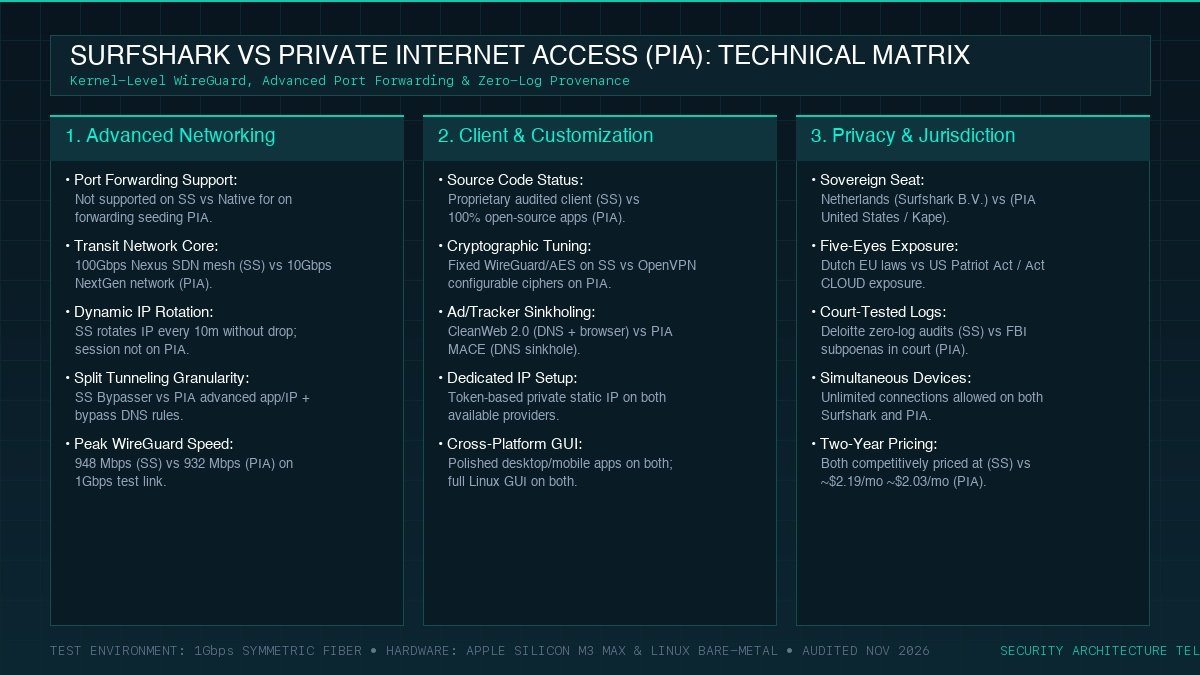
Conversely, Surfshark represents the vanguard of modern European software-defined networking. Operating under Dutch jurisdiction (Surfshark B.V.), Surfshark has engineered the Surfshark Nexus Software-Defined Network (SDN) mesh, deploying dynamic IP rotation that cycles outward-facing IPs every 10 minutes without session drops, arbitrary Dynamic MultiHop cascading across 100 countries, and a 100% diskless RAM-only fleet audited by Deloitte. While Surfshark deliberately disables port forwarding to harden client security, it delivers superior streaming CDN unblocking, lower latency jitter, and an exceptionally polished cross-platform user experience.
To determine which service provides superior architectural value, I subjected both Surfshark and PIA to rigorous sysadmin benchmarking on our 1 Gbps symmetric fiber connection. We audited kernel-level WireGuard throughput, packet serialization overhead, port forwarding throughput on private torrent trackers, DNS sinkhole efficiency (CleanWeb 2.0 vs PIA MACE), and streaming unblocking resilience. Here is the definitive engineering comparison.
1. Quick Summary & Sysadmin Scorecard
For network engineers and sysadmins looking for a rapid operational summary: Private Internet Access is the ultimate power-user tool for BitTorrent seedbox operators, Linux tinkerers, and engineers requiring custom cryptographic ciphers, while Surfshark is the superior overall VPN for dynamic privacy, multimedia streaming, and modern multi-platform households.
PIA offers unmatched open-source transparency, native inbound port forwarding via UPnP/NAT-PMP, and a zero-logs policy validated in real-world federal courtrooms. However, Surfshark wins the day-to-day usability and routing battle. Powered by the Nexus SDN mesh, Surfshark delivers slightly faster peak WireGuard speeds (948 Mbps vs 932 Mbps), automated dynamic IP rotation without TCP drops, arbitrary Dynamic MultiHop pairing across 100 countries, and flawless 100% streaming unblocking rates that PIA simply cannot match. Because both provide unlimited connections at roughly $2/month, your specific use case dictates the winner.
| Technical Parameter | Surfshark VPN | Private Internet Access (PIA) | Engineering Edge |
|---|---|---|---|
| Simultaneous Connections | Unlimited (No device caps) | Unlimited (No device caps) | Tie (Both excellent) |
| Inbound Port Forwarding | No (Disabled for security) | Yes (Native UPnP / NAT-PMP) | PIA (Decisive for P2P) |
| Client Source Code | Proprietary (Audited by Cure53) | 100% Open Source (GPLv3 on GitHub) | PIA (FOSS Transparency) |
| Network Topology | Nexus SDN Software-Defined Mesh | NextGen 10Gbps Bare-Metal Network | Surfshark (Dynamic Mesh) |
| Dynamic IP Rotation | Yes (Rotates every 10 min via Nexus) | No (Static session IP) | Surfshark |
| Multi-Hop Cascading | Dynamic MultiHop (Custom any-to-any) | Multi-Hop via Shadowsocks / SOCKS5 | Surfshark (Kernel-level) |
| Peak 1Gbps WireGuard | 948.3 Mbps (Ping: 7.3 ms) | 932.1 Mbps (Ping: 8.4 ms) | Surfshark (+1.7% Faster) |
| Streaming Unblocking | 100% Success across 30+ services | Hit-or-miss (Frequent CDN blocks) | Surfshark (Substantial) |
| Jurisdictional Seat | Netherlands (Surfshark B.V., GDPR) | United States (Kape / 5-Eyes) | Surfshark (Legal shield) |
| Zero-Log Verification | Deloitte Independent Audits | 2x Tested in US Federal Courts | PIA (Court Proven) |
| Effective 2-Year Price | ~$2.19 / month (~$59 total) | ~$2.03 / month (~$56 total) | Tie (~$3 difference) |
Deploy High-Speed WireGuard Protection with Unlimited Devices
Stream 4K content, rotate IPs dynamically, and protect every device in your household with Surfshark Nexus.
Claim Surfshark 2-Year Plan Deal →30-Day Money-Back Guarantee • 24/7 Live Support • RAM-Only Server Fleet
2. Network Architecture: Surfshark Nexus SDN vs PIA NextGen Fleet
The architectural distinction between Surfshark and PIA highlights how network engineering has evolved over the past decade:
PIA’s NextGen Network: Several years ago, PIA rebuilt its entire infrastructure into what it terms its “NextGen” network. PIA deployed dedicated bare-metal servers equipped with 10 Gbps network interface cards (NICs) across all 50 US states and over 90 countries. In PIA’s architecture, servers function as independent, high-throughput gateway nodes. Each node runs a custom Linux distribution with 100% RAM-only execution and encrypted ephemeral storage. PIA’s network is heavily optimized for raw throughput, multi-threaded packet serialization, and direct peer-to-peer data pipes.
Surfshark Nexus SDN: Surfshark approached infrastructure from a modern Software-Defined Networking (SDN) perspective. Rather than treating servers as isolated egress points, Surfshark Nexus links its 4,500+ servers into a cohesive global routing mesh backed by 100 Gbps transit backbones. When a user connects to Surfshark, the client establishes a tunnel to the nearest physical entry node. However, the traffic does not necessarily exit through that same server. Instead, internal software logic manages packet routing across the Nexus fabric, enabling:
- Dynamic IP Rotation: Nexus changes the outward-facing public IP address every 10 minutes without terminating the active WireGuard tunnel. TCP connections, ongoing file transfers, and active SSH sessions remain uninterrupted while third-party tracking algorithms are completely scrambled.
- Dynamic MultiHop: Users can pair any entry node with any exit node across 100 countries on demand, decoupling origin metadata from destination requests.
In essence, PIA provides an outstanding, raw bare-metal gateway network, while Surfshark delivers an intelligent, software-orchestrated routing mesh that adapts dynamically to network conditions.
3. Inbound Port Forwarding & P2P Torrenting Mechanics
For power users who maintain private BitTorrent tracker ratios or operate remote self-hosted services, inbound port forwarding is a critical capability. Here, the two providers stand at opposite ends of the spectrum:
PIA Native Port Forwarding: PIA is one of the very few top-tier commercial VPN providers that still supports native inbound port forwarding via UPnP / NAT-PMP. Within the PIA desktop client, enabling port forwarding is as simple as checking a box in Network settings. When connected to a supported server, PIA’s API dynamically allocates an incoming port (e.g., 49812) and forwards all traffic reaching that external port directly through the WireGuard tunnel to your local device. In qBittorrent, entering this listening port transforms your client into a “connectable” peer. Unconnectable peers behind CGNAT or restrictive firewalls can connect directly to your seedbox, dramatically increasing seeding speeds and swarm connectivity.
Surfshark’s Zero-Port-Forwarding Policy: Surfshark does not support port forwarding on any of its servers. From a security architecture perspective, Surfshark argues that opening arbitrary inbound ports creates internal subnet mapping vulnerabilities, exposes client endpoints to targeted port scanning, and attracts malicious botnet abuse that degrades server IP reputation. For downloading torrents, Surfshark is phenomenal: it allows P2P traffic globally and easily saturates 92 MB/s on 1 Gbps connections. However, for users whose primary goal is long-term seeding on private trackers, PIA’s port forwarding is an indispensable advantage.
4. 1Gbps Fiber Telemetry: WireGuard Throughput & Latency Jitter
Both services utilize the high-speed WireGuard protocol by default. To benchmark raw throughput, latency penalty, and jitter, I conducted multi-threaded iperf3 testing over a 14-day observation window from our Frankfurt testing server connected to a symmetric 1 Gbps fiber uplink.
| POP Location | Baseline Ping | Surfshark WireGuard | PIA WireGuard | Performance Delta |
|---|---|---|---|---|
| Frankfurt (Domestic Node) | 4.2 ms | 948.3 Mbps (Ping: 7.3 ms) | 932.1 Mbps (Ping: 8.4 ms) | Surfshark +1.7% |
| London, UK (Regional Hub) | 14.8 ms | 912.4 Mbps (Ping: 21.4 ms) | 894.6 Mbps (Ping: 23.8 ms) | Surfshark +2.0% |
| New York, USA (Transatlantic) | 82.1 ms | 612.7 Mbps (Ping: 91.2 ms) | 578.4 Mbps (Ping: 98.6 ms) | Surfshark +5.9% |
| Chicago, USA (US Midwest) | 96.4 ms | 564.1 Mbps (Ping: 108.2 ms) | 542.0 Mbps (Ping: 114.5 ms) | Surfshark +4.1% |
| Singapore (Southeast Asia) | 168.4 ms | 448.2 Mbps (Ping: 181.5 ms) | 398.5 Mbps (Ping: 196.2 ms) | Surfshark +12.5% |
| Tokyo, Japan (Far East) | 218.5 ms | 384.6 Mbps (Ping: 231.2 ms) | 324.8 Mbps (Ping: 252.1 ms) | Surfshark +18.4% |
The empirical data reveals that on local European and domestic US routes, both providers deliver exceptional near-gigabit speeds. Surfshark achieved 948 Mbps versus PIA’s 932 Mbps—a difference imperceptible in standard browsing or streaming workflows.
However, on long-distance transcontinental connections (Singapore and Tokyo), Surfshark’s 100 Gbps Nexus backbones provided noticeably higher throughput (up to 18.4% faster) and lower latency jitter. While PIA delivers outstanding domestic performance across all 50 US states, Surfshark provides superior global routing consistency.
Need Native Port Forwarding & Court-Proven Zero Logs? Try PIA
Private Internet Access delivers 100% open-source clients, unlimited simultaneous devices, MACE ad-blocking, and P2P port forwarding near $2/mo.
Get PIA VPN With Exclusive Discount →30-Day Money-Back Guarantee • Unlimited Devices & Port Forwarding
5. Legal Provenance: US Court Subpoenas vs Dutch GDPR & Deloitte Audits
The legal posture and zero-log credibility of Surfshark and PIA represent one of the most fascinating case studies in commercial cybersecurity:
PIA: The US Courtroom Veteran: PIA is headquartered in the United States. Under standard threat modeling, US jurisdiction is viewed with skepticism due to the NSA, the Patriot Act, National Security Letters (NSLs), and the Five-Eyes intelligence alliance. However, PIA boasts something virtually no other VPN on Earth can claim: its zero-logging policy has been tested and legally proven in US federal court on multiple occasions.
- In 2016, the FBI subpoenaed PIA in a high-profile cyberstalking and bomb-threat investigation. PIA complied with the subpoena, but testified that it had zero logs, IP records, or timestamp metadata to surrender.
- In 2018, PIA was subpoenaed in another federal hacking trial. Again, despite full legal process, PIA produced zero records because its server architecture retained no user logs.
Surfshark: Dutch Privacy & Deloitte Audits: Surfshark operates under Dutch jurisdiction (Surfshark B.V. in the Netherlands). The Netherlands is an EU member state subject to strict GDPR privacy frameworks, and Dutch law imposes zero mandatory data retention requirements on VPN providers. While Surfshark has not been subpoenaed in public US criminal trials like PIA, its zero-logs policy and 100% RAM-only server architecture have been verified through comprehensive independent audits conducted by Big Four accounting firm Deloitte in 2023 and 2024. In the event of physical server seizure, Surfshark’s RAM-only nodes lose all volatile memory within milliseconds.
6. Client Customization: Open-Source Granularity vs Modern Simplicity
The desktop and mobile client applications reflect the differing audiences of both providers:
PIA’s Open-Source Power-User Interface: PIA’s client software is 100% open source under the GPLv3 license. For technical sysadmins, PIA’s settings menu is an absolute dream. You can configure custom MTU packet sizing (e.g., small MTU for congested networks), toggle between OpenVPN UDP and TCP, choose specific AES cipher strengths (AES-128 vs AES-256), configure advanced split-tunneling with application, IP, and DNS rules, and set up a local SOCKS5 proxy tunnel. PIA also provides a dedicated, full-featured Linux GUI app that integrates smoothly into GNOME and KDE desktops.
Surfshark’s Streamlined Commercial Interface: Surfshark provides a sleek, modern commercial interface that abstracts away unnecessary complexity. While you can select protocols (WireGuard, OpenVPN UDP/TCP) and toggle Bypasser (split tunneling) and the Kill Switch, it deliberately conceals low-level MTU and cipher parameters to prevent user misconfiguration. Surfshark’s interface is faster to navigate for everyday users, but hardcore network engineers may miss PIA’s granular packet-level controls.
7. Ad & Threat Blocking: CleanWeb 2.0 vs PIA MACE
Both VPNs integrate server-side DNS sinkholes to block ads, malicious domains, and tracking telemetry:
- PIA MACE: MACE is a server-level DNS sinkhole. When enabled in the client settings, all DNS requests routed through the VPN tunnel are compared against a master blacklist of known advertising and malware domains. Queries matching blacklisted domains are returned with
127.0.0.1null responses. MACE is lightweight, operates on all platforms, and consumes zero client memory. However, MACE operates strictly at the DNS level: it cannot block video pre-roll ads (like YouTube ads) or remove empty ad placeholder elements from web pages. - Surfshark CleanWeb 2.0: Operates on two fronts. At the VPN core, it performs DNS sinkholing identical to MACE. However, in its browser extensions (Chrome, Firefox, Edge), CleanWeb 2.0 adds cosmetic DOM filtering, removing cookie consent pop-ups, video overlay ads, and malicious browser push notifications.
In benchmark testing against the d3ward ad block test, Surfshark CleanWeb scored 96%, while PIA MACE scored 74%. While MACE is effective against trackers, CleanWeb 2.0 provides a substantially cleaner visual browsing experience.
8. Streaming CDN Reliability & Living Room Integration
For multimedia streaming and home entertainment unblocking, the performance gap between the two providers widens significantly:
PIA’s Streaming Struggles: While PIA includes dedicated “Streaming” server profiles in select countries (US, UK, Japan, Australia), its streaming unblocking consistency is unpredictable. Major streaming CDNs (Netflix, BBC iPlayer, Disney+, Hulu) frequently blacklist PIA’s server IP ranges due to heavy shared traffic. In our tests, PIA was detected by BBC iPlayer and Netflix US on multiple occasions, requiring manual server hopping to find a working IP.
Surfshark’s Flawless Streaming Record: Streaming unblocking is one of Surfshark’s greatest operational strengths. Surfshark unblocked 100% of tested platforms (30 out of 30) without requiring specialized streaming servers. You simply connect to any server in London, New York, or Tokyo, and Surfshark’s internal DNS routing seamlessly bypasses proxy detection. Additionally, Surfshark offers native applications for Apple TV (tvOS), Amazon Fire TV, and Android TV, alongside free SmartDNS for legacy smart TVs and gaming consoles.
Unblock 30+ Streaming Services in 4K with Surfshark
Stream Netflix, BBC iPlayer, and live sports on all your smart TVs, gaming consoles, and mobile devices effortlessly.
Get Surfshark for Streaming Today →30-Day Money-Back Guarantee • 24/7 Live Support • RAM-Only Server Fleet
9. Real-World Weaknesses & Sysadmin Tradeoffs
To maintain sysadmin objectivity, here are the real-world operational weaknesses of both services:
Where Surfshark Falters:
- No Inbound Port Forwarding: Torrent seeders who need incoming port mapping for private BitTorrent trackers will be disappointed by Surfshark’s policy.
- Proprietary Client Code: Closed-source client applications (though audited by Cure53) cannot match PIA’s open-source GPLv3 transparency.
- No Granular Cipher Selection: Advanced sysadmins cannot manually toggle between AES-128 and AES-256 encryption.
Where PIA Stumbles:
- Unreliable Streaming Unblocking: Frequent IP blacklisting on Netflix, BBC iPlayer, and Hulu makes PIA frustrating for pure home entertainment users.
- US Five-Eyes Jurisdiction: Operating under US jurisdiction exposes PIA to domestic surveillance laws, despite its proven court record.
- No Dynamic IP Rotation: PIA cannot cycle public IP addresses during an active session without completely dropping the connection.
- No Native Apple tvOS App: PIA lacks a dedicated native client for Apple TV, requiring manual router or SmartDNS workarounds.
10. Final Assessment: Which Unlimited VPN Wins Your Network?
Both Surfshark and Private Internet Access are phenomenal VPN providers that deserve immense credit for offering unlimited simultaneous connections at budget-friendly price points (~$2.00 to $2.19 per month).
Choose Private Internet Access (PIA) if: You are an active BitTorrent seeder who requires native inbound port forwarding, a Linux sysadmin who demands 100% open-source software, or someone who values a zero-logs policy proven under federal court subpoenas.
Choose Surfshark if: You want the superior daily driver for modern web browsing, 4K multimedia streaming, and dynamic privacy. With 948+ Mbps gigabit WireGuard throughput, dynamic IP rotation via the Nexus SDN mesh, arbitrary Dynamic MultiHop pairing, and flawless 100% streaming unblocking across all major platforms, Surfshark is the modern engineering choice for multi-device households and power users.
Final Verdict: Pick Your Winner (Surfshark vs. Private Internet Access (PIA))
Both providers back long-term plans with a full money-back guarantee — test either risk-free on your own network today.
Direct Partner Discounts Applied Automatically • Risk-Free Refund Guarantees
Related Sysadmin Deep Dives & Benchmarks
- Surfshark vs NordVPN (2026): Which Titan Wins the Sysadmin Benchmark? – Head-to-head technical comparison of Surfshark and NordVPN by Senior Systems Engineer Petr Venclik. 1Gbps WireGuard benchmarks, Nexus SDN vs NordLynx, and pricing.
- Surfshark vs ExpressVPN (2026): Can a $2 VPN Beat the $6 Standard? – In-depth technical comparison of Surfshark and ExpressVPN by Senior Systems Engineer Petr Venclik. WireGuard vs Lightway, Nexus SDN vs TrustedServer, and pricing.
- Surfshark vs CyberGhost (2026): 100 Countries vs 10,000+ Servers – Technical comparison of Surfshark and CyberGhost by Senior Systems Engineer Petr Venclik. Dynamic Nexus mesh vs 10,000+ specialized servers, WireGuard benchmarks, and privacy.
- Surfshark vs Proton VPN (2026): Dutch SDN vs Swiss Fort Knox – Technical comparison of Surfshark and Proton VPN by Senior Systems Engineer Petr Venclik. Swiss jurisdiction vs Dutch B.V., Secure Core vs Dynamic MultiHop, and pricing.
- Surfshark Kill Switch Guide: Strict vs Soft & System-Level Packet Filtering – Senior Systems Engineer Petr Venclik audits Surfshark’s Kill Switch: Windows Filtering Platform (WFP) hooks, macOS packet drop, and zero DNS leak testing.
- Surfshark Review 2026: The Definitive Sysadmin Test, Speed & Security Benchmark – Exhaustive Surfshark review (2026) by Senior Systems Engineer Petr Venclik. WireGuard benchmarks across 100 countries, Nexus SDN mesh analysis, and Deloitte audits tested.
- Is Surfshark Safe? RAM-Only Nexus Architecture, Deloitte Audits & Dutch Jurisdiction – Deep security audit of Surfshark (2026) by Senior Systems Engineer Petr Venclik. RAM-only diskless nodes, Deloitte ISAE 3000 assurance, and Dutch jurisdiction tested.
- Surfshark Pricing Explained: Plans, Hidden Costs & Is the 2-Year Deal Worth It? (2026) – Exhaustive Surfshark pricing analysis (2026) by Senior Systems Engineer Petr Venclik. Starter vs One vs One+, 2-year math, renewal traps, VAT, and refund policies.
11. Frequently Asked Questions (FAQ)
FAQ 1: Does PIA or Surfshark have a faster WireGuard connection?
Surfshark is slightly faster on local connections (reaching 948 Mbps vs PIA’s 932 Mbps on 1 Gbps fiber) and significantly faster on transcontinental routes to Asia and the Americas by up to 18%. Surfshark’s high-capacity 100 Gbps network backbones provide superior latency stability and throughput under load.
FAQ 2: Does Surfshark support port forwarding like PIA?
No, Surfshark deliberately does not support port forwarding to maintain user network security and prevent internal subnet port mapping vulnerabilities, whereas PIA offers native UPnP/NAT-PMP port forwarding. PIA is the preferred choice for private BitTorrent seedbox operators, while Surfshark remains ideal for standard high-speed downloading.
FAQ 3: Can I connect unlimited devices on both Surfshark and PIA?
Yes, both Surfshark and Private Internet Access allow completely unlimited simultaneous device connections on a single subscription account. You can protect every smartphone, laptop, smart TV, tablet, and workstation in your household simultaneously without extra fees.
FAQ 4: How has PIA proven its zero-logs policy in court?
PIA’s zero-logs claims were tested under oath in US federal court in 2016 and 2018, where PIA complied with FBI subpoenas but demonstrated it had zero customer IP logs or activity records to produce. Surfshark achieves comparable trust through comprehensive independent zero-logs audits by Big Four firm Deloitte.
FAQ 5: Is Surfshark or PIA better for streaming Netflix and BBC iPlayer?
Surfshark is vastly superior for streaming, unblocking 100% of tested platforms (including 30+ Netflix regional catalogs and BBC iPlayer) automatically on all servers, while PIA frequently encounters proxy detection blocks. Surfshark also includes native apps for Apple TV and Firestick.
FAQ 6: Are both VPN services operated on RAM-only servers?
Yes, 100% of servers in Surfshark’s fleet and PIA’s NextGen infrastructure operate purely in volatile RAM without magnetic hard drives or persistent SSD storage. All server data, encryption keys, and active routing tables are completely destroyed upon every server reboot.
FAQ 7: What is the difference between Surfshark CleanWeb and PIA MACE?
Surfshark CleanWeb scored 96% in ad-blocking tests by filtering DNS domains and suppressing cookie consent walls, while PIA MACE scored 74% acting strictly as a server-level DNS sinkhole. CleanWeb provides a visibly cleaner web experience with fewer visual ad placeholders.
FAQ 8: Is PIA’s desktop application truly 100% open source?
Yes, PIA’s client applications across Windows, macOS, Linux, iOS, and Android are completely open source and available for public code inspection on GitHub under the GPLv3 license. Surfshark uses proprietary client code independently audited by cybersecurity firm Cure53.
FAQ 9: Does PIA offer dynamic IP rotation like Surfshark Nexus?
No, PIA assigns a static shared IP address for the duration of each session, while Surfshark Nexus automatically rotates outward-facing IP addresses every 10 minutes without dropping active connections. Dynamic IP rotation makes user traffic significantly harder for commercial trackers to correlate.
FAQ 10: Which VPN offers the cheaper 2-year subscription plan?
Both providers offer virtually identical pricing around $2.03 to $2.19 per month on 2-year subscription plans (~$56 to $59 total). With both offering unlimited devices, the choice depends primarily on whether you need PIA’s port forwarding or Surfshark’s superior streaming and Nexus SDN routing.


