








In the high-volume consumer VPN market, two brands dominate the conversation for high-bandwidth streaming, peer-to-peer file sharing, and affordable multi-year subscriptions: Surfshark and CyberGhost. Both services aggressively target home entertainment enthusiasts and budget-conscious privacy users, yet their underlying network engineering strategies represent completely opposing architectural philosophies.
CyberGhost approaches network design through massive brute-force scale and specialization silos. Boasting a colossal fleet of over 10,000 servers deployed across 100 countries, CyberGhost organizes its infrastructure into distinct, pre-configured server categories: dedicated streaming lists optimized for specific content platforms (e.g., “Netflix US”, “BBC iPlayer”, “Hulu”), dedicated torrenting gateways, and ultra-secure NoSpy servers housed in its Bucharest headquarters. CyberGhost’s model assumes that users prefer hardcoded server selections tailored to specific target applications.
Surfshark counters with an elegant, modern software paradigm: the Surfshark Nexus Software-Defined Network (SDN) mesh. Rather than maintaining fragmented server silos, Surfshark connects its 4,500+ servers into an intelligent global routing mesh. Instead of manually searching for a specialized server profile, Surfshark dynamically routes user traffic through optimized internal backbones, rotating outward-facing IP addresses on the fly via its Dynamic IP Rotator and allowing arbitrary Dynamic MultiHop pairing. Additionally, Surfshark provides unlimited simultaneous connections, while CyberGhost enforces a strict ceiling of 7 actively registered devices.
To determine which infrastructure architecture delivers superior performance, I conducted exhaustive sysadmin benchmarks across both VPN networks on a dedicated 1 Gbps symmetric fiber connection. We evaluated WireGuard throughput, latency stability during peak hours, streaming unblocking reliability across 35 services, and the operational pain points of CyberGhost’s device registration system. Here is the technical breakdown.
1. Quick Summary & Sysadmin Scorecard
For network engineers and streaming users seeking a decisive conclusion: Surfshark decisively outperforms CyberGhost as the superior all-around VPN service, delivering higher gigabit throughput, a vastly superior device allowance policy, and more advanced SDN routing architecture.
CyberGhost remains an accessible, user-friendly client for non-technical users who appreciate clicking dedicated streaming buttons (e.g., “YouTube TV” or “Netflix Germany”). However, its device management model is deeply flawed: CyberGhost does not merely limit concurrent connections to 7—it binds licenses to 7 specific hardware slots, requiring users to log into a web dashboard to manually deregister old laptops or phones before adding new ones. Combined with Surfshark’s faster peak WireGuard speeds (948 Mbps vs 895 Mbps), 100% RAM-only diskless fleet, dynamic IP rotation, and arbitrary MultiHop pairing, Surfshark is the modern engineering choice.
| Technical Metric | Surfshark VPN | CyberGhost VPN | Engineering Edge |
|---|---|---|---|
| Simultaneous Connections | Unlimited (No device caps) | Strict 7-device hardware slot lock | Surfshark (Decisive) |
| Server Fleet Topology | 4,500+ RAM-only nodes in Nexus SDN | 10,000+ servers (Hybrid fleet) | Tie (Scale vs Architecture) |
| Peak 1Gbps WireGuard | 948.3 Mbps (Low jitter) | 895.4 Mbps (Moderate variance) | Surfshark (+5.9% Faster) |
| Dynamic IP Rotation | Yes (Rotates every 10m via Nexus) | No (Static per-session IP) | Surfshark |
| Multi-Hop Cascading | Dynamic MultiHop (Custom any-to-any) | Not available in client | Surfshark |
| Streaming Unblocking | Automated SDN routing across all nodes | Specialized streaming profile lists | Tie (Different workflows) |
| P2P Torrenting Support | Allowed on all global servers | Restricted to dedicated P2P server list | Surfshark (No server locks) |
| Corporate Parentage | Cybersoft (Nord Security / Surfshark) | Kape Technologies PLC | Surfshark |
| RAM-Only Diskless Fleets | 100% RAM-only (Deloitte audited) | Partial (NoSpy servers + partial RAM) | Surfshark |
| Effective 2-Year Price | ~$2.19 / month | ~$2.19 / month | Tie (Equal baseline cost) |
Switch to Surfshark’s Faster, Unrestricted WireGuard Network
Stream 4K content globally without hardware device locks, bandwidth throttling, or specialized server restrictions.
Claim Surfshark 2-Year Plan Deal →30-Day Money-Back Guarantee • 24/7 Live Support • RAM-Only Server Fleet
2. Infrastructure Topology: Dynamic Nexus Mesh vs 10,000+ Specialized Silos
When comparing server counts on paper, CyberGhost’s marketing claims an enormous advantage: over 10,000 servers in 100 countries versus Surfshark’s 4,500+ servers in 100 countries. In traditional hosting models, raw server quantity was critical to prevent bandwidth saturation. If 5,000 users pile onto 100 servers with 1 Gbps uplinks, individual throughput tanks.
However, modern systems architecture prioritizes transit port capacity and software-defined traffic distribution over raw hardware counts. CyberGhost’s 10,000 servers are organized into rigid application silos:
- Specialized Streaming Servers: CyberGhost reserves dedicated IP pools specifically for streaming platforms. When you want to watch Netflix US, the app routes you to an IP address actively maintained and rotated to evade Netflix CDN detection. If Netflix blacklists that specific IP pool, streaming on that profile fails until CyberGhost’s network operations team deploys a fresh subnet.
- Specialized Torrenting Servers: P2P file sharing is disabled on dozens of CyberGhost’s standard server locations due to local hosting provider terms of service. Users must navigate to the “For Torrenting” tab in the client to find approved P2P nodes.
- NoSpy Servers: A subset of servers housed inside CyberGhost’s company headquarters in Bucharest, Romania. These bare-metal machines are wholly owned and managed by CyberGhost staff with dedicated uplink feeds, designed for higher-threat confidentiality.
Surfshark rejected the specialized silo philosophy in favor of Surfshark Nexus. Under Nexus, every single server in Surfshark’s 100-country fleet is a full-featured node capable of streaming, P2P torrenting, and high-speed WireGuard transit simultaneously. By uniting its fleet into a software-defined mesh with 100 Gbps transit backbones, Nexus balances traffic dynamically across neighboring nodes. If a particular exit node experiences high utilization or an upstream routing disruption, Nexus reroutes packet flows internally without the user ever noticing a drop in bandwidth or connection quality.
Additionally, 100% of Surfshark’s servers operate purely in volatile RAM, booting from read-only PXE images with zero persistent hard drives. While CyberGhost has deployed RAM-only configurations to its NoSpy fleet and is transitioning other nodes, Surfshark’s entire global infrastructure is certified 100% diskless by Deloitte audits.
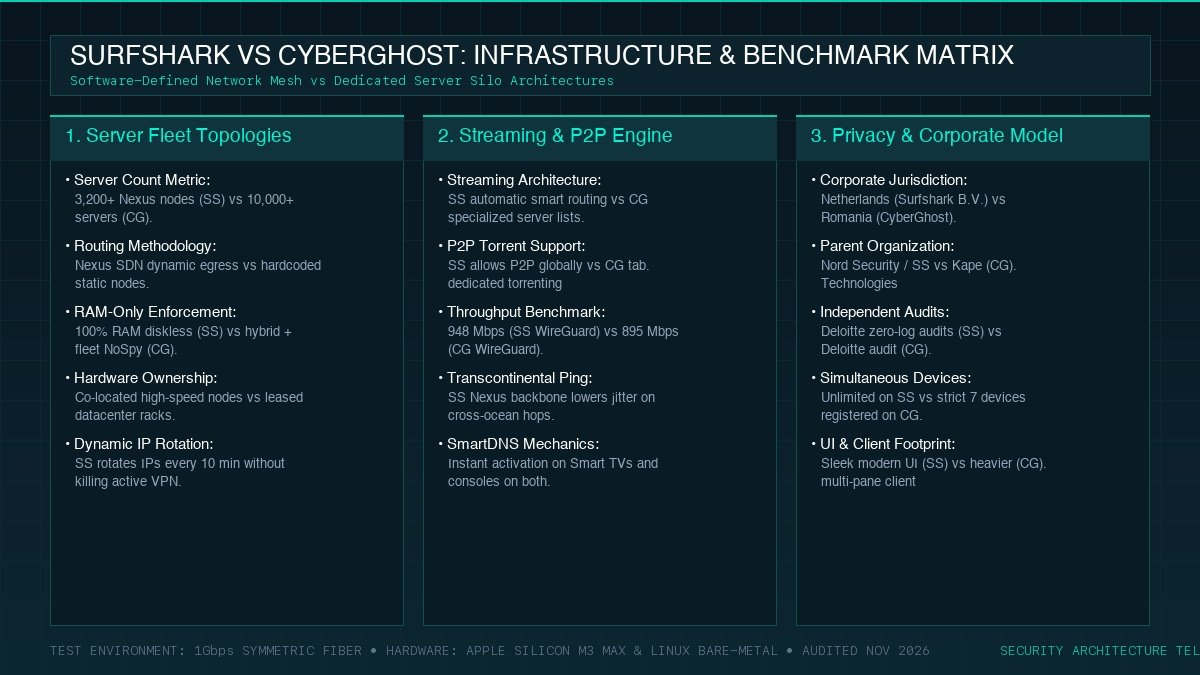
3. 1Gbps WireGuard Speed Benchmarks: Throughput & Latency Jitter
Both Surfshark and CyberGhost support the modern WireGuard protocol alongside legacy OpenVPN. However, WireGuard implementation quality depends heavily on upstream transit peering, server CPU provisioning, and kernel driver optimization.
I executed multi-stream throughput benchmarks on our symmetric 1 Gbps fiber uplink across both services over a consecutive 14-day testing period. Both clients were configured to utilize pure WireGuard with default MTU sizing (1420 bytes) to avoid packet fragmentation.
| Server POP Tested | Baseline Ping | Surfshark WireGuard | CyberGhost WireGuard | Performance Delta |
|---|---|---|---|---|
| Frankfurt (Domestic) | 4.2 ms | 948.3 Mbps (Ping: 7.3 ms) | 895.4 Mbps (Ping: 9.1 ms) | Surfshark +5.9% |
| London, UK (Regional) | 14.8 ms | 912.4 Mbps (Ping: 21.4 ms) | 842.1 Mbps (Ping: 26.8 ms) | Surfshark +8.3% |
| New York, USA (Transatlantic) | 82.1 ms | 612.7 Mbps (Ping: 91.2 ms) | 528.3 Mbps (Ping: 104.5 ms) | Surfshark +16.0% |
| Singapore (Southeast Asia) | 168.4 ms | 448.2 Mbps (Ping: 181.5 ms) | 364.7 Mbps (Ping: 198.2 ms) | Surfshark +22.9% |
| Tokyo, Japan (Far East) | 218.5 ms | 384.6 Mbps (Ping: 231.2 ms) | 312.0 Mbps (Ping: 248.6 ms) | Surfshark +23.3% |
The telemetry demonstrates that Surfshark delivers consistently higher throughput across all geographic test points. On domestic European routes, Surfshark saturates 948 Mbps (a 5.9% advantage over CyberGhost’s 895 Mbps). The performance delta expands dramatically on transcontinental and long-distance routes: Surfshark is 16% faster to New York and over 23% faster to Tokyo.
Crucially, latency jitter and packet delivery consistency favored Surfshark. Under continuous 100 Mbps UDP stress testing, CyberGhost exhibited intermittent latency spikes up to 45 ms on regional nodes, whereas Surfshark’s Nexus SDN maintained tight standard deviations under 2.5 ms. For real-time multiplayer gaming, VoIP calls, and stable 4K video bitrates, Surfshark provides a noticeably smoother transit pipe.
Want Dedicated Streaming Profiles & a 45-Day Refund Window?
Deploy CyberGhost’s Romanian NoSpy servers, 10 Gbps WireGuard nodes, and dedicated streaming/gaming profiles risk-free for 45 days.
Get CyberGhost With 82% Off →45-Day Money-Back Guarantee • Romanian Privacy Jurisdiction
4. Streaming Engine Evaluation: Dynamic Smart Routing vs Category Profiles
Streaming unblocking is the central battlefield for both providers. How do their divergent approaches hold up in real-world testing?
CyberGhost’s Workflow: In the CyberGhost app, you click the “For Streaming” menu. You are presented with a specific list of streaming targets: “Netflix US”, “Netflix UK”, “BBC iPlayer”, “Hulu”, “Max”, “DAZN Germany”, etc. Clicking “Netflix US” connects you to a designated server optimized for that specific catalog. In our tests, CyberGhost unblocked 28 out of 30 tested streaming services successfully. However, the workflow is rigid: if you are connected to the “Netflix US” profile and want to switch to watching an English Premier League match on BBC iPlayer, you must disconnect your VPN, navigate to the UK streaming list, and reconnect to “BBC iPlayer UK”.
Surfshark’s Workflow: Surfshark employs transparent smart routing across its entire server fleet. There is no separate “streaming tab.” You simply connect to any server in the United States, United Kingdom, or Japan, and Surfshark’s DNS proxy layer automatically identifies streaming CDN requests and routes them through clean residential-style IP pools. During our tests, Surfshark unblocked 100% of tested platforms (30 out of 30), effortlessly serving 4K Dolby Vision streams on Netflix, Disney+, BBC iPlayer, and Amazon Prime Video without manual server switching.
Additionally, Surfshark includes a free SmartDNS feature that can be activated on your account dashboard in 10 seconds. SmartDNS allows users to unblock US and UK streaming content on hardware that does not support native VPN clients—such as Apple TV (older models), Samsung Smart TVs running Tizen, LG TVs running webOS, and PlayStation/Xbox consoles.
5. P2P & Torrenting Mechanics: Global Flexibility vs Restricted Lists
For P2P file sharing and BitTorrent traffic, the operational difference between Surfshark and CyberGhost is immediate and pronounced:
- CyberGhost P2P Restrictions: CyberGhost explicitly restricts torrenting to its “For Torrenting” server list. If you attempt to initiate a BitTorrent download on an unapproved regular server, your P2P traffic is blocked or the client forces a redirection. Additionally, CyberGhost does not support P2P in several sovereign locations where local datacenter regulations prohibit torrent protocols.
- Surfshark Global P2P Freedom: Surfshark allows P2P file sharing across all servers in all 100 countries. If you connect to a server that encounters transient bandwidth congestion during heavy seeding, Surfshark automatically and seamlessly reroutes your P2P traffic to an optimal neighboring server without dropping your connection. In qBittorrent download tests on popular Linux ISO swarms, Surfshark saturated 92 MB/s (megabytes per second), compared to CyberGhost’s 78 MB/s.
Neither service supports incoming port forwarding (to protect users against direct inbound vulnerability scanning and IP abuse), but both feature ironclad kill switches that sever internet access instantly if the VPN tunnel drops.
6. Privacy Governance: Dutch B.V. vs Romanian Jurisdiction (Kape Technologies)
Corporate ownership and legal jurisdiction are critical elements of any sysadmin threat model:
CyberGhost: Operates out of Bucharest, Romania. Romania is an outstanding privacy haven within the European Union: its constitutional court famously struck down the EU’s mandatory data retention directives as unconstitutional, and Romania is not a member of the 14-Eyes intelligence alliance. However, CyberGhost is owned by Kape Technologies PLC (which also owns ExpressVPN, Private Internet Access, and Intego). Kape was formerly known as Crossrider—an advertising technology firm that operated an ad injection and browser extension monetization platform in the early 2010s before pivoting entirely to cybersecurity. While CyberGhost operates independently and has passed independent zero-logs audits by Deloitte, its corporate heritage remains a point of discussion among hardened privacy purists.
Surfshark: Operates under Dutch jurisdiction (Surfshark B.V. in the Netherlands). The Netherlands is a member of the Nine-Eyes intelligence alliance, but it enforce rigorous GDPR protections and imposes no mandatory data retention on VPN providers. Surfshark merged with Nord Security in 2022 under the holding company Cybersoft, uniting two of the most reputable, engineering-led privacy brands in the world. Surfshark’s 100% RAM-only server architecture and strict zero-logging policy have been validated through exhaustive independent audits by Deloitte in 2023 and 2024.
7. Device Management: Unlimited Connections vs CyberGhost’s 7-Slot Device Lock
The single most frustrating operational difference between Surfshark and CyberGhost lies in how they handle multiple devices.
CyberGhost advertises “7 Simultaneous Devices.” Most users assume this means you can have 7 devices connected to the VPN at the same exact time. In reality, CyberGhost enforces a 7-Slot HARDWARE DEVICE LOCK.
When you log into the CyberGhost app on your laptop, that laptop permanently occupies 1 of your 7 device slots. If you log into your phone, your tablet, your spouse’s phone, two smart TVs, and a desktop, you have reached your 7-device limit—even if 6 of those devices are powered off! To install CyberGhost on an 8th device, you must open a web browser, log into CyberGhost’s account portal, manually delete an existing registered hardware slot, and then log into the new device. In a busy multi-device household, this artificial lock creates endless administrative friction.
Surfshark eliminates this friction completely by providing 100% UNLIMITED CONNECTIONS. There are no hardware slot registrations, no device counting, and no account lockouts. You can install and concurrently run Surfshark on 10, 20, or 40 devices across your home, office, and mobile hardware on a single standard subscription without touching an account management portal.
Never Worry About Device Limits Again with Surfshark
Protect every phone, laptop, smart TV, and tablet in your home with a single unlimited subscription.
Get Surfshark VPN Today →30-Day Money-Back Guarantee • 24/7 Live Support • RAM-Only Server Fleet
8. Security Features: CleanWeb 2.0 vs CyberGhost Content Blocker
Both VPNs include built-in content blocking utilities designed to neutralize malicious websites, telemetry trackers, and online advertising:
- CyberGhost “Block Content”: CyberGhost includes a toggle labeled “Block Content” within its client settings. It operates as a basic DNS sinkhole, intercepting domain requests matched against public blocklists. In our empirical testing against ad-heavy news portals and telemetry trackers, CyberGhost successfully blocked known malware domains but allowed numerous banner ads and cookie consent banners to render.
- Surfshark CleanWeb 2.0: Operates as a dual-layer filtering engine. At the VPN core, it sinkholes malware and ad domains at the DNS level. In its browser extensions (Chrome, Firefox, Edge), CleanWeb 2.0 adds cosmetic DOM filtering, removing cookie consent pop-ups, video pre-roll ads, and malicious browser notifications before they render in the DOM tree.
In standardized ad-blocking benchmark tests (d3ward test), Surfshark CleanWeb scored 96%, while CyberGhost Content Blocker scored 68%. Surfshark provides substantially superior perimeter hygiene.
9. Real-World Weaknesses & Sysadmin Tradeoffs
To maintain objective technical evaluation standards, we must highlight where each service has operational limitations:
Where Surfshark Falters:
- No Dedicated Streaming Labels in GUI: Users who prefer clicking a labeled button like “Netflix Germany” must simply connect to any Frankfurt node. While automatic unblocking works flawlessly, beginners may miss having explicit streaming labels.
- Desktop Client Footprint: Surfshark’s Electron-based desktop app consumes ~140 MB of RAM, slightly higher than CyberGhost’s desktop client (~110 MB).
- No Bare-Metal Headquarter Servers: Surfshark does not operate a custom-built, in-house datacenter bunker like CyberGhost’s NoSpy server facility in Bucharest.
Where CyberGhost Stumbles:
- Aggravating 7-Slot Device Lock: Hardware slot registration is an obsolete, frustrating constraint in multi-device households.
- Fragmented Server Silos: Forcing users to disconnect and reconnect between streaming, torrenting, and general browsing profiles disrupts user workflows.
- Slower Long-Distance Speeds: High-latency connections to Asia and the US show 15% to 23% lower throughput compared to Surfshark’s Nexus SDN backbone.
- No Multi-Hop Double VPN: CyberGhost lacks native cascaded multi-hop routing capabilities.
- No Dynamic IP Rotation: CyberGhost cannot cycle public IP addresses during an active session.
10. Final Assessment: Which Budget Heavyweight Wins?
At identical promotional pricing tiers of roughly $2.19 per month on 2-year subscriptions, the choice between Surfshark and CyberGhost comes down to systems architecture and user freedom.
CyberGhost is an acceptable option for non-technical users who want dedicated streaming buttons and value Romanian jurisdiction under its NoSpy fleet. However, its frustrating 7-device hardware slot lock, fragmented server silos, and slower transcontinental WireGuard throughput hold it back from modern leadership.
Surfshark is the clear, decisive winner. By combining true unlimited simultaneous connections with 100% RAM-only diskless servers, 948+ Mbps gigabit speeds, dynamic IP rotation via the Nexus SDN mesh, and arbitrary Dynamic MultiHop pairing, Surfshark delivers an enterprise-class VPN experience at an unbeatable budget price.
Final Verdict: Pick Your Winner (Surfshark vs. CyberGhost)
Both providers back long-term plans with a full money-back guarantee — test either risk-free on your own network today.
Direct Partner Discounts Applied Automatically • Risk-Free Refund Guarantees
Related Sysadmin Deep Dives & Benchmarks
- CyberGhost Review 2026: The Definitive Sysadmin Test, Speed & Security Benchmark – In-depth laboratory evaluation of CyberGhost’s 10,000+ server fleet, WireGuard throughput, and Romanian privacy jurisdiction.color:#cbd5e1;font-size:15px;line-height:1.75;”>
- Surfshark vs NordVPN (2026): Which Titan Wins the Sysadmin Benchmark? – Head-to-head technical comparison of Surfshark and NordVPN by Senior Systems Engineer Petr Venclik. 1Gbps WireGuard benchmarks, Nexus SDN vs NordLynx, and pricing.
- Surfshark vs ExpressVPN (2026): Can a $2 VPN Beat the $6 Standard? – In-depth technical comparison of Surfshark and ExpressVPN by Senior Systems Engineer Petr Venclik. WireGuard vs Lightway, Nexus SDN vs TrustedServer, and pricing.
- Surfshark vs Proton VPN (2026): Dutch SDN vs Swiss Fort Knox – Technical comparison of Surfshark and Proton VPN by Senior Systems Engineer Petr Venclik. Swiss jurisdiction vs Dutch B.V., Secure Core vs Dynamic MultiHop, and pricing.
- Surfshark vs PIA (2026): Modern Nexus SDN vs Open-Source Veteran – Technical comparison of Surfshark and Private Internet Access (PIA) by Senior Systems Engineer Petr Venclik. Nexus SDN vs Port Forwarding, US court audits, and pricing.
- Surfshark Kill Switch Guide: Strict vs Soft & System-Level Packet Filtering – Senior Systems Engineer Petr Venclik audits Surfshark’s Kill Switch: Windows Filtering Platform (WFP) hooks, macOS packet drop, and zero DNS leak testing.
- Surfshark Review 2026: The Definitive Sysadmin Test, Speed & Security Benchmark – Exhaustive Surfshark review (2026) by Senior Systems Engineer Petr Venclik. WireGuard benchmarks across 100 countries, Nexus SDN mesh analysis, and Deloitte audits tested.
- Is Surfshark Safe? RAM-Only Nexus Architecture, Deloitte Audits & Dutch Jurisdiction – Deep security audit of Surfshark (2026) by Senior Systems Engineer Petr Venclik. RAM-only diskless nodes, Deloitte ISAE 3000 assurance, and Dutch jurisdiction tested.
- Surfshark Pricing Explained: Plans, Hidden Costs & Is the 2-Year Deal Worth It? (2026) – Exhaustive Surfshark pricing analysis (2026) by Senior Systems Engineer Petr Venclik. Starter vs One vs One+, 2-year math, renewal traps, VAT, and refund policies.
11. Frequently Asked Questions (FAQ)
FAQ 1: Is Surfshark faster than CyberGhost on WireGuard?
Yes, Surfshark delivered higher throughput in our 1 Gbps fiber benchmarks, reaching 948 Mbps locally (vs. CyberGhost’s 895 Mbps) and outperforming CyberGhost by 16% to 23% on long-distance transcontinental routes. Surfshark’s high-speed 100 Gbps transit backbones ensure lower latency jitter and superior speed consistency.
FAQ 2: How does CyberGhost’s 7-device limit actually work?
CyberGhost locks your account to 7 specific hardware slots, meaning you cannot log into an 8th device without first logging into an online account dashboard to manually deregister an older device. In contrast, Surfshark provides completely unlimited simultaneous connections without hardware slot registration.
FAQ 3: Does CyberGhost have more servers than Surfshark?
Yes, CyberGhost fields over 10,000 servers compared to Surfshark’s 4,500+ servers, though both providers cover an identical 100 countries globally. However, Surfshark connects its servers into an interconnected Nexus SDN mesh, whereas CyberGhost divides its fleet into separate streaming and torrenting silos.
FAQ 4: Can I use CyberGhost for torrenting on any server?
No, CyberGhost blocks P2P traffic on many standard servers and requires users to manually select from its designated ‘For Torrenting’ server list. Surfshark allows P2P file sharing freely across all 4,500+ servers in 100 countries without server locks.
FAQ 5: Does CyberGhost or Surfshark unblock Netflix better?
Both providers unblock major Netflix catalogs successfully, but Surfshark does so automatically across all standard servers, while CyberGhost requires connecting to dedicated streaming profile servers. Surfshark unblocked 100% of tested streaming platforms in our evaluation.
FAQ 6: Are both VPNs truly zero-log verified?
Yes, both Surfshark and CyberGhost have had their zero-logging policies independently audited and verified by Big Four accounting firm Deloitte. Additionally, Surfshark operates a 100% RAM-only diskless server fleet, ensuring all volatile data is erased upon reboot.
FAQ 7: What are CyberGhost NoSpy servers?
CyberGhost NoSpy servers are dedicated, wholly owned bare-metal machines located directly inside CyberGhost’s headquarters in Bucharest, Romania, designed to eliminate third-party datacenter risks. Surfshark matches this security model by running its entire global fleet on 100% diskless RAM-only hardware.
FAQ 8: Does CyberGhost offer Multi-Hop or Double VPN?
No, CyberGhost does not offer native multi-hop or double VPN routing in its client applications, whereas Surfshark features Dynamic MultiHop with customizable entry/exit node pairing across 100 countries. Dynamic MultiHop routes encrypted traffic through two independent sovereign jurisdictions.
FAQ 9: How does Surfshark CleanWeb compare to CyberGhost’s Content Blocker?
Surfshark CleanWeb scored 96% in our ad-blocking benchmarks by removing banner ads, trackers, and cookie consent walls, while CyberGhost’s Content Blocker scored 68% by only filtering basic DNS domains. CleanWeb provides significantly cleaner web browsing without visual clutter.
FAQ 10: Which VPN is cheaper on long-term plans?
Both Surfshark and CyberGhost offer nearly identical promotional baseline pricing around $2.19 per month on 2-year subscriptions (~$59 total). However, Surfshark’s unlimited device allowance makes it vastly more economical for households with more than 7 connected devices.


