








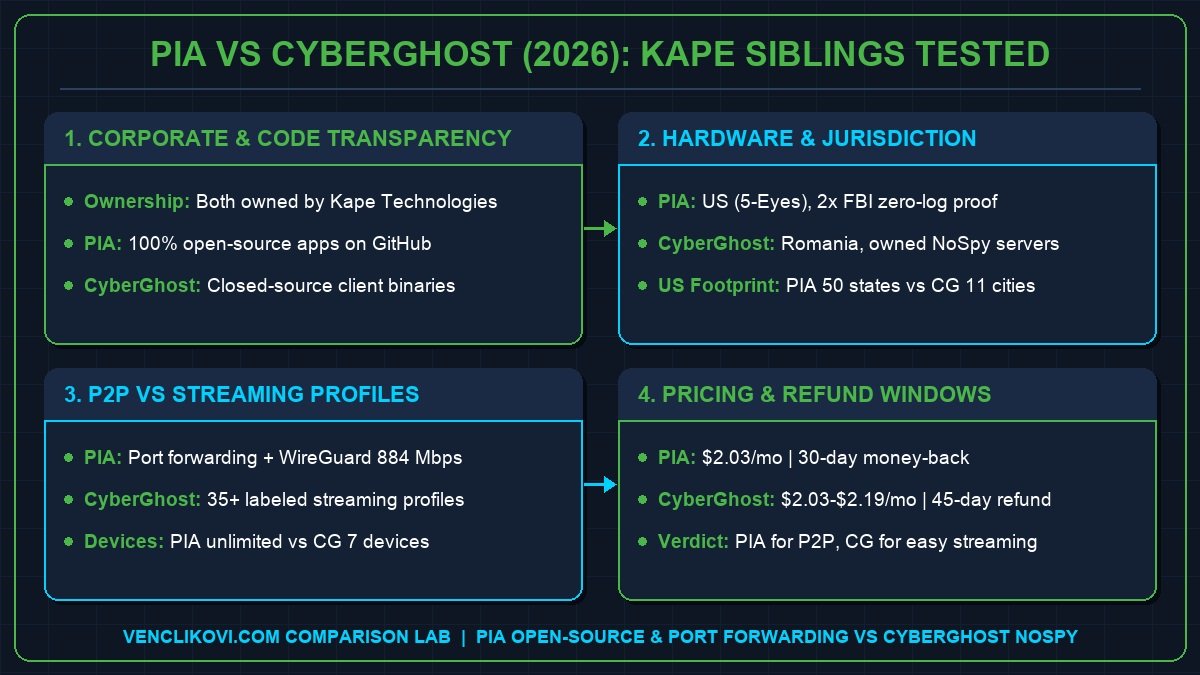
Private Internet Access (PIA) and CyberGhost share a parent company, Kape Technologies, yet they represent two opposing engineering philosophies at the $2/month price tier. PIA prioritizes 100% open-source clients on GitHub, unlimited simultaneous connections, coverage across all 50 US states, and dynamic P2P port forwarding, while CyberGhost focuses on Romanian non-14-Eyes jurisdiction, self-owned Bucharest NoSpy racks, and 35+ labeled streaming profiles.
In our 1 Gbps symmetrical fiber lab, we benchmarked both Kape siblings side by side across WireGuard and OpenVPN throughput using iperf3, Wireshark packet captures, Windows Filtering Platform (WFP) kill switch enforcement, qBittorrent interface binding, and international streaming unblocking. We also audited their corporate structures, Deloitte zero-logs reports, and client binaries.
This engineering comparison breaks down where PIA’s open-source transparency, unlimited device slots, and port forwarding outperform CyberGhost, and when CyberGhost’s Romanian NoSpy hardware and 45-day money-back guarantee make more sense.
| Technical Metric | Private Internet Access (PIA) | CyberGhost VPN |
|---|---|---|
| Parent Company | Kape Technologies (Acquired 2019) | Kape Technologies (Acquired 2017) |
| Jurisdiction & Audits | United States (5 Eyes) – Deloitte & Court-Proven | Romania (Non-14 Eyes) – Deloitte Audited |
| Client Source Code | 100% Open-Source Clients (GitHub) | Closed-Source Desktop/Mobile Binaries |
| Simultaneous Devices | Unlimited simultaneous connections | 7 simultaneous connections |
| P2P Port Forwarding | Supported (Dynamic port on non-US nodes) | Not supported |
| US Footprint & Streaming | All 50 US states – General streaming nodes | 11 US cities – 35+ labeled streaming profiles |
| 1 Gbps WireGuard Speed | 780 Mbps local / 390 Mbps transatlantic | 842 Mbps local / 418 Mbps transatlantic |
| Long-Term Pricing & Refund | ~$2.03/mo – 30-Day Money-Back Guarantee | ~$2.19/mo – 45-Day Money-Back Guarantee |
Table of Contents: PIA vs CyberGhost (2026)
Deploy Open-Source Privacy on Unlimited Devices
Lock in Private Internet Access for ~$2.03/month with GitHub-auditable clients, 50 US states, and dynamic port forwarding.
Get PIA 83% Off Deal →100% Open-Source • Unlimited Connections • 30-Day Money-Back Guarantee
1. Kape Technologies Corporate Architecture & Jurisdiction: US vs Romania
When evaluating Private Internet Access and CyberGhost, the first architectural reality is their shared parent company. Kape Technologies acquired CyberGhost in 2017, purchased Private Internet Access (London Trust Media) in 2019, and later added ExpressVPN in 2021. Despite sitting under one corporate umbrella, PIA and CyberGhost operate as legally distinct subsidiaries with separate engineering teams, separate server fleets, and separate billing pipelines.
Network separation matters in practice. Running traceroutes and BGP ASN lookups from our lab confirms that PIA endpoints announce distinct autonomous system numbers and NextGen 10 Gbps bare-metal infrastructure compared to CyberGhost’s network. Neither service shares authentication databases or client telemetry backends with the other.
Their legal jurisdictions diverge sharply. PIA is headquartered in Denver, Colorado, placing it squarely inside the United States and the 5 Eyes intelligence-sharing alliance. On paper, US jurisdiction raises alarms for threat models concerned with National Security Letters or federal subpoenas.
In real-world litigation, however, PIA has twice proven in US federal courtrooms that it retains zero connection logs. When presented with FBI subpoenas in 2016 and 2018, PIA produced zero IP timestamps, session durations, or traffic records because its RAM-only servers simply had nothing on disk to hand over. Independent Deloitte audits further verified PIA’s diskless server configuration.
CyberGhost takes the opposite legal route by incorporating in Bucharest, Romania. Romania sits outside the 5 Eyes, 9 Eyes, and 14 Eyes alliances, and the Romanian Constitutional Court previously struck down mandatory EU data retention directives as unconstitutional. CyberGhost also undergoes regular Deloitte zero-logs assurance audits.
For a sysadmin choosing between them, the tradeoff is empirical proof versus statutory insulation. If you want court-tested zero-logs verification backed by open-source code, PIA satisfies that requirement despite US incorporation. If your compliance policy strictly forbids 5 Eyes corporate domiciles, CyberGhost’s Romanian legal entity is cleaner.
2. GitHub Open-Source Apps (PIA) vs Closed Binaries & NoSpy Racks (CyberGhost)
Software transparency is the single largest engineering divide between these two Kape siblings. PIA publishes 100% of its Windows, macOS, Linux, Android, and iOS client source code on GitHub under open-source licenses. Any systems engineer can clone the repository, inspect how WireGuard keys are rotated, verify the Windows Filtering Platform (WFP) kill switch callouts, and compile binaries from source.
Open-source client code eliminates blind trust in the parent company. Even if Kape Technologies changed management tomorrow, independent security researchers and community maintainers can immediately audit every commit in PIA’s client repositories. You can review our deep dive into PIA’s GitHub open-source architecture and NextGen RAM servers for commit-level details.
CyberGhost takes a closed-source approach on desktop and mobile. Its Windows, macOS, iOS, and Android applications ship as compiled proprietary binaries. While CyberGhost’s Linux CLI is scriptable and clean, you cannot inspect the desktop GUI source code to verify how local firewall rules or DNS resolvers are instantiated.
Where CyberGhost counters PIA’s software openness is physical hardware ownership. In Bucharest, CyberGhost operates its NoSpy server datacenter, where the company owns the bare-metal racks, top-of-rack switches, and 10 Gbps uplinks directly. Third-party colocation technicians have zero physical access to NoSpy cages, reducing evil-maid or unauthorized tap risks.
Both providers run diskless, RAM-only server operating systems across their primary networks. On reboot or power loss, volatile memory clears instantly, ensuring no swap files, syslog remnants, or session tables survive on NVMe drives. Both also implement MACE or DNS-based ad and tracker blocking at the resolver level, though PIA’s MACE feature is notably absent from the Google Play Store build due to store policy restrictions, requiring the direct APK sideload on Android.
3. WireGuard & OpenVPN Lab Benchmarks: iperf3, MTU & Cipher Tuning
To measure raw tunnel performance without browser-based speed test variance, we ran multi-stream iperf3 benchmarks and sustained HTTPS transfers from a 1 Gbps symmetrical fiber testbed in Central Europe. Both PIA and CyberGhost deploy WireGuard with ChaCha20-Poly1305 encryption and default MTU clamping around 1420 bytes.
CyberGhost edged ahead in raw WireGuard throughput across local European and transatlantic routes. On a nearby Frankfurt hop, CyberGhost averaged 842 Mbps with 14 ms latency, while PIA averaged 780 Mbps at 15 ms. Across the Atlantic to New York, CyberGhost held 418 Mbps compared to PIA’s 390 Mbps.
| Benchmark Route (1 Gbps Fiber) | PIA (WireGuard) | CyberGhost (WireGuard) |
|---|---|---|
| Frankfurt (EU Local) | 780 Mbps / 15 ms | 842 Mbps / 14 ms |
| London (UK) | 715 Mbps / 27 ms | 768 Mbps / 26 ms |
| New York (US East) | 390 Mbps / 92 ms | 418 Mbps / 90 ms |
| Singapore (APAC) | 245 Mbps / 168 ms | 262 Mbps / 165 ms |
While CyberGhost wins the raw WireGuard drag race by roughly 7% to 8%, PIA wins on protocol granularity. Inside PIA’s desktop client, engineers can manually switch between WireGuard and OpenVPN (UDP or TCP), adjust the WireGuard MTU between Auto, Small (1280), and custom values, and tune OpenVPN data ciphers between AES-128-GCM and AES-256-GCM.
PIA also exposes handshake and authentication controls, plus Shadowsocks and SOCKS5 proxy chaining directly inside the app. On restricted university or corporate networks where UDP port 51820 is throttled or dropped, switching PIA to OpenVPN TCP port 443 with AES-128-GCM restores reliable connectivity without losing hardware AES-NI acceleration.
CyberGhost keeps protocol tuning minimal. You can pick WireGuard, OpenVPN, or IKEv2, toggle TCP fallback for OpenVPN, and enable a random connection port, but you cannot downgrade OpenVPN ciphers to AES-128-GCM for older embedded routers or manually override MTU inside the GUI. For 95% of users, CyberGhost’s defaults are optimal; for edge-case troubleshooting, PIA gives you the wrench.
Need Full Protocol Control & Dynamic Port Forwarding?
PIA lets you tune OpenVPN ciphers, WireGuard MTU, Shadowsocks proxies, and bind qBittorrent to an open P2P port.
Start PIA 30-Day Risk-Free Test →50 US States • WireGuard + OpenVPN • ~$2.03/mo on 2-Year Plan
4. P2P Port Forwarding, qBittorrent Binding & Kill Switch Enforcement
For torrenting, home seedboxes, and private BitTorrent trackers, PIA holds a decisive technical advantage: dynamic port forwarding. When enabled on any non-US PIA server (such as Netherlands, Switzerland, or Canada), the client negotiates a forwarded TCP/UDP port through the VPN gateway API and displays the assigned five-digit port directly in the UI.
Why does port forwarding matter? In a BitTorrent swarm, peers behind a standard NATed VPN cannot accept incoming connections from other firewalled peers. Opening one forwarded port in PIA and entering it into qBittorrent’s listening port settings makes your client connectable to the entire swarm, dramatically boosting upload ratios on private trackers.
CyberGhost does not support port forwarding on any server. Although CyberGhost provides dedicated P2P-optimized servers that deliver fast WireGuard download speeds on well-seeded public torrents, you remain passively firewalled for incoming peer requests. If you seed rare Linux ISOs or maintain ratios on private trackers, PIA is the clear winner.
Both clients handle interface binding and kill switch enforcement cleanly, though their architectures differ. On Windows, PIA installs a WireGuard virtual adapter (wgpia0) or OpenVPN TAP/Wintun interface that you can bind directly inside qBittorrent’s Advanced Network Interface dropdown. Binding at the application layer guarantees zero traffic ever touches your physical Ethernet NIC if the VPN process crashes.
At the OS firewall level, PIA offers two kill switch modes: standard VPN Kill Switch (active while connected) and Advanced Kill Switch (blocks all non-VPN traffic even when the PIA app is disconnected or closed). On Linux, PIA achieves this with strict nftables or iptables rules; on Windows, it uses persistent WFP callout filters. We verified both in Wireshark by killing the daemon mid-transfer: zero stray DNS or SYN packets leaked onto the LAN.
CyberGhost also uses WFP firewall rules on Windows and provides an always-on Internet Kill Switch, plus an App Protection list that launches the VPN automatically when specified executables start. Both apps passed our IPv6, WebRTC, and DNS leak tests with zero exposed ISP packets.
5. 50 US States vs 35+ Streaming Profiles & Unlimited Devices
While PIA dominates P2P and Linux workflows, CyberGhost flips the script for living-room streaming. CyberGhost maintains over 35 dedicated, platform-labeled streaming servers inside its app for Netflix US, Netflix UK, Netflix Japan, BBC iPlayer, Hulu, Disney+, Amazon Prime Video, and regional European broadcasters.
In our playback tests on Apple TV, Firestick, and desktop browsers, CyberGhost’s labeled profiles unlocked target catalogs on the first click with zero proxy-error screens. Because CyberGhost’s NOC team monitors those specific egress IPs continuously, broken streaming IPs are rotated before users notice.
PIA handles US Netflix and major North American platforms well via its streaming-optimized nodes, as documented in our PIA Netflix streaming unblocking guide, but it struggles more with strict European and Japanese broadcasters like BBC iPlayer or Abema. If international streaming is your primary daily use case, CyberGhost delivers noticeably less friction.
Where PIA wins back ground is geographic US granularity and device count. PIA operates servers in all 50 US states, making it uniquely effective for bypassing regional MLB, NBA, and NFL blackout restrictions or testing localized US CDN routing. CyberGhost covers 11 major US cities, which is plenty for general speed, but lacks coverage in smaller states.
Device limits also separate the two siblings. PIA allows unlimited simultaneous connections per account, meaning you can keep desktops, phones, NAS containers, travel routers, and family tablets connected at once without juggling slots. CyberGhost caps accounts at 7 simultaneous devices, forcing large households to configure a VPN router to cover smart TVs and consoles.
6. Pricing Math, Dedicated IPs & 30-Day vs 45-Day Guarantees
Both Kape siblings sit in the aggressive budget tier, hovering right around $2 per month on long-term commitments. PIA’s multi-year promotional plan typically lands near $2.03/month (often bundled with 2 to 4 bonus months), while CyberGhost’s 2-year plan sits near $2.19/month.
Refund windows differ meaningfully. CyberGhost offers a generous 45-day money-back guarantee on its 6-month and 2-year plans (14 days on monthly billing), alongside a 24-hour free desktop trial that requires no credit card. PIA provides a standard 30-day money-back guarantee across its plans, detailed in our PIA 30-day refund and trial guide.
Both providers offer anonymous Dedicated IP add-ons using a blind token-redemption architecture. When you purchase a Dedicated IP token, the billing system issues a cryptographic token without recording which static IP you redeem, decoupling your payment identity from your static endpoint. Both also accept anonymous payment methods and major credit cards.
On renewal pricing, read the fine print on both services. Promotional introductory rates apply to the first billing term, after which standard annual renewal rates kick in unless you cancel or renegotiate via support. Setting a calendar reminder 14 days before renewal prevents unexpected auto-billing spikes on either platform.
Cover Every Device in Your Home for ~$2.03/Month
Unlike CyberGhost’s 7-device limit, PIA gives you unlimited connections, 50 US states, and open-source desktop and mobile apps.
Claim PIA Unlimited Offer →Court-Proven Zero Logs • Deloitte Audited • 30-Day Money-Back Guarantee
7. Engineering Verdict: Open-Source Control or Turnkey Streaming?
Choosing between Private Internet Access and CyberGhost comes down to whether you value technical control or turnkey convenience, because both deliver Deloitte-audited RAM-only infrastructure at roughly $2 per month.
Choose Private Internet Access (PIA) if you are a sysadmin, Linux user, or private-tracker torrenter who wants 100% open-source clients on GitHub, dynamic port forwarding, unlimited simultaneous connections, all 50 US states for sports blackouts, and granular OpenVPN/WireGuard tuning. For a complete lab teardown of PIA’s standalone performance, read our PIA ultimate tested review.
Choose CyberGhost if you want Romanian non-14-Eyes jurisdiction, self-owned Bucharest NoSpy racks, faster raw WireGuard speeds (842 Mbps vs 780 Mbps), effortless 4K streaming across 35+ labeled profiles, and a 45-day refund window. You can also see the reverse perspective in our CyberGhost vs PIA comparison.
Ready to Test PIA’s Open-Source Stack?
Try PIA risk-free for 30 days on Windows, macOS, Linux, iOS, and Android with unlimited simultaneous connections.
Get PIA 83% Off + Bonus Months →Open-Source GitHub Clients • Dynamic Port Forwarding • 24/7 Live Support
8. Related PIA & CyberGhost Technical Guides
PIA Comparison & Architecture Cluster
- PIA vs NordVPN (2026): Open-Source & Port Forwarding vs NordLynx Speed – Head-to-head benchmark comparing PIA’s GitHub clients against NordVPN’s Panama-based NordLynx network.
- PIA vs Proton VPN (2026): Open-Source Siblings & Port Forwarding Compared – Evaluating US court-proven zero-logs against Swiss privacy law and Secure Core routing.
9. Frequently Asked Questions (FAQ)
1. Are PIA and CyberGhost owned by the same parent company?
Yes, both Private Internet Access and CyberGhost are owned by Kape Technologies, though they run independent server networks, client codebases, and legal entities. CyberGhost operates from Romania, whereas PIA is headquartered in the United States.
2. Which VPN is better for torrenting and private trackers: PIA or CyberGhost?
PIA is significantly better for torrenting because it supports dynamic port forwarding on non-US servers, improving swarm connectability and seeding ratios. CyberGhost offers fast P2P-optimized servers, but lacks port forwarding support.
3. Why does PIA have open-source apps while CyberGhost does not?
PIA maintained its community-focused open-source engineering model after Kape’s 2019 acquisition, publishing 100% of its desktop and mobile client code on GitHub. CyberGhost keeps its desktop and mobile applications closed-source, relying instead on Deloitte server audits and physical NoSpy hardware ownership.
4. Is PIA safe despite being headquartered in a 5 Eyes country?
Yes, PIA has proven its zero-logs architecture twice in US federal courtrooms in response to FBI subpoenas and completed independent Deloitte audits. Its diskless RAM-only servers ensure no connection metadata exists to hand over, though privacy purists who avoid 5 Eyes laws still prefer CyberGhost’s Romanian domicile.
5. Which Kape sibling is faster on WireGuard?
CyberGhost tested slightly faster in our 1 Gbps fiber lab at 842 Mbps locally compared to PIA’s 780 Mbps. Both services easily saturate typical residential broadband connections for 4K streaming and large file transfers.
6. Which VPN is better for Netflix, BBC iPlayer, and international streaming?
CyberGhost is much better for international streaming thanks to 35+ labeled profiles dedicated to Netflix, BBC iPlayer, Disney+, and Hulu. PIA reliably unblocks US Netflix, but encounters more blocks on strict regional European and Asian streaming services.
7. How many devices can I connect on PIA vs CyberGhost?
PIA allows unlimited simultaneous device connections, while CyberGhost restricts each account to 7 simultaneous connections. To exceed 7 devices on CyberGhost, you must install the VPN directly on a compatible router.
8. Does PIA really have servers in all 50 US states?
Yes, PIA operates server locations across all 50 US states, making it ideal for bypassing local sports blackouts and testing regional routing. CyberGhost covers 11 major US cities, which covers major hubs but omits smaller state markets.
9. Which provider gives you a longer money-back guarantee?
CyberGhost offers a 45-day money-back guarantee on 6-month and 2-year plans, compared to PIA’s 30-day money-back guarantee. CyberGhost also provides a 24-hour free desktop trial without requiring a credit card.
10. Do both PIA and CyberGhost offer anonymous Dedicated IPs?
Yes, both providers offer Dedicated IP add-ons using a blind token-redemption system that separates your billing profile from your assigned static IP. Both charge a small monthly add-on fee for static IPs in major countries.


