








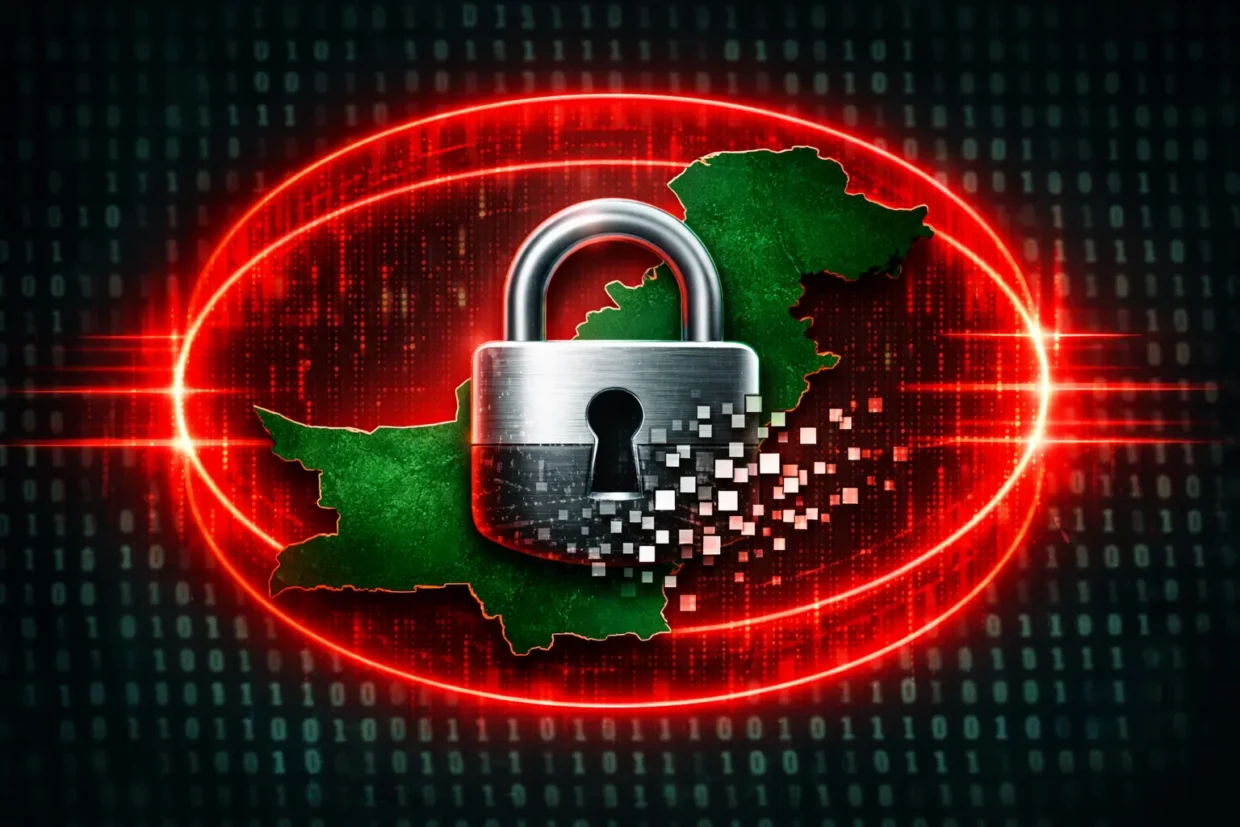
In the span of just 24 months, Pakistan has transitioned from a landscape of sporadic internet shutdowns to a sophisticated, integrated regime of digital authoritarianism.
By early 2026, the country has successfully established a national digital perimeter often referred to as a “Great Firewall” that allows the state to monitor, filter, and throttle the flow of information in real-time.
This transformation is not merely a local policy shift but a global case study in how a democratic state can leverage Chinese style technology to consolidate power at the expense of its digital economy.
The Architecture of Control: WMS 2.0 and the National Firewall
Pakistan’s current censorship infrastructure is built upon three technological pillars that work in tandem to eliminate digital anonymity.
1. Web Monitoring System (WMS 2.0)
The core of the regime is the Web Monitoring System 2.0, an upgrade of a platform originally procured from Canadian firm Sandvine for approximately $18.5 million. Utilizing Deep Packet Inspection (DPI), WMS 2.0 allows authorities to:
- Identify and block specific features within encrypted apps (e.g., disabling WhatsApp voice calls while allowing text).
- Detect and throttle VPN traffic to force users onto monitored connections.
- Filter content across all major internet gateways, mobile service provider data centers, and ISPs.
2. Lawful Intercept Management System (LIMS)
Following the February 2024 elections, telecom operators were mandated to integrate the Lawful Intercept Management System (LIMS). This system provides intelligence agencies with instantaneous, warrantless access to citizen metadata and private communications.
- Scale: LIMS is technically capable of monitoring at least 4 million mobile users simultaneously.
- Access: Agencies can retrieve call logs, SMS records, browsing histories, and even full content streams of audio and video with a “single click” using a SIM or IMEI number.
3. National Telecom Monitoring Solution (February 2026)
As of February 20, 2026, the Pakistan Telecommunication Authority (PTA) has moved toward the final phase of its intranet strategy by introducing the “National Telecom Monitoring Solution.”
This initiative includes a new framework for Internet Exchange Points (IXPs) aimed at localizing internet traffic, which reduces dependence on international routing and ensures all data flows remain under state visibility.
| System Component | Technology Used | Primary Function | Scale/Impact |
| National Firewall | Chinese-built DPI | Throttling & filtering | Nationwide deployment at gateways |
| LIMS | Direct Network Integration | Mass Surveillance | ~4 million users simultaneously |
| WMS 2.0 | Deep Packet Inspection | Content Management | Feature-level blocking (e.g. WhatsApp) |
| IXP Framework | National Routing | Data Localization | Enhanced real-time oversight |
The Legal Framework: PECA 2025 and the Death of Dissent
The technological crackdown is anchored by the Prevention of Electronic Crimes (Amendment) Act 2025 (PECA 2025), passed in January 2025 with minimal public debate.
Criminalizing “Fake News”
The most controversial addition is Section 26A, which criminalizes the dissemination of information deemed “false” or “fake” that might cause fear, panic, or unrest.
The law notably lacks a clear definition of what constitutes a “falsehood,” allowing the newly established Social Media Protection and Regulatory Authority (SMPRA) to serve as a subjective arbiter of truth. Penalties include up to three years in prison and fines of 2 million PKR (~$7,150).
Weaponized Sentencing
In a landmark case in January 2026, human rights lawyers Imaan Zainab Mazari-Hazir and Hadi Ali Chattha were sentenced to 17 years in prison for social media posts criticizing the military.
Their trial, which lasted less than three months, relied on screenshots of tweets as primary evidence. Global watchdogs have cited this case as the definitive signal of the “weaponization of dissent” under PECA 2025.
Read best article about VPN and Pakistan – Best VPN for Pakistan 2026: Tested Against DPI Firewall
The Economic “Bannistan”: $1.62 Billion in Self-Sabotage
The aggressive push for digital control has come at a staggering cost to the Pakistani economy. In 2024, Pakistan led the world in financial losses due to intentional internet shutdowns and social media blackouts.
- Financial Impact: Cumulative losses in 2024 totaled $1.62 billion, surpassing the economic damage in conflict zones like Sudan and Myanmar.
- The “X” Ban: The 15-month ban on X (formerly Twitter) alone cost the economy an estimated $1.34 billion before its silent restoration in May 2025 during a military conflict with India.
- Freelance Collapse: Pakistan hosts the world’s 4th largest freelancer market with 2.37 million professionals. Due to unreliable connectivity and VPN throttling, local freelancers have reported a 70% drop in work opportunities as international clients lose confidence in the region’s digital reliability.
Digital Sovereignty vs. Global Standards
While the PTA maintains that these measures are necessary for “national security” and combating “digital terrorism,” the reality is a growing isolation from the global open internet.
In 2025, Freedom House ranked Pakistan’s internet freedom at a dismal 27/100 (“Not Free”), citing increased censorship and surveillance.
The silent lifting of the X ban in May 2025 serves as a potent example of how the state views digital access: not as a right, but as a geopolitical tool.
The ban was lifted primarily to allow state-linked accounts to counter Indian narratives during a border conflict, proving that censorship in Pakistan is as much about information warfare as it is about internal stability.
Digital Privacy & Tools: Navigating the Pakistan Firewall
As digital restrictions tighten, protecting your online privacy has become both a necessity and a challenge. In late 2025, Pakistan’s Council of Islamic Ideology briefly declared unregistered VPNs “un-Islamic,” and the PTA has since introduced a licensing regime for VPN providers.
Why You Need a Privacy Tool
In the current climate, your ISP (Internet Service Provider) is legally mandated to share your browsing history and metadata with authorities upon request. A Virtual Private Network (VPN) encrypts your data, shielding it from both the state and potential cyber-intruders.
Current VPN Status in Pakistan (February 2026)
- Registration Risks: The PTA now grants licenses to specific VPN providers (e.g., Crest VPN, Kestrel VPN). However, these “licensed” providers are required to provide user information to the state upon request, defeating the primary purpose of a no-logs policy.
- Throttling: Unregistered commercial VPNs often face technical throttling or connection drops during periods of political sensitivity.
Our Recommendations
For those seeking to maintain privacy while operating within or interacting with the region, we recommend tools that offer “obfuscation” (the ability to hide the fact that you are using a VPN).
- NordVPN: Known for its high-speed servers near Pakistan (e.g., UAE, India) and robust obfuscation technology.
- Surfshark: An affordable option with “NoBorders” mode specifically designed to function in restrictive environments.
- Proton VPN: A security-first provider that has actively fought against the recent blocks in Pakistan, though its apps are currently subject to intermittent restrictions.
| 3 Best VPN for Pakistan | Offer + Discount | URL |
|---|---|---|
| NordVPN | 77% off + 3 months free | Try NordVPN |
| SurfShark | 87% off + 2 months free | Try SurfShark |
| ProtonVPN | 70% off | Try ProtonVPN |
Legal Disclaimer: Using unregistered VPNs in Pakistan may carry legal risks under the PECA 2025 framework. We advise all users to remain informed of local regulations before connecting.
Sources
- European Times: Pakistan’s Expanding Digital Censorship and Surveillance Regime (Jan 2026) – https://europeantimes.org/pakistans-expanding-digital-censorship-and-surveillance-regime/
- Global Voices: Pakistan jails two lawyers for 17 years over old tweets (Feb 2026) – https://globalvoices.org/2026/02/20/pakistan-jails-two-lawyers-for-17-years-over-old-tweets/
- Freedom House: Freedom on the Net 2025 – https://freedomhouse.org/country/pakistan/freedom-net/2025
- Dawn News: Pakistan tops world in economic losses due to internet shutdowns (Jan 2025) – https://www.dawn.com/news/1882972/
- ProPakistani: PTA Plans New System to Monitor Internet and Telecom Networks (Feb 20, 2026) – https://propakistani.pk/2026/02/20/pta-plans-new-system-to-monitor-internet-and-telecom-networks/
- TechRadar: Pakistan begins blocking unregistered VPN apps (Jan 2026) – https://www.techradar.com/vpn/vpn-privacy-security/pakistan-begins-blocking-unregistered-vpn-apps-and-this-popular-service-is-among-the-casualties
- Human Rights Watch: Pakistan: Repeal Amendment to Draconian Cyber Law (Feb 2025) – https://www.hrw.org/news/2025/02/03/pakistan-repeal-amendment-draconian-cyber-law