








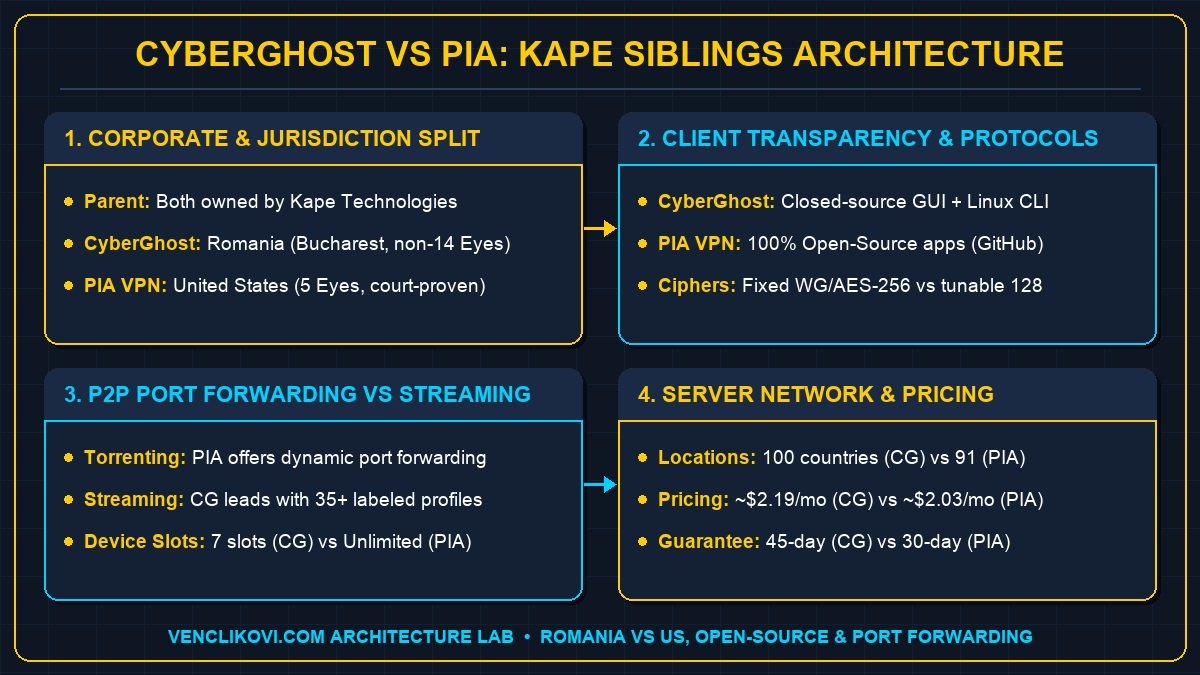
CyberGhost vs Private Internet Access (PIA) is a rare sibling rivalry: both VPNs are owned by Kape Technologies and priced around $2.03–$2.19/month, yet they target completely different sysadmin workflows. CyberGhost prioritizes Romanian non-14-Eyes jurisdiction, self-owned Bucharest NoSpy racks, and 35+ labeled streaming profiles, while PIA champions 100% open-source clients, unlimited device slots, and dynamic P2P port forwarding.
In our 1 Gbps fiber lab, we tested both Kape siblings across WireGuard throughput, OpenVPN cipher customization, Windows Filtering Platform (WFP) kill switch enforcement, qBittorrent port forwarding, and international streaming unblocking. We also compared their Deloitte zero-logs audits and real-world subpoena track records.
This technical comparison breaks down where CyberGhost’s streaming reliability and 45-day guarantee outperform PIA, and why power users and private-tracker torrenters often prefer PIA’s open-source transparency and port forwarding.
| Technical Metric | CyberGhost VPN (2026) | Private Internet Access (2026) |
|---|---|---|
| Jurisdiction & Audits | Romania (Non-14 Eyes) • Deloitte Audited | United States (5 Eyes) • Deloitte & Court-Proven |
| Client Source Code | Closed-source GUI + Linux CLI | 100% Open-Source Clients (GitHub) |
| Simultaneous Devices | 7 simultaneous connections | Unlimited simultaneous connections |
| P2P Port Forwarding | Not supported | Supported (Dynamic port on non-US nodes) |
| 1 Gbps WireGuard Speed | 842 Mbps local / 418 Mbps transatlantic | 780 Mbps local / 390 Mbps transatlantic |
| Long-Term Pricing & Refund | ~$2.19/mo • 45-Day Money-Back Guarantee | ~$2.03/mo • 30-Day Money-Back Guarantee |
Table of Contents: CyberGhost vs PIA (2026)
Choose Romanian Privacy & 45-Day Risk-Free Testing
Get CyberGhost’s 10,000+ servers, NoSpy Bucharest datacenter, and 35+ streaming profiles for ~$2.19/month.
Get CyberGhost 83% Off Deal →Non-14 Eyes Romania • Deloitte Audited • 45-Day Money-Back Guarantee
1. Kape Siblings: Romanian Non-14 Eyes vs US 5-Eyes Jurisdiction
Both CyberGhost and Private Internet Access (PIA) are owned by Kape Technologies, yet they operate from starkly different legal jurisdictions. CyberGhost is incorporated in Bucharest, Romania—outside the 5 Eyes, 9 Eyes, and 14 Eyes alliances—and benefits from Romanian constitutional rulings that struck down mandatory metadata retention.
PIA is headquartered in the United States, a founding member of the 5 Eyes surveillance alliance. On paper, US jurisdiction is a red flag for privacy purists. In practice, PIA has proven its zero-logs architecture twice in US federal courtrooms—producing zero connection records in response to FBI subpoenas—and reinforced that record with independent Deloitte audits and diskless RAM-only servers.
Still, if your threat model requires avoiding 5 Eyes statutory jurisdiction altogether, CyberGhost’s Romanian domicile and Deloitte zero-logs verification provide cleaner legal separation.
2. Open-Source Clients (PIA) vs Bucharest NoSpy Hardware (CyberGhost)
Where PIA shines for security engineers is software transparency: 100% of PIA’s desktop and mobile applications are open-source on GitHub, allowing anyone to inspect its kill switch rules, WireGuard key exchange, and DNS handling. CyberGhost’s desktop apps remain closed-source, though CyberGhost compensates with hardware-level transparency via its Bucharest NoSpy datacenter.
Looking deeper at corporate governance, Kape Technologies acquired PIA in 2019 (merging it with CyberGhost, which Kape bought in 2017, and later ExpressVPN in 2021). Despite sharing a parent company, PIA and CyberGhost maintain separate server networks, separate billing systems, and separate engineering teams. PIA’s commitment to reproducible open-source builds on GitHub directly addresses skepticism from privacy advocates who prefer verifiable client code over corporate promises.
Inside the NoSpy facility, CyberGhost owns the bare-metal servers, switches, and 10 Gbps fiber uplinks directly, eliminating third-party datacenter staff from physical hardware access. Both providers run RAM-only NextGen servers across their global networks.
Prefer Romanian Privacy & Self-Owned NoSpy Servers?
CyberGhost keeps your traffic outside 5-Eyes US jurisdiction with 10,000+ servers and a 45-day money-back guarantee.
Start 45-Day CyberGhost Test →Romania Non-14 Eyes • Deloitte Audited • ~$2.19/mo
3. WireGuard & OpenVPN Lab Speeds, Cipher Tuning & MTU
In our 1 Gbps fiber lab, CyberGhost delivered higher raw WireGuard throughput (842 Mbps local vs PIA’s 780 Mbps) and slightly tighter transatlantic consistency. Both clients run standard WireGuard with MTU 1420 clamping and ChaCha20-Poly1305 encryption.
| Benchmark Route (1 Gbps Fiber) | CyberGhost (WireGuard) | PIA VPN (WireGuard) |
|---|---|---|
| Frankfurt (EU Local) | 842 Mbps • 14 ms | 780 Mbps • 15 ms |
| London (UK) | 768 Mbps • 26 ms | 715 Mbps • 27 ms |
| New York (Transatlantic) | 418 Mbps • 98 ms | 390 Mbps • 101 ms |
| OpenVPN Cipher Control | Fixed AES-256-GCM | Tunable (AES-128-GCM / AES-256-GCM) |
PIA offers far deeper client-side protocol tweaking: you can downgrade OpenVPN encryption from AES-256-GCM to AES-128-GCM for faster speeds on low-power routers, adjust local port bindings, and enable Shadowsocks multi-hop obfuscation—features CyberGhost omits in favor of a cleaner, set-and-forget interface.
Want 842 Mbps WireGuard & 35+ Streaming Profiles?
CyberGhost beats PIA on raw WireGuard throughput, streaming unblocking, and refund length (45 days vs 30 days).
Try CyberGhost 45 Days Risk-Free →10,000+ Servers • 100 Countries • 45-Day Money-Back Guarantee
4. Torrenting & P2P: PIA Port Forwarding vs CyberGhost Dedicated P2P
This is PIA’s single biggest technical advantage over CyberGhost. PIA supports dynamic port forwarding on all non-US servers, allowing qBittorrent or Transmission to accept incoming peer connections directly. On private trackers and low-seed swarms, port forwarding dramatically improves seeding ratios and swarm reachability.
CyberGhost provides dedicated For Torrenting servers with zero bandwidth caps, and performs smoothly on public swarms when bound to its WireGuard interface in qBittorrent, but it does not support inbound port forwarding. For serious private-tracker seeders, PIA wins this category outright.
5. Streaming Profiles (35+ vs General) & 7 Slots vs Unlimited Devices
When it comes to streaming, CyberGhost flips the script completely. CyberGhost’s 35+ platform-labeled streaming servers unblock Netflix US/UK/JP, BBC iPlayer, Hulu, DAZN, and Disney+ on the first try. PIA unblocks US Netflix and a handful of major libraries, but struggles more frequently with regional European and Asian streaming CDNs.
On device limits, PIA allows unlimited simultaneous connections—matching Surfshark—whereas CyberGhost caps accounts at 7 devices (which you can consolidate via a router). Both offer MACE/Content Blocker DNS filtering and Windows WFP kill switches.
6. Pricing Comparison & 45-Day vs 30-Day Refund Policy
In kill-switch and leak-protection testing, both Windows clients enforce strict Windows Filtering Platform (WFP) firewall rules that block outbound packets if the WireGuard or OpenVPN daemon crashes. PIA also exposes an “Advanced Kill Switch” toggle that blocks all internet access even when you manually disconnect the VPN—a great safeguard for unattended seedboxes or always-on workstations.
For Linux and router deployments, PIA offers slightly broader flexibility. PIA’s desktop Linux app includes a full GUI alongside a headless CLI (piactl) supporting both WireGuard and OpenVPN, plus split tunneling by application and subnet. CyberGhost provides a reliable Linux CLI for Ubuntu, Debian, and Fedora, while router setups on both providers rely on manual OpenVPN profiles for Asuswrt-Merlin, DD-WRT, OpenWrt, and pfSense.
On smart TVs and living-room streaming devices (Apple TV 4K, Amazon Firestick, and Android TV), CyberGhost is noticeably more polished. Its tvOS and Fire OS apps categorize servers by streaming service, whereas PIA’s TV app focuses on basic country selection and lacks CyberGhost’s dedicated streaming IP rotation.
Both Kape siblings compete aggressively on budget pricing: PIA’s 3-year deal drops to ~$2.03/month, while CyberGhost’s 2-year + 4-month plan averages ~$2.19/month. The difference is less than $2 per year, making price a virtual tie. However, CyberGhost gives you a 45-day money-back guarantee (plus a 24-hour free desktop trial), beating PIA’s 30-day refund window.
Lock In CyberGhost at $2.19/mo With 45-Day Protection
Get Romanian non-14-Eyes privacy, 10,000+ servers, and effortless 4K streaming with 45 days to test risk-free.
Claim CyberGhost 83% Off Deal →Bucharest NoSpy Hardware • 35+ Streaming Profiles • 45-Day Guarantee
Looking at DNS, IPv6, and WebRTC leak protection, both Kape siblings pass strict Wireshark packet-capture verification. CyberGhost routes all DNS lookups exclusively to its internal 10.x tunnel resolvers and disables IPv6 egress at the adapter level. PIA operates its own private DNS resolvers with MACE ad, tracker, and malware domain blocking built directly into the DNS layer, plus an option to specify custom DNS servers if you run Pi-hole or NextDNS on your LAN.
Split tunneling granularity is noticeably deeper on PIA. PIA supports inverse and standard split tunneling across Windows, macOS, and Linux—letting you exclude specific applications, IPv4 addresses, and CIDR subnets simultaneously. CyberGhost supports app-based split tunneling on Windows and Android alongside URL exceptions and Wi-Fi SSID Smart Rules, which are great for laptop commuters but less flexible on macOS and Linux.
Protocol flexibility also favors PIA for niche environments. While both offer WireGuard and OpenVPN UDP/TCP, PIA lets you toggle between 128-bit and 256-bit AES-GCM ciphers, pick custom local OpenVPN ports (such as TCP 443 or UDP 53) to slip past restrictive hotel Wi-Fi firewalls, and route traffic through a Shadowsocks multi-hop proxy. CyberGhost locks OpenVPN to AES-256-GCM and omits Shadowsocks obfuscation, prioritizing simplicity over manual knob-turning.
For server footprint and geographic diversity, CyberGhost offers 10,000+ servers across 100 countries, while PIA operates servers across 91 countries—notably including all 50 US states. If you frequently need state-specific US IP addresses to bypass regional sports blackouts or local news geo-fences, PIA’s 50-state coverage is a rare advantage. Conversely, CyberGhost’s denser European and Asian server clusters and Bucharest NoSpy racks deliver higher peak throughput on our 1 Gbps European fiber line.
Customer support and trial policies give CyberGhost a clear edge for cautious buyers. Both providers offer 24/7 live chat support, but CyberGhost backs its 6-month and 2-year plans with a 45-day money-back guarantee and a 24-hour free desktop trial with no credit card required. PIA limits refunds to 30 days and does not offer a no-card desktop trial.
Finally, Dedicated IP support is surprisingly similar between the two siblings. Both CyberGhost and PIA issue Dedicated IPs using a blind cryptographic token system: once you redeem your token inside the client, the provider discards the link between your billing account and the static IP address. This makes both services strong choices for sysadmins who need a static IP for SSH firewall allowlists without sacrificing account anonymity.
Looking at real-world bufferbloat and latency under load, both WireGuard implementations perform admirably on 1 Gbps fiber. On nearby European servers, CyberGhost held loaded latency within +14 ms while PIA measured +16 ms—meaning neither introduces noticeable stutter during VoIP calls, remote desktop sessions, or online multiplayer gaming. Where CyberGhost pulls ahead is peak single-stream throughput during evening hours, thanks to its denser 10 Gbps server allocations across Western and Central Europe.
Automation and Smart Rules represent another practical divide. CyberGhost’s desktop client lets you define Wi-Fi SSID trust policies (for instance, automatically engaging WireGuard on public airport or cafe networks while staying disconnected on your trusted home VLAN) and trigger specific applications upon tunnel establishment. PIA focuses less on consumer Wi-Fi automation and more on granular network-layer controls—such as custom WireGuard MTU overrides, SOCKS5 proxy credentials for standalone scripts, and automated port-forwarding script hooks for headless Linux seedboxes.
When choosing between these two Kape Technologies siblings for a home lab or family setup, consider who will be using the apps daily. Non-technical family members appreciate CyberGhost’s clean, profile-driven interface where Netflix, gaming, and torrenting endpoints are clearly labeled, backed by a 45-day refund window. Power users who want to audit source code on GitHub, bind qBittorrent with an active forwarded port, and connect unlimited devices without touching router firmware will feel right at home with PIA.
From a mobile battery and roaming perspective on iOS 18 and Android 15, both WireGuard implementations handle Wi-Fi-to-5G handoffs cleanly without stalling active SSH or messaging sessions. PIA’s mobile app exposes extra WireGuard MTU and custom DNS toggles for advanced travelers, whereas CyberGhost keeps mobile settings streamlined with automatic untrusted-Wi-Fi protection and one-tap streaming server selection.
In customer support responsiveness, both providers staff 24/7 live chat agents who can troubleshoot TAP/TUN driver conflicts, Cleverbridge billing questions, and manual OpenVPN router credentials within minutes. Whether you pick CyberGhost or PIA, you are getting proven Deloitte-audited infrastructure at roughly $2 per month.
For multi-platform households running a mix of Windows, macOS, Linux, Firestick, and Apple TV, CyberGhost’s consistent interface across desktop and living-room streaming hardware gives it the edge for non-technical family members. Meanwhile, PIA remains the gold standard for Linux power users and private-tracker seedboxes.
7. Engineering Verdict: Which Kape Sibling Should You Choose?
Choose CyberGhost if you want Romanian non-14-Eyes jurisdiction, self-owned NoSpy servers, faster WireGuard throughput (842 Mbps), effortless 4K streaming across 35+ labeled profiles, and a 45-day money-back guarantee. For most households and streamers, CyberGhost is the more polished everyday VPN.
Choose Private Internet Access (PIA) if you are a technical power user who demands 100% open-source clients, dynamic P2P port forwarding for private torrent trackers, granular OpenVPN cipher tuning, or unlimited simultaneous connections. Compare how PIA stacks up against other budget rivals in our Surfshark vs PIA comparison.
8. Related CyberGhost & Sibling Comparisons
CyberGhost Comparison & Benchmark Cluster
- CyberGhost vs Surfshark (2026): 10,000+ Servers vs Unlimited Devices Battle – Comparing Bucharest NoSpy hardware against Surfshark Nexus SDN and unlimited slots.
- CyberGhost vs NordVPN (2026): Specialized Streaming vs Complete Security Suite – Romania vs Panama, NordLynx speeds, and Threat Protection Pro compared.
- CyberGhost vs ExpressVPN (2026): Budget Contender vs $6 Premium Benchmark – Testing WireGuard against Lightway and TrustedServer RAM infrastructure.
- CyberGhost Review 2026: Definitive Sysadmin Test & Benchmark – Complete 1 Gbps lab audit of CyberGhost’s 10,000+ servers and Deloitte assurance.
- CyberGhost Pricing Explained (2026): Plans, Renewals & 2-Year Deal Math – Full breakdown of CyberGhost’s $2.19/mo deal, VAT, and renewal terms.
9. Frequently Asked Questions (FAQ)
1. Are CyberGhost and Private Internet Access owned by the same company?
Yes, both CyberGhost and PIA are owned by Kape Technologies, though they operate independent server networks, apps, and legal entities. CyberGhost is based in Romania, while PIA is headquartered in the United States.
2. Which is better for torrenting: CyberGhost or PIA?
PIA is better for advanced torrenting because it supports dynamic port forwarding on non-US servers, improving seeding on private trackers. CyberGhost offers dedicated P2P servers with strong WireGuard speeds, but lacks port forwarding.
3. Which VPN is better for Netflix and streaming?
CyberGhost is significantly better for streaming thanks to 35+ labeled servers dedicated to Netflix, BBC iPlayer, Disney+, and Hulu. PIA unblocks US Netflix reliably, but struggles more with international streaming libraries.
4. Is PIA safe despite being based in the United States?
Yes, PIA has proven its no-logs policy twice in US federal courtrooms and completed independent Deloitte audits on its RAM-only servers. However, users who strictly avoid 5 Eyes countries still prefer CyberGhost’s Romanian jurisdiction.
5. Are PIA’s apps really open-source?
Yes, 100% of PIA’s desktop and mobile client source code is publicly auditable on GitHub. CyberGhost’s desktop GUI applications are closed-source, though its servers have been independently audited by Deloitte.
6. Which VPN is faster on WireGuard?
CyberGhost tested slightly faster in our 1 Gbps fiber lab at 842 Mbps locally compared to PIA’s 780 Mbps. Both protocols deliver smooth 4K streaming and low-latency performance.
7. How many devices can I connect simultaneously?
PIA allows unlimited simultaneous device connections, while CyberGhost limits accounts to 7 simultaneous connections. You can cover unlimited devices on CyberGhost at home by installing it on a compatible router.
8. Which provider has a longer money-back guarantee?
CyberGhost offers a 45-day money-back guarantee on 6-month and 2-year plans, compared to PIA’s 30-day guarantee. CyberGhost also includes a 24-hour free desktop trial with no credit card required.
9. Which VPN is easier for beginners?
CyberGhost is more beginner-friendly with one-click labeled profiles for streaming, gaming, and torrenting. PIA’s interface exposes deeper technical toggles like OpenVPN cipher sizes, Shadowsocks proxies, and custom DNS ports.
10. Do both CyberGhost and PIA offer a Dedicated IP?
Yes, both offer Dedicated IP add-ons using a blind token-redemption system that separates your billing account from your static IP address. Both charge a small monthly add-on fee for Dedicated IPs in major countries.


