







If you are planning a trip to Istanbul, moving to Antalya as a digital nomad, or just trying to access your favorite apps from within Turkey, you are about to encounter one of the world’s most sophisticated digital firewalls.
By early 2026, the internet landscape in Turkey has shifted from “partially restricted” to “heavily controlled.” It’s not just about political news anymore; gaming platforms, communication tools, and even travel necessities like eSIM providers have been caught in the net.
This guide covers everything you need to know about the current state of internet censorship in Turkey, which specific sites are down, and how to navigate the digital chaos safely.
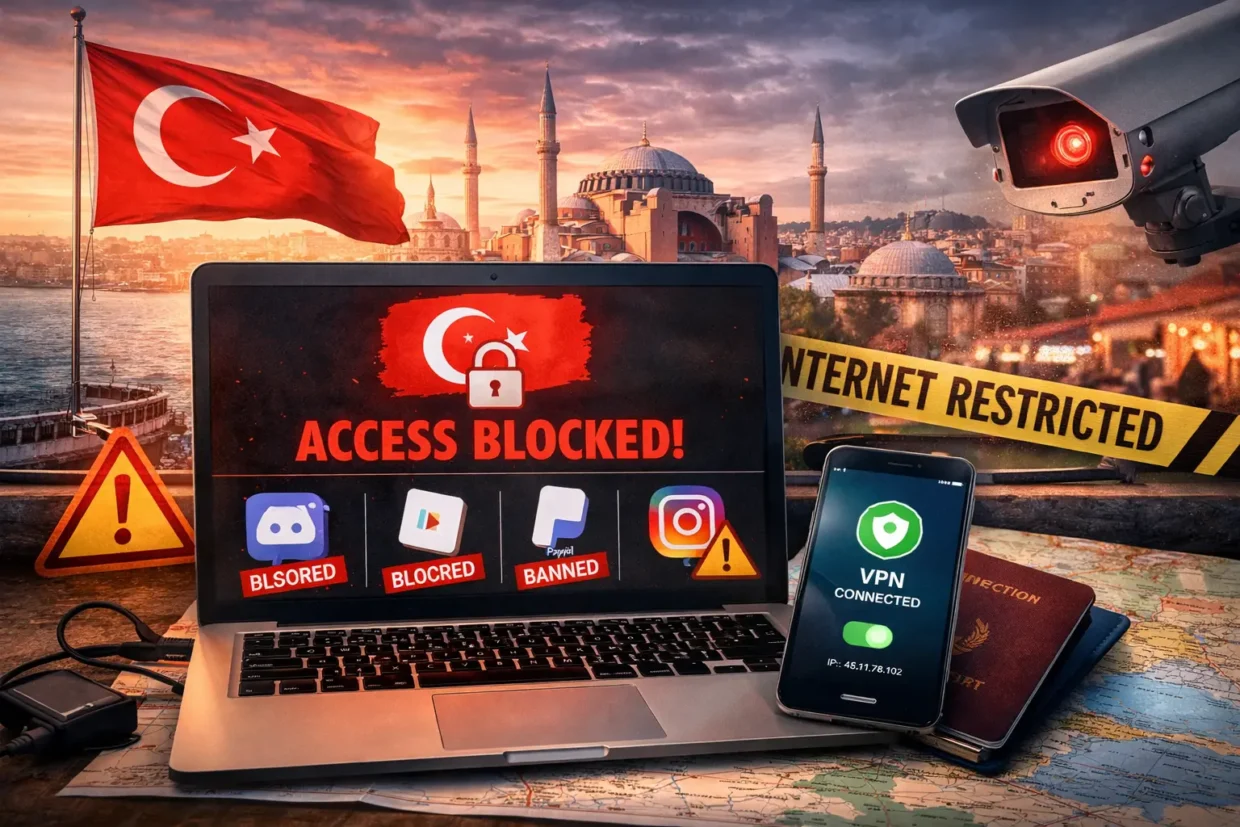
The “Red Alert” List: Major Platforms Blocked in 2025–2026
If you haven’t visited Turkey in a few years, the landscape has changed drastically. The government has moved beyond blocking news sites to targeting massive lifestyle and entertainment platforms.
1. Discord
Status: BLOCKED In October 2024, Turkey blocked access to Discord following a court order related to “child sexual abuse and obscenity” investigations. As of early 2026, the ban remains strictly enforced. For gamers and remote teams that rely on Discord for voice chat and community management, the app is completely unusable without a VPN.
2. Roblox
Status: BLOCKED In a shock move in August 2024, Turkey banned the massive gaming platform Roblox, citing concerns over content exploitation and child safety. This ban has persisted into 2026, cutting off millions of young users and developers from the platform.
3. Wattpad
Status: BLOCKED Turkey became the first country in the world to ban Wattpad in July 2024. The platform, famous for amateur writing and fanfiction, was blocked due to concerns over “obscenity” and “protection of the family.” If you are an avid reader or writer on the platform, you will find it inaccessible.
4. Instagram (The “On-Again, Off-Again” Relationship)
Status: ACTIVE (But High Risk) While Instagram is currently working, it serves as a cautionary tale. In August 2024, the government blocked the entire platform for nine days following a dispute over the removal of condolence posts for a Hamas leader. While access was restored, the platform is frequently “throttled” (intentionally slowed down to the point of being unusable) during times of political unrest or tragedy.
The Traveler’s Headache: Booking and Connectivity
Tourists often get blindsided by bans that affect their logistics. These restrictions can leave you stranded if you aren’t prepared.
The eSIM Ban (Airalo, Holafly, Nomad)
Status: WEBSITES BLOCKED In a move that stunned travelers in July 2025, Turkey’s regulator (BTK) blocked access to the websites of major eSIM providers like Airalo, Holafly, and Nomad.
- The Catch: The ban targets the storefronts and apps. If you already have the eSIM installed before you land, it usually connects to the local network fine. However, if you run out of data and need to “top up” via the app while in Turkey, you will be blocked.
- The Fix: You must use a VPN to access these apps to buy more data once you are inside the country.
Booking.com
Status: RESTRICTED This is a long-standing commercial dispute. You cannot use Booking.com to book a hotel inTurkey while you are inside Turkey.
- The Workaround: You can book Turkish hotels from abroad before you travel. Once you are in Turkey, you need a VPN to change your IP address to another country to make a domestic reservation.
PayPal
Status: BANNED PayPal has been banned in Turkey since 2016. It simply does not work. You cannot pay vendors or receive money.
- Alternative: Wise is the gold standard for expats and travelers in Turkey, and it works perfectly for local transfers.
The “Permanent Ban” List
Some categories of the internet are permanently off-limits in Turkey without circumvention tools.
- International News: The websites for Deutsche Welle (DW) and Voice of America (VOA) have been blocked since 2022 for refusing to apply for broadcast licenses that would subject them to censorship.
- Adult Content: Almost 100% of pornography sites (Pornhub, Xvideos, etc.) are blocked under “obscenity” laws.
- Gambling: All non-state-approved gambling sites (Bet365, casinos) are blocked. The government aggressively targets these, and in late 2025, even introduced stricter penalties for illegal gambling.
- LGBTQ+ Resources: Many community sites and news portals (like parts of Bianet or Kaos GL) face intermittent or permanent blocks.
Do You Need a VPN in Turkey? (And Which Ones Actually Work)
The short answer is: Yes, absolutely.
Attempting to use the internet in Turkey without a VPN is like browsing with blinders on. However, Turkey doesn’t just block websites; it aggressively blocks VPNs themselves.
The “Cat and Mouse” Game
Since late 2023 and continuing through 2025, Turkish ISPs (like Turk Telekom and Turkcell) have been using Deep Packet Inspection (DPI) to identify and strangle VPN protocols. Standard VPN connections (like basic OpenVPN) will often fail to connect or drop constantly.
What You Need: Obfuscation
To bypass the Turkish firewall in 2026, you need a VPN that offers obfuscation (often called “Stealth Mode” or “Cloaking”). This disguises your VPN traffic as regular HTTPS web traffic, fooling the DPI sensors.
Top 3 VPN Recommendations for 2026
Based on recent performance tests in Istanbul and Ankara:
- NordVPN (Best Overall)
- Why: It has specific “Obfuscated Servers” designed for restrictive regimes. It’s fast enough for streaming and generally beats the DPI blocks.
- Tip: You must go into settings and switch the protocol to “OpenVPN (TCP)” to see the Obfuscated Servers option.
- Surfshark (Best Value)
- Why: It has a “NoBorders” mode that automatically kicks in when it detects network restrictions. It’s cheaper than Nord and allows unlimited devices—great if you are traveling with a family.
- Tip: If it struggles, try changing the protocol to “WireGuard” or enable “Camouflage Mode”.
- ExpressVPN (Most Reliable/Premium)
- Why: It uses a proprietary protocol called “Lightway” that is incredibly good at bypassing censorship without complex setup. It is often the most expensive, but also the most “plug-and-play”.
⚠️ Critical Warning: Do not wait until you arrive in Turkey to download these apps. The websites for NordVPN, ExpressVPN, and Surfshark are blocked inside the country. Download and install them before you get on the plane.
Essential Apps to Survive the Digital Blockade
Since many western apps are restricted or behave differently, you should download these local equivalents to make your life easier:
- Transport:BiTaksi.
- Uber exists in Istanbul, but it only hails regular yellow taxis (no private cars) and is often unreliable. BiTaksi is the local favorite for hailing licensed cabs safely.
- Food:Yemeksepeti and Getir.
- Uber Eats does not exist here. Yemeksepeti is the king of food delivery. Getir is essential for ultra-fast grocery delivery (snacks, water, chargers) in under 15 minutes.
- Money:Wise.
- Since PayPal is dead, Wise is the best way to handle currency conversion and transfers.
Final Verdict
Turkey offers incredible culture, history, and food, but its digital landscape is authoritarian. In 2026, the government views the internet as a domain to be controlled.
If you value your privacy, want to access your bookings, need to top up your phone data, or just want to chat with friends on Discord, a high-quality, obfuscated VPN is not a luxury—it is a travel essential.
Disclaimer: While using a VPN is technically legal in Turkey, using it to access illegal content is not. Laws change rapidly; always stay informed about local regulations.


