








When you talk sports in 2025, you’re not just talking about who wins on the field — you’re talking about culture, money, TikTok clips that go viral overnight, and stadiums packed with fans who’d sell their left shoe just to see their team live. I’ve been around enough games, from Champions League nights in Europe to a Sunday tailgate outside an NFL stadium, to know one thing: sports fandom today is a full-blown ecosystem.
The numbers are staggering. Soccer is still the undisputed king, cricket rules entire continents, basketball is exploding thanks to Gen Z and social media, and even sports like volleyball and table tennis are pulling in audiences in the hundreds of millions.
But here’s the catch — popularity isn’t just about how many people tune in anymore. It’s about how deep the obsession runs and how much cash fans are willing to drop on tickets, jerseys, or streaming subscriptions.
That’s why the Global Fan Index 2025 doesn’t just count eyeballs. It breaks sports down into four pillars that really define popularity today.
How We Measure Popularity in 2025
Back in the day, popularity meant TV ratings and maybe stadium attendance. Now? It’s a whole lot more complicated. Here’s the framework I use when I look at the biggest sports worldwide:
Audience Reach
Who actually watches or plays the sport? Soccer’s huge because you only need a ball and some space. Compare that to golf or American football, where gear and access limit how many people can play. Participation builds future fans, and some sports are naturally easier to pick up.
Media Engagement
This is the “attention currency.” How many people tune into the big finals? How many stick around for highlights? The FIFA World Cup final pulling 1.5 billion viewers is insane — but the real growth comes from younger fans who binge 30-second highlight reels on YouTube and TikTok instead of watching a three-hour broadcast.
Digital Footprint
Let’s be real: Cristiano Ronaldo has more power with one Instagram post than some leagues have in an entire season. Sports live online now. The size and activity of communities on social media are a huge indicator of how relevant a sport is.
Commercial Power
At the end of the day, money talks. Media rights deals, sponsorships, ticket sales, and merchandise tell you just how much brands value a sport. The NFL, for example, doesn’t have soccer-level global fandom numbers, but its domestic market is so wealthy that it generates mind-blowing revenue.
The Top 10 Sports in 2025
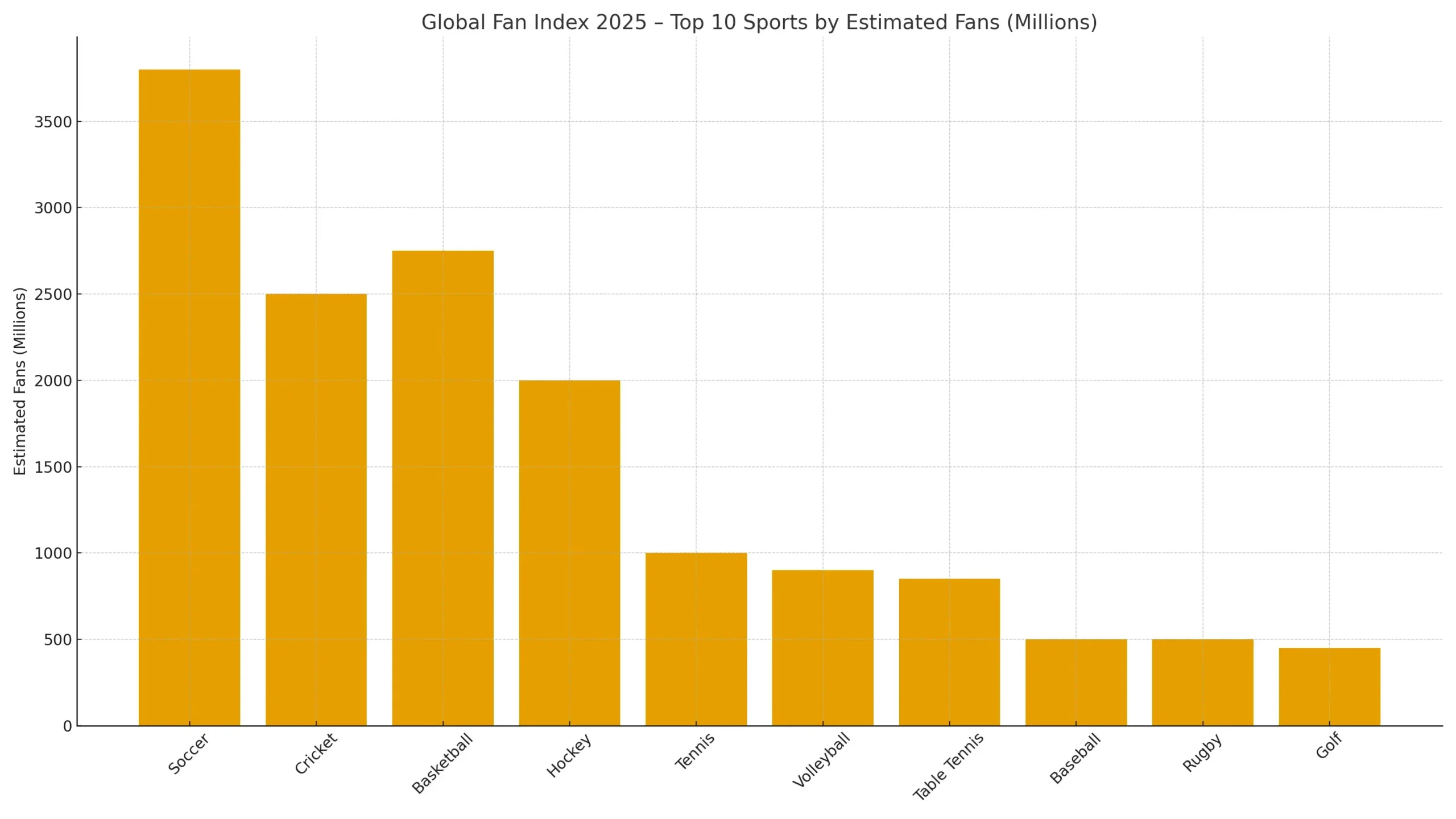
Here’s a snapshot of the definitive ranking this year — not just by raw fan numbers, but by their reach, digital influence, and commercial pull.
| Sport | Global Fan Base (Est.) | Biggest Event & Viewership |
|---|---|---|
| Soccer | 3.5–4.0 billion | FIFA World Cup Final – 1.5B viewers |
| Cricket | 2.5 billion | ICC World Cup Final – 59M concurrent digital |
| Basketball | 2.2–3.3 billion | NBA Finals Game 7 – 16.4M US viewers |
| Hockey (Ice & Field) | 2.0 billion | IIHF Worlds cumulative – 1.3B viewers |
| Tennis | 1.0 billion | Wimbledon Final – 8.8M UK viewers |
| Volleyball | 900 million | FIVB Worlds Women’s Final – 4.5M Turkey |
| Table Tennis | 850 million | ITTF Worlds 2023 – 1.1B cumulative |
| Baseball | 500 million | World Baseball Classic – 62.5M Japan |
| Rugby Union | 500 million | Rugby World Cup 2023 – 1.33B hours watched |
| Golf | 450 million | The Masters 2025 – 12.7M US viewers |
That’s the big picture. But the fun part is diving into each tier — the untouchables, the global challengers, the universal players, and the regional giants with ambition.
1. The Untouchables – Soccer & Cricket
When you talk about sports that run entire continents, two names dominate: soccer and cricket. These aren’t just games — they’re cultural lifelines, religion-level obsessions, and billion-dollar industries that don’t just survive but thrive in the digital age.
Soccer: The World’s Game
I’ve sat in a packed pub in London for a Champions League night, watched kids barefoot kicking a ball in a dusty field in Africa, and felt the energy in South America where people treat their club colors like family heritage. Soccer is universal, and the numbers back it up.
- Audience Reach: Over 3.5 billion fans. More than half the planet cares about this game.
- Biggest Event: The FIFA World Cup final 2022 pulled 1.5 billion live viewers. That’s basically “everyone you know.”
- Digital Footprint: Cristiano Ronaldo’s Instagram alone (663+ million followers) reaches more people than most entire sports combined. Messi isn’t far behind at 506M.
What makes soccer unbeatable is its simplicity. A ball, two makeshift goals, and you’ve got a game. That’s why it’s played in more than 200 countries and why every kid growing up feels like they could be the next Messi, Ronaldo, or Mbappé.
Commercial power? Insane. The Premier League alone signed a $7B+ TV deal, and when clubs like Manchester United, Real Madrid, or PSG tour the U.S. or Asia, stadiums sell out instantly.
💡 Travel tip: If you’ve ever dreamed of seeing a live match in Europe or South America, book early. Big derbies like Barcelona vs Real Madrid or Boca Juniors vs River Plate sell out in minutes.
I usually use Booking or Expedia to lock in a hotel near the stadium. Pair that with a VPN like NordVPN if you want to stream local matches from abroad without getting hit by annoying geo-blocks.
Cricket: The Commonwealth Colossus
Cricket doesn’t get the same attention in North America, but in South Asia? Forget about it. The sport literally shuts down cities in India, Pakistan, and Bangladesh. I was in Mumbai once during an IPL playoff, and the streets were empty. Everyone was glued to a screen somewhere.
- Audience Reach: Around 2.5 billion fans, concentrated heavily in South Asia.
- Biggest Event: ICC Cricket World Cup 2023 — 422 billion minutes watched in India alone, with 59M concurrent digital viewers on Disney+ Hotstar. That’s streaming history.
- Digital Footprint: Virat Kohli has 270M+ Instagram followers, and IPL teams like Mumbai Indians rival NBA franchises in social numbers.
Cricket’s global growth engine is the Indian Premier League (IPL). It’s worth over $12 billion, and sponsors fight tooth and nail to get a piece. What Formula 1 did with Netflix’s Drive to Survive, cricket has done with endless T20 leagues, celebrity owners, and perfectly timed short-format games for modern attention spans.
💡 Fan hack: If you’re outside India, good luck finding reliable cricket streams. I usually connect with Surfshark VPN or ExpressVPN to catch Hotstar broadcasts. Works like a charm, especially when I’m traveling in Europe or the U.S.
And if you actually want to go — trust me, nothing beats the energy of an IPL night game in Delhi or Mumbai. Hotels near stadiums vanish fast, so I’d grab something on Kayak or Hotels.com as early as possible.
Why Nobody Can Touch Them
The reason soccer and cricket are untouchable is simple: sheer population density combined with cultural dominance. Soccer rules Europe, Africa, South America, and increasingly North America. Cricket owns South Asia — home to 1.5 billion people — and has roots in the UK, Australia, and beyond.
It’s a network effect: more fans → more media coverage → more sponsors → more money → more fans. Breaking that cycle is nearly impossible for other sports.

2. The Global Powers – Basketball & Hockey
These are the sports that aren’t quite at soccer or cricket levels of raw numbers, but they pack serious cultural clout. They’ve got strong international leagues, big-name athletes who double as global celebrities, and they’re particularly good at reaching young fans.
Basketball: The Fastest Riser
If there’s one sport tailor-made for the TikTok and Instagram era, it’s basketball. Fast pace, highlight dunks, buzzer-beaters — it’s snackable content heaven.
- Audience Reach: Anywhere from 2.2 to 3.3 billion fans, depending on how you count casual vs hardcore.
- Biggest Event: NBA Finals 2025 Game 7 pulled 16.4 million U.S. viewers — and that’s just domestic.
- Digital Footprint: LeBron James has 158M+ followers on Instagram. Stephen Curry has 58M. The NBA’s own social channels pump out billions of views yearly.
Basketball’s real edge? Culture fusion. Music, fashion, sneakers — basketball bleeds into everything. That’s why it resonates so strongly with Gen Z and why it’s blowing up across Africa and Asia.
💡 Pro tip: If you’re trying to catch NBA streams from outside the U.S., networks like ESPN and TNT geo-block hard. I usually switch on CyberGhost VPN because they have streaming-optimized servers that unlock the games with minimal lag.
And if you ever dream about seeing the NBA Finals live — start saving. Flights and hotels skyrocket. I’ve had luck finding decent packages on Agoda or last-minute steals on VRBO.
Hockey: A Two-Sport Powerhouse
When we say hockey here, we’re talking ice hockey and field hockey combined. Sounds odd, but between Canada, Russia, Scandinavia, and South Asia, these two versions give the sport global weight.
- Audience Reach: About 2.0 billion fans combined.
- Biggest Events:
- Ice hockey – IIHF Worlds reach 1.3 billion cumulative viewers.
- Field hockey – World Cup finals fill 60,000+ stadiums in India and the Netherlands.
- Digital Footprint: NHL teams like the Boston Bruins crank out over a billion impressions per season.
Ice hockey is king in cold regions, with the NHL as its crown jewel. The Stanley Cup Finals are bucket-list sports moments. On the other hand, field hockey dominates in India, Pakistan, and parts of Europe. Together, they give hockey a unique global map.
💡 Fan hack: Seeing a live NHL game in North America is pricey, but absolutely worth it for the atmosphere. I recommend grabbing tickets in advance and using Tripadvisor to scout hotels and restaurants near the arena.
If you’re more into field hockey, the FIH World Cup in India is an unreal experience — and a VPN like PIA can help you stream matches if local broadcasters block them where you are.
Why They’re Rising
Basketball and hockey thrive because they’re flexible and media-friendly. Basketball thrives on short, viral highlights and superstar personalities. Hockey benefits from deep traditions, international competitions, and loyal fanbases across multiple continents. Both sports are smart at turning moments into shareable content — exactly what younger fans crave.
3. The Universal Players – Tennis, Volleyball & Table Tennis
These three sports live in that sweet spot where anyone can pick them up, schools push them globally, and the Olympic Games give them regular prime-time exposure. They’re not topping the money charts like soccer or the NFL, but they’re everywhere.
Tennis: Year-Round Global Theater
Tennis is one of the few sports where men and women compete with nearly equal billing. You’ve got Serena Williams shaping generations, Novak Djoković dominating headlines, and kids everywhere picking up rackets because they saw a highlight from Wimbledon.
- Audience Reach: Roughly 1 billion fans across Europe, Asia, and the Americas.
- Biggest Events: The four Grand Slams. Wimbledon 2025 men’s final alone hit 8.8 million UK viewers, plus record streaming numbers.
- Digital Footprint: Tennis legends are Instagram brands — Djoković, Nadal, Federer (even in retirement), Serena. Their posts drive as much conversation as the matches themselves.
💡 Fan hack: If you’re traveling for a Slam, book months in advance. London during Wimbledon? Brutal. I usually grab spots on Booking or Kayak. And if your country blocks certain streams (yes, it happens with ESPN or Eurosport), a Proton VPN connection gets the job done.
Volleyball: The Participation Powerhouse
Volleyball might not dominate sports bars in the U.S., but worldwide it’s one of the most played sports on earth. School gyms, beaches, pro leagues — it’s everywhere.
- Audience Reach: Around 900 million fans globally.
- Biggest Events: The FIVB World Championships and the Olympics. The women’s final in Turkey in 2025 pulled 4.5 million viewers locally — huge for a “non-core” sport.
- Digital Footprint: Star players in Brazil, Italy, and Japan have loyal online fanbases. Not Ronaldo-level, but strong community engagement.
What makes volleyball so sticky is low barriers. A ball, a net, and you’re in business. That’s why schools love it, and why volleyball consistently feeds new generations of players and fans.
💡 Travel tip: Brazil and Italy are volleyball heavens. If you’re visiting, use Expedia to bundle flights + hotels near matches. For live streaming, I’ve had success unblocking regional broadcasters with IPVanish.
Table Tennis: The Asian Juggernaut
Ping pong may look casual in your garage, but at elite levels? It’s lightning fast and attracts hundreds of millions of viewers, especially in Asia.
- Audience Reach: About 850 million fans, most concentrated in China and East Asia.
- Biggest Events: ITTF World Championships 2023 racked up 1.1 billion cumulative viewers worldwide.
- Digital Footprint: China’s Weibo and Douyin (TikTok’s cousin) light up during big matches, with interaction spikes of over 80% during major finals.
The beauty of table tennis is accessibility. You don’t need much space, equipment is cheap, and skill development feels addictive. That’s why it’s a school and recreation staple in so many countries.
💡 Streaming hack: If you want to watch the ITTF Worlds or Olympic ping pong outside Asia, a Surfshark VPNworks great for bypassing regional blocks. And if you actually want to see it live, Asia trips are easier than you think with Hotels.com or Agoda.
Why These Sports Stay Relevant
Tennis, volleyball, and table tennis don’t dominate global sponsorship money like soccer or basketball, but they’re cemented into global culture thanks to:
- Mass participation (everyone’s played at least once).
- Olympic spotlight every four years.
- Strong international federations keeping the calendar busy.
They’ve carved out a sustainable niche where they might never dethrone soccer — but they’ll never fade, either.
4. Regional Giants with Global Ambition
These are the sports that dominate specific regions with unmatched intensity. They might not pull billions of fans worldwide, but in their home territories, they’re kings — and the money shows it.
American Football: The U.S. Powerhouse
If you’ve ever been to an NFL Sunday, you know it’s not just a sport. It’s part religion, part entertainment, and part billion-dollar machine.
- Audience Reach: Around 400 million fans, mostly U.S.-based.
- Biggest Event: The Super Bowl is untouchable — 127.7 million average viewers in 2025, with a total reach of 191M. That’s just one game.
- Commercial Power: The NFL prints money. Teams like the Dallas Cowboys are worth over $9 billion.
The challenge? Global expansion. NFL games in London and Mexico City sell out, but cracking Asia or Africa is tough. Still, the league’s “Global Markets Program” now covers 25 countries, and you can bet they’re going to keep pushing.
💡 Travel tip: Heading to the U.S. for a game? Tailgates are half the fun. I usually find a nearby stay with VRBO so I can crash with friends after a long game day. And if you’re outside the States and want to catch the game live, a NordVPN connection works flawlessly for unblocking U.S. streams.
Baseball: America’s Pastime, Asia’s Obsession
Baseball is unique: while its U.S. TV numbers have dipped, its global pull is stronger than ever thanks to Japan, Korea, and Latin America.
- Audience Reach: Around 500 million fans worldwide.
- Biggest Event: The World Baseball Classic 2023 quarterfinal in Japan pulled 62.5M viewers. That’s bigger than most Super Bowls internationally.
- Cultural Power: From MLB’s rich history to Shohei Ohtani’s global superstardom, baseball is still alive and swinging.
💡 Fan hack: If you’re catching a game in Japan, book well in advance. Stadiums like Tokyo Dome sell out instantly. I’ve scored good deals with Agoda. Streaming-wise, ExpressVPN is a lifesaver for MLB.tv when you’re outside the U.S. and facing blackout restrictions.
Rugby Union: Passion Nations
Rugby doesn’t have billions of fans, but where it’s popular, it’s everything. Think New Zealand’s haka, Twickenham packed with English fans, or South Africa’s World Cup victories.
- Audience Reach: Around 500 million fans.
- Biggest Event: Rugby World Cup 2023 saw 1.33 billion hours watched globally.
- Cultural Power: It’s not just a game, it’s identity — especially in Oceania, South Africa, and parts of Europe.
Women’s rugby is booming, too. Stars like Ilona Maher pull millions of followers on TikTok and Instagram, making the sport more accessible to younger fans.
💡 Pro tip: Rugby matches abroad? I use Tripadvisor to map stadiums, hotels, and local spots for a pint afterward. And if you’re in a country without a local broadcast, Surfshark helps you stream like you’re back in England or South Africa.
Golf: Sport, Lifestyle, and Business
Golf’s not a “mass” sport like soccer, but its niche is powerful: wealth, lifestyle, and prestige.
- Audience Reach: About 450 million fans.
- Biggest Event: The Masters 2025 final round hit 12.7 million U.S. viewers — huge for a single-day event.
- Cultural Pull: It’s less about screaming stadiums, more about green jackets, Tiger Woods nostalgia, and networking deals on the fairway.
Golf is also reinventing itself with off-course experiences like Topgolf, and influencers like Paige Spiranac (4M+ IG followers) keeping the sport fresh for a younger crowd.
💡 Travel hack: If you’re planning a golf trip (say, Scotland’s St Andrews or Pebble Beach in California), bundle flights and stays through Kayak or Expedia. For streaming, PIA VPN is a solid option to unblock PGA coverage.
Why They Matter
What sets these sports apart isn’t global reach — it’s value per fan. The NFL may “only” have 400M fans versus cricket’s 2.5B, but its revenue crushes cricket because its core market (the U.S.) is rich and advertisers pay top dollar. Same goes for MLB and golf: fewer fans, but higher spending power.
The Athlete Effect – Why Stars Drive the Game
In 2025, leagues are important, teams are important — but let’s be honest: fans often follow players first, teams second. Cristiano Ronaldo, LeBron James, Virat Kohli — these guys aren’t just athletes, they’re full-blown media empires.
What’s wild is that one Instagram post from Ronaldo can reach more people than a Champions League broadcaster. Same with LeBron James when he drops something on Twitter/X or TikTok. Athletes aren’t just players anymore — they’re content creators, influencers, and even business moguls.
Case Studies
- Cristiano Ronaldo & Lionel Messi: Over 1.1 billion combined followers. Their rivalry isn’t just on the pitch — it’s the biggest social media showdown in sports history.
- LeBron James: Beyond basketball, LeBron’s turned himself into a brand. He runs a media company, stars in movies, and uses his platform for activism.
- Virat Kohli: Cricket’s global face, with 270M+ followers. In India, he’s bigger than Bollywood stars.
- Ilona Maher: A rugby player turned TikTok icon. With 5.2M+ followers, she shows how even “niche” sports can break mainstream through personality.
Top 10 Most-Followed Athletes on Instagram (2025)
| Athlete | Sport | Followers (Millions) |
|---|---|---|
| Cristiano Ronaldo | Soccer | 663+ |
| Lionel Messi | Soccer | 506+ |
| Virat Kohli | Cricket | 270+ |
| Neymar Jr. | Soccer | 231+ |
| LeBron James | Basketball | 158.6 |
| Kylian Mbappé | Soccer | 125+ |
| David Beckham | Soccer | 88.2+ |
| Ronaldinho | Soccer | 77.7+ |
| Stephen Curry | Basketball | 58.1 |
| Ilona Maher | Rugby | 5.2 |
Why This Matters
This shift to athlete-first fandom changes everything:
- Sponsors: Brands want faces, not just logos. A Nike deal with Ronaldo is worth more than sponsoring an entire league.
- Streaming: Fans will pay to watch LeBron’s last season or Messi’s Inter Miami games, even if they don’t care about the league as a whole.
- Culture: Athletes use their platforms for fashion, music, lifestyle — making them relevant outside sports, which keeps fans hooked 24/7.
💡 Fan hack: Want to follow these stars live when traveling? Many matches aren’t available abroad due to rights issues. That’s where a NordVPN or ExpressVPN subscription pays for itself.
And if you’re flying to catch them in action, bundle a hotel + flight on Booking or Kayak — trust me, star-player matches spike local hotel prices fast.
The Future of Fandom: Four Trends Shaping Sports to 2030
If the last decade taught us anything, it’s that sports don’t stand still. The way fans watch, engage, and even choose whichsports to care about has flipped upside down thanks to streaming, TikTok, and a generation that doesn’t have patience for three-hour broadcasts. Looking ahead to 2030, a few big shifts are crystal clear.

1. The Commercial Explosion of Women’s Sports
What used to be an afterthought is now becoming the smartest bet in sports.
- World Cup 2023 (Women’s Soccer): Over 2 billion viewers worldwide.
- WNBA: U.S. fanbase jumped 31% in just two years.
- Rugby Women’s World Cup 2025: Projected to hit 50M+ hours watched.
Women’s leagues bring in younger, more diverse, and highly engaged fans. And brands are finally waking up: sponsoring women’s sports is no longer charity, it’s ROI gold.
💡 If you’re traveling to catch women’s tournaments, tickets and hotels are still cheaper than men’s events — but that gap is closing. I usually use Expedia or Hotels.com early because demand spikes fast, especially around World Cups or Olympics.
2. The Battle for Gen Z
Gen Z (born ~1997–2012) doesn’t care about traditional sports “rules.” They want speed, content, and personality.
- They consume highlights, not full games.
- They follow athletes, not teams.
- They value authenticity and social stances as much as performance.
That’s why basketball and MMA crush it online — every dunk or knockout is instantly shareable. And why influencers boxing on YouTube sometimes outdraw professional cards.
💡 Want to keep up with Gen Z sports? Social platforms sometimes block region-specific content. A quick switch with Surfshark lets me scroll the same feeds as fans in the U.S. or Asia.
3. Global Expansion and New Frontiers
Sports aren’t just chasing fans — they’re chasing markets.
- NFL: Games in London, Frankfurt, and Mexico City are now annual staples.
- Formula 1: Went from niche in the U.S. to mainstream, largely thanks to Netflix’s Drive to Survive.
- NBA: Africa academies and China/Philippines fanbases are skyrocketing.
By 2030, expect leagues to go harder into Africa, Southeast Asia, and even untapped Middle East markets. The money and young populations are just too attractive to ignore.
💡 If you’re planning sports trips abroad, sites like Kayak make it easier to hop between cities hosting international matches — whether it’s an NFL game in Germany or an NBA exhibition in the Philippines.
4. Tech-Enhanced Fan Experiences
The way we’ll watch sports by 2030 will look futuristic:
- AR/VR viewing: Courtside at an NBA game… from your couch.
- Live betting integrations: Odds and stats updating in real time on your stream.
- AI personalization: Highlight reels cut for you, not everyone.
We’re already seeing hints. ESPN and DAZN experiment with interactive stats overlays, while clubs test VR “stadium tours” for fans overseas. By 2030, this will be standard.
💡 VPN note: A lot of these new tech platforms will roll out region by region. Using PIA or CyberGhost is going to be clutch if you want early access to platforms that aren’t yet available in your country.
Why These Trends Matter
The sports winners of the next decade won’t just be the ones with the biggest fan numbers. They’ll be the ones who:
- Tap into new demographics (women’s sports, Gen Z).
- Expand into new markets (Africa, Asia).
- Embrace technology to make watching more personal.
In short, the future fan isn’t just watching the game — they’re interacting with it, streaming it on-demand, and following the athletes like influencers.
Strategic Takeaways & Final Thoughts
After digging through all the numbers, events, and social media madness, one thing is clear: sports in 2025 aren’t just about who wins the game. They’re about how fans connect, consume, and spend.
The Global Fan Index shows soccer and cricket still run the world, but the real action is in the details — the rise of basketball, the resilience of “smaller” Olympic sports, and the way athletes themselves are now media companies.
For Fans
We’ve never had more access. Whether you’re streaming the IPL from a hotel in Europe with NordVPN, or flying across the world to catch Wimbledon (book early with Booking), fandom is borderless. Sure, rights restrictions and blackout rules are annoying — but with the right VPN and a little planning, you’re never shut out.
For Brands
The future is athlete-first. Ronaldo or LeBron posting your logo beats a league banner on the sidelines every day. Add in the surge of women’s sports and Gen Z’s appetite for authenticity, and the smart brands will pivot to personal, story-driven partnerships.
For Leagues & Teams
The winners won’t just be organizers of matches. They’ll be content studios. Daily highlights, behind-the-scenes clips, interactive apps, AR/VR experiences — that’s what fans expect. And those who expand fastest into emerging markets like Africa, India, and Southeast Asia will own the next billion fans.
My Perspective as a Fan
I’ll be real with you — I love the numbers, but at the end of the day, fandom comes down to the feeling. The goosebumps when the Champions League anthem plays. The chaos of a Super Bowl party. The quiet intensity of a Wimbledon final on a summer afternoon.
Sports have always been about connection, but 2025 feels different. I can follow Messi in Miami, Kohli in Delhi, or LeBron in LA all from my phone. I can book a last-minute flight on Kayak, land in a city, and stream the match I just missed with Surfshark. It’s insane how global — and personal — fandom has become.
And that’s the real story: adaptability wins. For fans, it means finding new ways to watch and travel. For brands, it means staying authentic. For leagues, it means embracing digital-first storytelling.
The Road Ahead
By 2030, the biggest sports will still be soccer and cricket — but the landscape around them will look nothing like today. Women’s sports will be mainstream, Gen Z will be driving viewership trends, and AR/VR will change what “watching a game” even means.
The sports that thrive will be the ones that don’t just count fans, but actually connect with them.
And honestly? I can’t wait to be part of that ride — whether it’s cheering in a stadium halfway across the world or streaming highlights at 2 a.m. from my couch.