







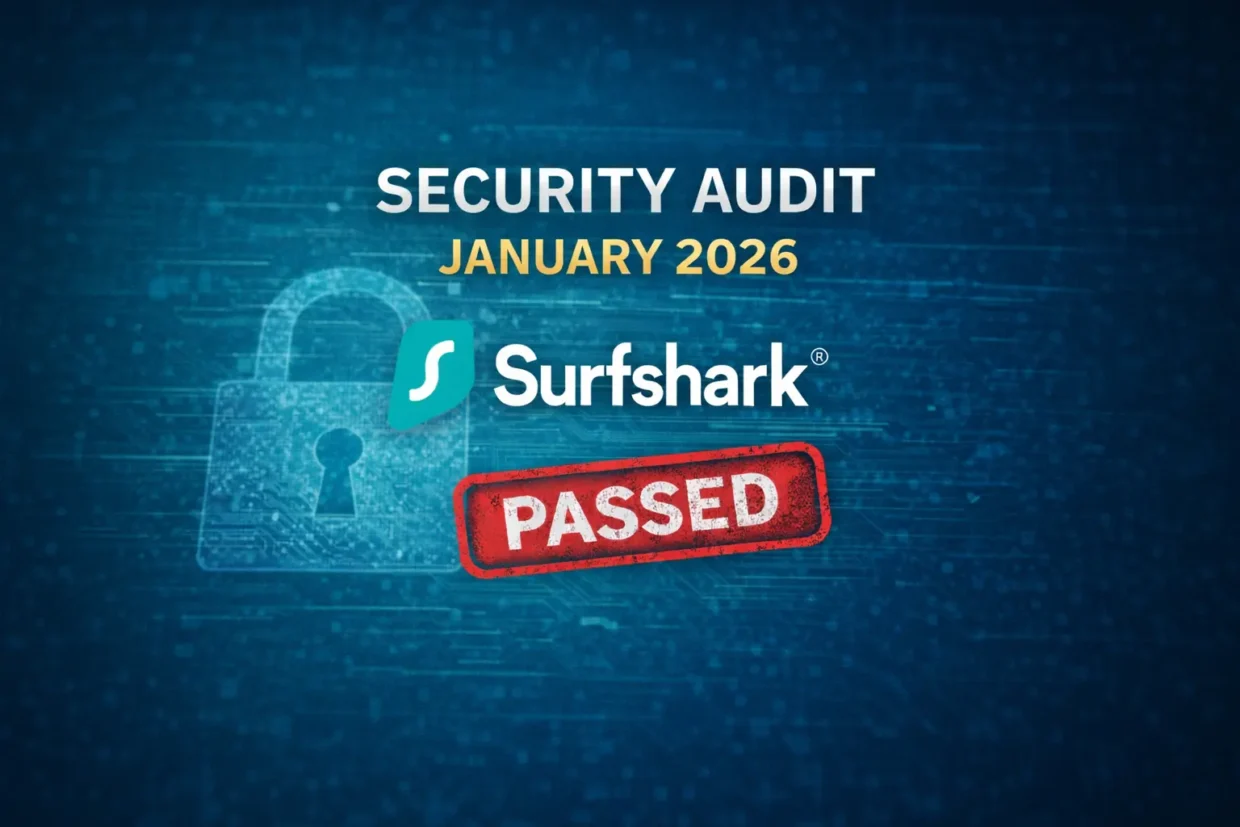
When you rely on a VPN to protect your online life, it’s only fair to ask one simple question: can I trust them to keep my data safe? That’s exactly why security audits matter – and Surfshark just went through a new round of testing in December 2025, performed by the independent cybersecurity firm SecuRing. Here’s a breakdown of what was tested, what (little) was found, and what it means for you as a user.
TL;DR (Too Long; Didn’t Read)
- Surfshark passed its network infrastructure audit with no critical or high-risk issues
- One medium-risk vulnerability related to SSL/TLS was found and is being addressed
- SecuRing, an independent Polish cybersecurity firm, conducted the audit
- The test covered both public and internal systems via grey-box penetration testing
- The results show Surfshark is maintaining a strong security posture going into 2026
Who Performed the Audit?
The penetration test was conducted by SecuRing, a well-established security firm based in Kraków, Poland. They’ve been around since 2003 and have completed over 10,000 security projects in more than 20 countries. In other words – not a no-name company.
They work with big players in banking, fintech, healthcare and SaaS, and were even awarded the CYSSDE Grand Winner title in 2025.
What Was Tested?
The audit focused on Surfshark’s network infrastructure – specifically, what an attacker might access through the public internet or through Surfshark’s VPN. This wasn’t a generic review.
The testing team used grey-box penetration testing, which simulates a real-world attack by someone who has user-level access to the system and some insider understanding. In this case, they tested:
- External infrastructure with no initial privileges
- Internal systems accessed through the VPN tunnel
- A full set of attack techniques based on OWASP and CVSS methodologies
The tests were conducted between December 1 and December 10, 2025, and the report was finalized in January 2026.
What Did They Find?
Let’s cut to the chase – no critical vulnerabilities were found. That’s a strong result for any VPN provider.
Here’s the exact outcome:
- ❌ No critical risk vulnerabilities
- ❌ No high-risk findings
- ⚠️ One medium-risk issue
- 💡 One non-risk-based recommendation
That single medium-risk finding (labeled as F1) was related to SSL/TLS configuration. To be more specific, the servers supported some outdated or weak encryption protocols, which – under very specific conditions – could allow someone to intercept encrypted traffic between a user and the VPN server.
It’s important to stress that:
This vulnerability does not affect core functionality or user data unless an attacker already has access to the network traffic – which is not easy to achieve.
What’s Being Done?
The fix is straightforward: Surfshark has been advised to disable insecure protocol versions like SSLv2, SSLv3, TLS 1.0and TLS 1.1, and to tighten cipher suite configurations.
These are well-known industry best practices. The full list of affected settings was included in a confidential appendix provided to Surfshark, and the fix is relatively low-effort for their tech team.
On top of that, SecuRing also recommended limiting redirect URLs to specific trusted domains, as a way to prevent potential phishing scenarios via open redirects. Again, this wasn’t tied to any direct vulnerability, but more of a proactive security tip.
Why It Matters
Many VPN providers make bold claims about security, but very few open up to external scrutiny. Surfshark deserves credit here – they commissioned an independent audit and published the results, even though a small issue was found. Transparency like this is a green flag.
Here’s what this audit proves:
- Surfshark’s infrastructure is not vulnerable to major attacks
- No customer data was exposed during testing
- The team follows a strong internal security model
- They’re willing to take recommendations seriously and improve further
Final Thoughts
For anyone using Surfshark in 2026, this audit is a solid reassurance. It shows that their systems are professionally tested, and no serious flaws were discovered. While no system is perfect, the way Surfshark handled the audit – from commissioning an external team to openly acknowledging the results – shows they’re serious about user privacy and infrastructure resilience.
🔒 If you’re still deciding whether Surfshark is right for you, this audit gives you one more reason to consider it a trustworthy option.